
10.31.26 · 13 min read
What is GTM engineering? Learn the definition, what a GTM engineer does, the stack, reported pay and when a startup needs one. Plan your first build.
GTM engineering is the practice of building and automating the systems behind go-to-market work: data, enrichment, signals, routing and outbound. This guide defines it, explains what a GTM engineer does, lists the stack, shows what the role pays and says when a startup needs one.
Disclosure: QC Growth builds GTM systems for clients, so we have a stake in this topic. Figures about pay and demand come mostly from companies that sell tools to GTM teams, and we label them as vendor claims. Sources were checked on 30 October 2026.
The table gives the short version. The sections below explain each row and show where the claims come from.
| Topic | Short answer |
|---|---|
| Definition | Building and running the automated systems that produce pipeline |
| Typical owner | A GTM engineer, usually inside RevOps or growth, or an agency or contractor |
| Core outputs | Clean data, signal tracking, scoring, routing, outbound sequences, reporting |
| Common tools | A CRM, enrichment sources, a workflow builder such as Clay, n8n, Zapier or Make, a sending tool |
| Measured on | Pipeline created, data quality and conversion between stages |
| Reported pay | Medians reported between about $127,500 and $160,000, depending on the source |
| Best time to hire | When outbound or routing work is repeating by hand and nobody owns it |
Most figures about this role come from companies that sell tools to GTM engineers, so we mark vendor claims as such.
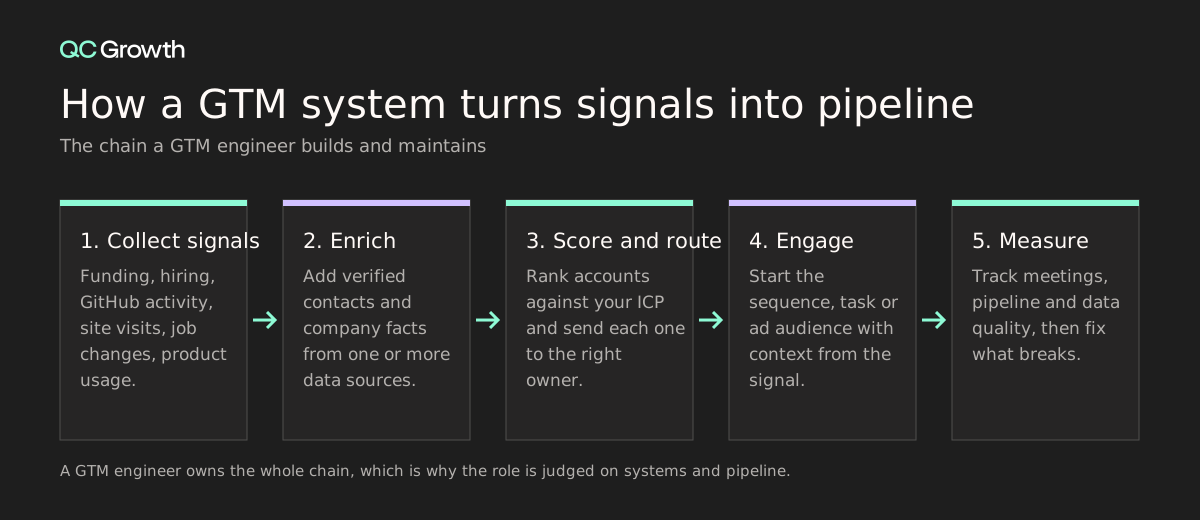
GTM engineering is the practice of designing, building and maintaining the technical systems that produce pipeline. A GTM engineer connects data sources, enrichment, signals, scoring, routing and sending into one chain, and then keeps it running. Clay describes the work as building revenue engines using AI and automation.
Most of the job is wiring existing tools together, cleaning data and deciding what should happen when a signal arrives. Some GTM engineers write code in Python, SQL or TypeScript, and others work in no-code builders.
A useful test separates the role from adjacent ones. If the job is measured on systems it owns, such as pipeline coverage or data quality, it is GTM engineering. If it is measured on activity, such as meetings booked, it is closer to an SDR role.
Clay says it coined the role in 2023 and that it has since appeared at companies such as Cursor, Lovable and Webflow (Clay). In August 2025 Clay announced a $100 million Series C at a $3.1 billion valuation, led by CapitalG (Clay announcement). Clay also says about 100 GTM engineer job listings go live each month. That is a vendor figure.
Not everyone agrees the role is new. Diginomica reports practitioners who compare the title to data scientist, a rebranded analyst role, and who describe the work as making sure sales and marketing tools talk to each other (Diginomica). We read that as a fair warning. The title is recent and the work overlaps with RevOps and marketing operations.
What changed is the tooling. Workflow builders, enrichment APIs and AI research agents let one person assemble a system that once needed a small engineering team.
The day-to-day work falls into five jobs. Titles and scope vary by company, and some roles also cover customer success and renewals.
Clay describes the role as an internal product team for the go-to-market side: identify problems, write specs, ship prototypes and scale what works.
The first job is clean data. That means deduplicating records, mapping fields between tools, and choosing which source fills which field. Without it, scoring and routing run on bad inputs.
Enrichment sits here. Our guide to lead enrichment tools compares ten options and explains waterfall lookups.
Signals tell you which accounts to contact now: a funding round, a hiring post, a new release, a pricing-page visit, a job change. The GTM engineer decides which signals count and how much each one weighs.
For developer-tool and AI companies, technical signals such as GitHub activity and release cycles often matter more than topic interest. See our comparison of intent data providers for the paid options.
Routing sends each lead or account to an owner by rule: territory, segment, score or product usage. A good setup removes the manual step where a lead sits in a queue.
The same logic starts a sequence, creates a task or adds the account to an ad audience, with context from the signal that triggered it.
Outbound needs infrastructure: sending domains, mailboxes, authentication records, warm-up and list verification. A GTM engineer sets these up and watches deliverability.
Poor authentication ends in the spam folder whatever the copy says, so SPF, DKIM and DMARC records are part of the job.
AI steps can summarize a company, extract facts from a website or a call transcript, and draft a first line. Clay lists examples such as automating account research and enriching CRM data from call transcripts.
Someone has to check the output. A GTM engineer samples results, sets rules for when a human reviews, and shuts a workflow off when quality drops.
No single tool covers every layer, so most stacks combine five or six. The table lists the layers and common examples. Clay's own guidance names Clay, n8n, Zapier, Lovable, Bolt, TypeScript, Python and SQL as the fluency it looks for.
Start with the layer that hurts most. A team with a messy CRM should clean data before it buys signals.
QC Growth runs this as a four-layer model it calls the GTM OS: a signal layer, orchestration in Clay and AI, a data layer or cockpit of CRM and dashboards, and an execution layer, joined by feedback loops for context, attribution and response. Signal stacking combines firmographics, LinkedIn activity, job changes, hiring, tech stack and web visits, and context engineering keeps the ICP and messaging current inside the Clay prompts and scoring.
| Layer | What it does | Common examples |
|---|---|---|
| CRM | System of record for accounts, contacts and deals | HubSpot, Salesforce |
| Enrichment | Adds verified contacts and company facts | Clay, Apollo, Lusha, FullEnrich |
| Signals | Shows which accounts are active now | GitHub data, funding feeds, Common Room, Dealfront |
| Orchestration | Connects tools and runs workflows | Clay, n8n, Zapier, Make |
| Sending and deliverability | Sends email and protects sender reputation | Sequencers, SPF, DKIM and DMARC records |
| Reporting | Tracks pipeline, conversion and data quality | CRM dashboards, a data warehouse |
GTM engineering vs RevOps is the question most buyers ask first. A popular framing says RevOps runs and optimizes existing revenue processes while GTM engineering builds new systems. Landbase quotes Saad Bayezeed, Head of Revenue Operations at Easygenerator, calling GTM engineering the R&D arm for RevOps, and other sources credit him with popularizing the build-versus-run split (Landbase).
The split is one popular model, and teams draw the line in different places. At a startup, one person often does both. Our short guide to GTM engineering vs RevOps covers the hiring order by stage.
| GTM engineer | RevOps | SDR | |
|---|---|---|---|
| Main job | Build and automate revenue systems | Run and improve revenue process and reporting | Contact prospects and book meetings |
| Measured on | Pipeline, data quality, stage conversion | Forecast accuracy, process health, reporting | Meetings and activity |
| Works with | APIs, enrichment, workflow builders | CRM, dashboards, territory and comp rules | Sequencer, phone, LinkedIn |
| Time horizon | Project builds that compound | Ongoing tuning | Daily and weekly activity |
| Risk appetite | Tests new methods, accepts some breakage | Favors stability | Follows a playbook |
GTM engineer salary figures vary by source, and almost every source sells tools or services to GTM teams. Apollo's analysis of about 1,000 postings reports a median near $127,500. Cargo's analysis of 509 disclosed US salaries between April and July 2026 reports a median of $159,000, with a range of $135,000 to $190,000 between the 25th and 75th percentiles (Cargo). Clay's August 2025 announcement cited $160,000. RevGuild's report on 190 US vacancies gives a median base near $150,000.
Pay depends on seniority, location and whether the company treats the role as engineering or as operations. Cargo reports senior medians above the overall figure. Compare any offer to postings in your own market and stage.
On demand, Clay says about 100 GTM engineer listings go live each month. The number is the vendor's and covers all company sizes. For a startup, the more useful question is whether the role pays back at your volume, which the next section addresses.

You likely need one when repeated manual work blocks pipeline. Typical signs: someone builds prospect lists by hand every week, CRM fields disagree across tools, inbound leads wait in a queue, or outbound domains keep landing in spam.
You can skip the hire when the list is short and a founder still knows every account. A spreadsheet and a free plan on one enrichment tool will do. Add the role when the work repeats and nobody owns it.
Three routes exist, and each carries a different cost and risk. Hiring gives you full-time ownership and puts one person's skills at the center of your pipeline. A contractor fits a defined build. An agency gives you a team and a handover.
QC Growth publishes packages from $7,500 to $25,000 a month on 6 to 12 month terms for its embedded GTM engineering work, and the infrastructure, data and playbooks stay with you. Our GTM engineering agencies roundup compares ten firms.
| Route | Best for | Watch for |
|---|---|---|
| Full-time hire | A team with steady, growing GTM work and a manager who can direct it | Key-person risk and a long search |
| Contractor | A defined build such as a CRM clean-up or one outbound system | Handover and maintenance after the contract ends |
| Agency or embedded team | Teams that want the system and the selling motion built together | Who owns the data, domains and tables afterward |
A first quarter works best as three small, finished steps. The plan below assumes one person and an existing CRM.
Adjust it to your stack. The order matters more than the dates.
List every tool that touches a lead and the fields each one writes. Find duplicates and conflicting fields, then fix the worst ones and agree on one source of truth per field.
Define the ICP in fields the CRM can filter on. Set up reporting for three numbers: new accounts, meetings and pipeline created.
Pick one workflow with clear value, such as enriching and routing inbound leads. Build it end to end, test it on a sample and review the first outputs by hand.
Add one signal that you can act on within a day. Record which signal triggered each sequence so you can test it later.
Compare results for accounts that received the new workflow against accounts on the old process. Keep what works and cut what does not.
Write the runbook: what each workflow does, where its data comes from and how to switch it off. Anyone should be able to run the system without its builder.
Automation scales mistakes as quickly as it scales wins. A bad enrichment rule can write wrong titles into thousands of records. A weak message can reach a whole market before anyone reads a reply.
Data rules apply. Enrichment, scraping and cold outreach raise questions under GDPR and similar laws, and matching a GitHub profile to a work email needs a documented basis. Keep a log of where each field came from and ask counsel before you scale.
Deliverability is the other limit. Poor domain setup, missing SPF, DKIM or DMARC records and unverified lists damage sender reputation for every later campaign. Our roundup of cold email agencies shows how agencies handle sending.
AI output needs review. Sample results every week, set rules for human review and keep a switch to stop any workflow that starts to drift.
Use the table as a quick reference.
It also works as a checklist for a first conversation with a candidate or an agency.
| Category | Key Considerations |
|---|---|
| What it is | Building and running automated systems that produce pipeline |
| Who does it | A GTM engineer, a contractor or an agency, often inside RevOps or growth |
| Use cases | Data clean-up, enrichment, signal tracking, scoring, routing, outbound, reporting |
| How to start | Audit the foundation, build one system, test it against the old process, document it |
| Mistakes to avoid | Automating before cleaning data, skipping deliverability setup, ignoring consent rules, no owner |
| Pay (reported) | Medians between about $127,500 and $160,000 depending on the source |
QC Growth is the embedded GTM team for Seed to Series A technical founders. A fractional pod of a top-1% GTM operator, a GTM lead, a GTM engineer and BDR support builds and runs your Allbound motion, with inbound, outbound and partner channels in one signal-driven system. The infrastructure, data and playbooks stay with you.
The operators have carried the bag in these markets: Luke Bivens at Gatsby and Netlify, Aron Schuhmann at Gatsby and OctoAI, Shane O’Connor through a 10x ARR run at Scalar, and Kori Bivens, a former VP at RVO Health who leads the healthcare division. Eraser.io CEO Shin Kim says the team “built a repeatable outbound process that helped us land our first enterprise customers.”
It is built for Seed to Series A companies past product-market fit in developer tools, AI, healthcare and deep tech, that need GTM engineering work done without a full-time hire.
A pod is live within weeks, while a GTM engineer search and ramp takes months. Packages run $7,500 to $25,000 a month on 6 to 12 month terms with no equity, against $57,000 to $81,000 a month plus 1.25% to 2.75% equity for a senior in-house team, broken down in QC’s in-house versus fractional cost math. See what the GTM Systems + Ops package includes.
GTM engineering is the practice of building and automating the systems behind go-to-market work, including data, enrichment, signals, scoring, routing and outbound. A GTM engineer owns that chain and is judged on pipeline and data quality. Clay says it coined the role in 2023. The work overlaps with RevOps, and many teams place the role inside it.
GTM engineering differs from RevOps in focus, though the two overlap. A common framing says RevOps runs and optimizes existing revenue processes while GTM engineering builds new systems. Landbase quotes Saad Bayezeed of Easygenerator calling GTM engineering the R&D arm for RevOps. At small companies one person often covers both.
A startup should hire a GTM engineer when manual GTM work repeats every week and nobody owns it. Signs include hand-built prospect lists, conflicting CRM fields, inbound leads waiting in a queue and outbound domains landing in spam. Before that point, a founder with a spreadsheet and a free enrichment plan is usually enough.
GTM engineer medians reported by different sources run from about $127,500 to $160,000. Apollo reports near $127,500 from about 1,000 postings, RevGuild about $150,000 base from 190 US vacancies, Cargo $159,000 from 509 disclosed US salaries and Clay $160,000. Most of these sources sell tools to GTM teams, so treat them as directional.
A GTM engineer builds and maintains the systems that turn signals into pipeline. The work covers data clean-up, enrichment, signal tracking, scoring, routing, outbound infrastructure and AI research workflows. Clay describes the role as an internal product team for the go-to-market side that writes specs, ships prototypes and scales what works.
GTM engineers do not always need to code, though many do. Clay's hiring guidance lists fluency in tools such as Clay, n8n and Zapier, and in TypeScript, Python or SQL. Cargo's analysis of job descriptions lists Python in about 40% of postings and SQL in about 38%. Workflow builders cover many tasks without code.
A GTM engineer uses a CRM, enrichment sources, a workflow builder and a sending tool, plus a data warehouse at larger companies. Clay's own answer names Clay for sourcing, enrichment and AI messaging, alongside a CRM, an email-sending tool and links to data warehouses and signal providers. Its hiring guidance adds n8n, Zapier, Lovable and Bolt. HubSpot and Salesforce are the usual CRMs.
GTM engineering overlaps heavily with sales ops and RevOps, and some practitioners call the title a rebrand. Diginomica reports practitioners who compare it to data scientist, a rebranded analyst role. What changed is the tooling: workflow builders, enrichment APIs and AI agents let one person build systems that once needed a small team. The test is whether the role owns systems and pipeline or reports on them.
If you're at the inflection point, technology proven, market waiting, and the canyon between them, we should talk.