
Compare the best GTM engineering agencies for 2027, from QC Growth to RevPartners and The Kiln. See pricing and Clay fit, then book a strategy call.
Disclosure: QC Growth publishes this comparison and appears in it at number one. Prices and features for other firms come from each firm's own site or contact form, and many figures are the firms' own claims. Verify any ranking you read, including this one.
| Company | Best For | Key Strengths | Pricing |
|---|---|---|---|
| QC Growth | Seed to Series A software founders in devtools, AI and healthtech | Embedded pod with a GTM engineer, Clay and AI orchestration, you keep the system | $7.5k to $25k per month, 6 to 12 month terms |
| The GTM Engineering Company | Seed to Series B teams that want builds inside HubSpot or Salesforce | Fractional engineers, tools in your name, you keep the playbook | $5k and $7k per month tiers, enterprise custom |
| RevPartners | HubSpot teams that need RevOps plus Clay and signal-based outbound | Clay Elite Studio Partner, HubSpot Elite Solutions Partner | GTM engineering tiers $12,900 to $24,000 per month, Clay implementation $25,000 one-time |
| The Kiln | Growth and RevOps teams that already use Clay | Team with former Clay employees, now part of 2X | Not published |
| Growth Engine X | Companies with large target lists and a sales team to work replies | Cold email infrastructure, Clay Elite Studio Partner badge | Not published |
| Go Nimbly | Funded B2B SaaS companies with complex revenue systems | RevOps projects, dedicated Clay and Gong services | Not published |
| Understory Agency | Post-product-market-fit B2B companies that want outbound plus paid media | Clay Enterprise Partner badge, HubSpot RevOps, LinkedIn ads | Flat retainers, 6 month minimum (4 for smaller teams) |
| SalesCaptain | B2B services and SaaS firms that want multichannel outbound | Cold email, LinkedIn and Clay workflows | Not published |
| GTM Walnut | Seed to Series C teams that want fast builds across outbound, CRM and SEO | Systems engineering, Claude Code and n8n work alongside Clay | Not published on the page reviewed |
| ColdIQ | Teams that want data access and enrichment through one account | Credit-based data tool with a Clay export option | Free plan, then $99 to $4,999 per month |

A GTM engineering agency builds the technical systems that produce pipeline: enrichment, scoring, signal tracking, CRM routing, sending infrastructure and reporting. The work sits between sales, marketing operations and software engineering. Many of these firms build in Clay, and some also write code, connect APIs and run AI agents against the data.
The title "GTM engineer" comes from Clay, which is credited with coining it. Clay is a New York company that raised $100M in a Series C at a $3.1B valuation, bringing total funding to $204M, according to Built In. It reports more than 10,000 customers, and its CEO has called the GTM engineer role "the first true AI-native profession."
Not everyone agrees the role is new. Diginomica quotes a practitioner who describes GTM engineering as making sure marketing and sales tools talk to each other, and it paraphrases a former Forrester analyst who calls the skills familiar. We read that as a useful warning: the title is new, and the work overlaps with RevOps and marketing operations.
Agencies in this category differ in what they hand you, and Clay agencies vary most of all. A Clay agency builds and maintains workflows in Clay and pushes results to a CRM or sequencer. A broader GTM engineering agency adds CRM architecture, routing and attribution. An embedded team like QC Growth adds the selling motion on top.
Outbound has more moving parts than it did three years ago. A team needs data sources, waterfall enrichment, signals such as job changes and hiring, scoring, domain setup, deliverability checks, sequencing and CRM sync. Each piece breaks in its own way, and the person who built it has to be around when it does.
Hiring that person in-house is a bet on one individual. Clay's own figures, as reported by Built In, put the median GTM engineer salary at $160,000, about 20% above traditional sales operations roles. Clay's August 2025 Series C press release also counted more than 280 open GTM engineer positions at companies such as Cursor, Webflow, Notion and Lovable. That is a vendor-reported snapshot, but it points to a competitive hiring market.
Clay's own advice is to make the first GTM hire a GTM engineer, ahead of the first account executive. That is Clay's view, and it sells the tool, so weigh it accordingly. For a Seed team, the practical issue is simpler: you need the system in weeks, and a full-time search takes a quarter.
An agency shortens that gap, but only if you can inspect what it builds. A table that lives in the agency's Clay workspace and a list of sending domains that sits in someone else's account leave you with nothing when the contract ends. Write ownership into the agreement before you pay the first invoice.
The right agency depends on your stage, your CRM and how much of the motion you want to run yourself. These are the five profiles we see most often.
You closed the first customers through your network and now need outbound that works without you writing every email. You do not have a RevOps team, and a CRM full of half-filled fields is the least of your problems. An embedded pod such as full-service GTM from QC Growth fits, since it builds the system and runs campaigns with you.
If you already have a salesperson and only need the plumbing, a build-and-handover firm costs less. Check whether anyone on your team can own the system the week after launch.
Developers read cold email with suspicion. Targeting based on repository activity, hiring, tech stack and job changes gives you a reason to write, and copy that sounds like a peer gives you a chance of a reply. The dev tools GTM approach pairs operators who sold to developers with signal-based account selection.
Pure volume agencies tend to burn these markets quickly. A few hundred real accounts is a normal list size, and it will not survive a spray-and-pray campaign.
Every enterprise buyer hears from a dozen AI vendors a week. You need to find the accounts with budget and a trigger, and you need the context behind each message to stay current as your positioning changes. Look at how enterprise AI GTM work is structured for this profile.
Clay-heavy agencies fit well when your ICP shifts every month. Ask how fast they can update scoring logic when you change it.
Provider and payer buyers respond to credibility and referrals more than to volume. Automation helps with account research and routing, and it should never write the first message to a hospital executive without a human reading it. HealthTech GTM work needs operators who have sold in healthcare and understand compliance sensitivities.
Most firms in this list serve healthcare as one vertical among many. Ask for a named healthcare reference.
Once you have a sales team, the problems change to duplicate accounts, lead routing, attribution and trust in the data. Firms such as RevPartners, Go Nimbly and The GTM Engineering Company work inside HubSpot or Salesforce to fix that layer.
If your pipeline problem is data quality and routing, an embedded outbound team will not solve it. Buy the system work first, then add outbound capacity if you still need it.
We reviewed each firm's own site for services, channels, pricing and contract terms. Claims below are the firms' own unless stated otherwise. We rank QC Growth first because it is our company, and we say plainly where it is the wrong choice.
QC Growth is an embedded go-to-market team for Seed to Series A B2B software companies. A fractional pod sits inside the client's environment: a top-tier GTM operator, a GTM lead, a GTM engineer and BDR support. The pod handles strategy, outbound infrastructure, messaging, campaigns and reporting.
QC runs its own operations on Clay and AI orchestration, a CRM with dashboards, and GitHub with Claude Code and MCPs. It builds an "Allbound" system where inbound, outbound and partner channels share signals. Clients keep the infrastructure, data and playbooks.
Two ideas shape how the pod works. Signal stacking combines firmographics, LinkedIn activity, job changes, hiring, tech stack and web visits, so outreach goes to accounts with a reason to talk. Context engineering keeps a living ICP and messaging file wired into Clay prompts and scoring, so the model writes from current positioning instead of a stale brief.
The operators have sold in the buyer's own vertical, with backgrounds at Gatsby, Netlify, Workpop, MightyAI, Uber, OctoAI, NVIDIA, Tyk and SmartBear. The team has worked with more than 50 portfolio companies, most at Seed to Series A. Grafbase CEO Fredrik Bjork said QC "helped us land our first enterprise customers and find product-market fit," and Eraser.io CEO Shin Kim said QC "built a repeatable outbound process that helped us land our first enterprise customers."
Packages run $7.5k to $25k per month depending on scope, on 6 to 12 month engagements. QC estimates an in-house senior GTM team at $57k to $81k per month plus 1.25% to 2.75% in equity. The GTM systems and ops package covers the CRM, signal tracking and reporting layer alone, and the full-service package adds execution.
QC Growth is a stretch as a pure GTM engineering shop, and it fits best when you want an engineer and operators running the motion with you. It suits founders who want the system built and operated, and who plan to own it afterward. If you need a CRM rebuild or a one-time Clay implementation, compare the specialists below.
The GTM Engineering Company is a go-to-market engineering agency that builds enrichment, CRM and outbound systems inside a client's existing HubSpot or Salesforce account. Its site lists four service tracks by seat: Founders (a GTM stack audit), Operations (automated CRM enrichment), Sales (signal-based outbound and inbound activation) and Marketing (data-led segmentation).
Builds use tools such as Clay, Apollo, Smartlead, Instantly and Apify. The page describes the work as fractional engagements, with a custom option for problems outside the listed services.
The pricing is public, which is rare here. It lists a Starter tier at $5k per month, a Growth tier at $7k per month marked as recommended, and custom pricing for enterprise. The page says tools sit "in your name, on your card" and that the client keeps the playbook.
It reports results such as 48.7K leads enriched for Slate and 11 meetings in a week for trumpet, without timeframes or method. It also says it is not a fit for companies without a CRM or for teams seeking full-time headcount.
Starter at $5k per month, Growth at $7k per month, and custom enterprise pricing with dedicated fractional GTM engineer support.
The GTM Engineering Company suits teams that want a CRM-native build at a low published price. Founders who need someone to run outbound and sell alongside them will need to add that capacity.
RevPartners is a HubSpot and RevOps firm that also sells GTM engineering. It offers RevOps as a Service in five tiers, GTM Engineering as a Service in four tiers covering SEO and website UX, CRM data enrichment, paid search and signal-based outbound, and a separate Clay implementation package. It also provides HubSpot onboarding and migrations from Salesforce, Marketo, Pipedrive, Dynamics and Zendesk.
Its site lists HubSpot Elite Solutions Partner and Clay Elite Studio Partner status. It describes itself as technical experts and says it is not an agency, with more coders than graphic designers on staff.
RevPartners publishes the most detailed price sheet in this list. GTM engineering tiers run from $12,900 per month for 60 hours to $24,000 per month for 120 hours. The Clay implementation is $25,000 one-time with a 90-day launch and weekly meetings.
Its own claims include being the fastest-tiering HubSpot Solutions Partner to Platinum, Diamond and Elite and holding over 700 HubSpot certifications. Treat those as the company's own claims and check the HubSpot directory.
GTM Engineering as a Service runs $12,900 to $24,000 per month. RevOps as a Service runs $9,850 to $27,000 per month with a $5,000 onboarding fee listed. Clay implementation is $25,000 one-time.
RevPartners fits HubSpot companies that need disciplined RevOps and a clean Clay build. Early-stage teams without a HubSpot setup may find the price floor high for what they need first.
The Kiln is a GTM services firm staffed by automation experts, data scientists and former Clay employees. Its site lists sales and GTM work (TAM mapping, enrichment, personalized outbound, deliverability, LinkedIn outreach), marketing work (inbound enrichment, account scoring, paid audiences, visitor tracking) and RevOps work (CRM cleaning, normalization, lead scoring).
The page says The Kiln was recently acquired by 2X and describes it as a Clay partner. It also lists custom engineering, with GTM engineers assigned to only a few clients at a time.
The Kiln leans on proximity to the tool. A Clay co-founder and COO gives a testimonial on the page, and clients such as Browserbase, Antimetal and Hologram appear as references. One case study says Azuga went from 640+ hours of manual work per week to an automated data engine.
The page claims requests are delivered in under 48 hours. Those are promotional figures, and the page does not state pricing or contract terms.
Not published on its site.
The Kiln suits teams that already use Clay and want specialists to deepen the build. Founders who need someone to run outbound should ask whether sending and replies are in scope.
Growth Engine X is a cold email agency that builds on Clay. Its site (which redirects from growthenginex.com to coldoutbound.com) lists email infrastructure with domain warming and backup domains, list building with enrichment, AI scoring and validation, campaign strategy with 15 to 20 ideas at the start, and CRM integration through OutboundSync.
It shows a Clay Elite Studio Partner badge and describes itself as Clay's largest user. It offers a free test campaign before a longer engagement.
The firm is direct about fit. It says the best clients have 100K+ target contacts and lifetime gross profit over $5,000, and it says it is usually not a fit for under 40K contacts or no sales system to work leads. That clarity saves time on both sides.
It reports 8M+ emails sent monthly and 62K+ positive responses in 2025. Client examples include 552 positive responses in 4 months for Heritage Wealth Capital. These are the firm's own numbers.
No prices or contract terms on the site.
Growth Engine X fits companies with big addressable markets and a team ready to handle replies. Seed-stage teams with a small ICP should look at signal-based options instead.
Go Nimbly is a RevOps consultancy for fast-growing B2B SaaS companies. Its site lists RevOps work, dedicated Gong and Clay services, a Phase 0 planning engagement of 8 to 12 weeks, and seven project types covering account hierarchy, data enrichment, lead-to-opportunity, product-led growth, funnel insights, quote-to-cash and AI-enabled GTM.
It organizes the work across a five-layer RevTech stack from systems of record to AI orchestration. Customer profiles on the page include Intercom, Superhuman and Watershed.
Go Nimbly shows long relationships. An Intercom leader says the firm has been a partner for close to four years, and a Superhuman leader credits it with helping redesign the sales process for upmarket selling. The page names well-known SaaS companies among its clients.
The Clay services page exists, but the site does not state a formal Clay partner status, so verify the tier in Clay's directory. Pricing and contract terms are not published.
Not published.
Go Nimbly suits larger SaaS companies that need governance and a rebuilt revenue stack. A Seed team that needs meetings in a month will find the planning phase too long.
Understory is a B2B growth agency with five service lines: paid media on LinkedIn, Google, Meta, Reddit and X, GTM engineering with Clay enrichment, domain health and CRM integration, LinkedIn content, creative and landing pages, and HubSpot-native RevOps with attribution reporting.
Its site lists Clay Enterprise Partner and HubSpot Solutions Partner badges, reports 100+ B2B clients and says it ranked No. 140 on the 2026 Inc. 5000. It says its best fit is a post-product-market-fit company with an existing go-to-market motion.
Understory combines Clay-based outbound with paid and content channels under one retainer. Its page gives launch timelines: about 3 to 4 weeks for cold email and 2 to 3 weeks for LinkedIn outreach, with first qualified replies possibly by the end of month one.
It carries client testimonials, including a Hiver executive who says Understory booked 30+ demos in the first month and a half. That is a self-reported claim.
Flat retainers based on services and service level, with prices shared on a call.
Understory fits post-product-market-fit companies that want outbound and paid channels managed together. Founders at an earlier stage should check whether the four-month minimum and bundled services match their budget.
SalesCaptain is an outbound agency offering outbound sales, inbound-led outbound, CRM enrichment, LinkedIn social selling, and Clay and AI workflows. Its site also lists an AI GTM program and tools pages.
It describes cold email, LinkedIn outreach and text campaigns as multichannel and says it has worked with more than 60 organizations. It reports a team of 80+ across several regions.
SalesCaptain offers breadth across channels with Clay and AI workflows built into the service. It lists case studies including 50+ booked meetings and 45% positive replies for a B2B SaaS cold email campaign.
Some numbers on the page conflict. One case study quotes 120+ booked meetings and $1.5M of new revenue, while its body text says over $1M, so confirm figures before relying on them. The site does not state a formal Clay partner status.
Not published. The site offers a call booking link.
SalesCaptain suits services and SaaS firms that want multichannel outbound from an established team. Ask for consistent, named references before you sign.
GTM Walnut is a GTM systems agency whose site lists GTM systems engineering, outbound automation, CRM and RevOps work in HubSpot, Attio or Folk, an AI content and SEO engine, and AI implementation with Deepline, Claude Code, n8n and Clay.
It says it serves Seed to Series C B2B SaaS and services companies, and its page carries a "Trusted by 40+" line.
GTM Walnut covers the widest scope in this list, from outbound to CRM to SEO. It claims a 30-day average to a live operating system and $320M+ in total pipeline across 40+ clients, along with several case figures without named clients.
All of these are self-reported and the page does not explain how pipeline is counted. It does not publish prices, contract terms or formal Clay partner status.
Not published on the page reviewed.
GTM Walnut suits teams that want one vendor to build across several channels quickly. Ask how it defines pipeline, and request references you can call.
ColdIQ is named in several GTM agency roundups, but the page we reviewed describes a credit-based data tool. It offers company and people search, email and phone verification, tech stack and job posting data, 40+ data providers and 700+ endpoints, access through chat, Slack, an MCP server for Claude Code, Cursor and Codex, and a REST API.
Our data on ColdIQ's agency services is thin, because the page we reviewed does not describe them. Confirm current services directly.
ColdIQ's page shows plain pricing for the data tool: a free plan with 300 credits, Starter plans from $99 to $399 per month and Scale plans from $499 to $4,999 per month. There is no per-seat licence and no minimum, and each call is priced before it runs.
It reports 300+ companies, $50M+ ARR generated and 7+ years of outbound, plus case claims from companies such as AirOps and Design Pickle. These are self-reported. The page does not state a Clay partner status.
Free plan with 300 credits, Starter at $99 to $399 per month, Scale at $499 to $4,999 per month.
ColdIQ suits operators who want data access they can query themselves. Anyone who needs a managed build should confirm what the agency side still offers.
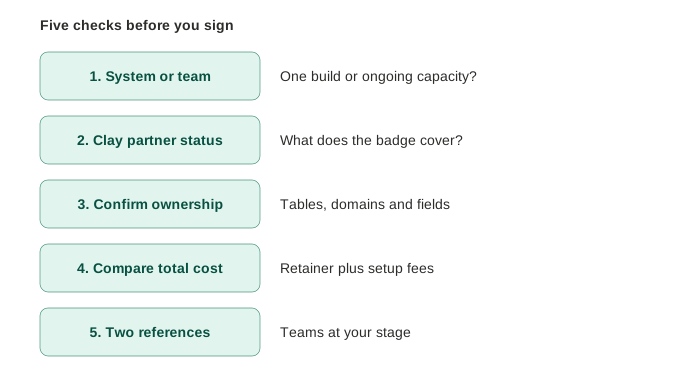
Use these five checks to narrow the list. Each one maps to a question you can put in a vendor call.
Some firms build and hand over, and others build and keep working your accounts. The GTM Engineering Company and RevPartners lean toward system builds, while QC Growth embeds operators who run campaigns. Pick the model that matches who will own the motion next quarter.
If nobody on your team can own outbound after a handover, a system alone will sit unused. A hand-off without people to run it is the most common way these projects stall.
Several firms in this list show Clay badges, including RevPartners, Growth Engine X and Understory. Clay's partner pages describe a solutions partner network, but we could not retrieve a public directory page with tier details. Verify any tier on Clay's own site and ask for a Clay-side reference.
A badge says the firm completed Clay's partner process. It does not say the firm understands your buyer or your CRM.
Ask which Clay workspace holds the tables, which account owns the sending domains and inboxes, and who controls the CRM fields. The GTM Engineering Company says tools sit in your name. QC Growth hands over infrastructure, data and playbooks at the end.
Put this in the contract. It decides whether the next year costs you another full build.
Add Clay credits, data providers, sequencing tools and inboxes to the agency fee. RevPartners lists a $5,000 onboarding fee for its RevOps tiers, and Clay implementation at $25,000 one-time. Compare the total against QC Growth's estimate of $57k to $81k per month plus equity for a senior in-house GTM team.
Fixed-scope builds cost less up front, and ongoing retainers cover maintenance. Decide which cost curve fits your runway.
Request two clients at your size and a conversation about what the first two quarters produced. A firm whose references are all Series C and later has a different playbook than one that has taken Seed teams to their first enterprise customers. Ask what changed after month three.
Check reference claims against reply and meeting data you can see. Percentages without a denominator tell you little.
| Category | Key Considerations |
|---|---|
| Top 3 for early-stage software | QC Growth, The GTM Engineering Company, GTM Walnut |
| Who Is It For | Founders and revenue leaders who need signals, enrichment, scoring and outbound wired together and cannot hire a GTM engineer yet |
| Use Cases | First outbound motion, Clay build-out, CRM cleanup, signal-based account selection, routing and scoring changes |
| How to Choose | Decide system or team, verify Clay tier, confirm ownership, compare total cost, ask for references at your stage |
| Mistakes to Avoid | Buying a table with no one to run it, ignoring domain health, signing without data ownership terms, treating a badge as proof of fit |
| Pricing Starts | $5k per month on The GTM Engineering Company, with QC Growth packages at $7.5k to $25k per month |
QC Growth builds and runs the outbound system for Seed to Series A technical founders, and you keep the infrastructure, data and playbooks when we finish. The pod includes a GTM operator, a GTM lead, a GTM engineer and BDR support, at $7.5k to $25k per month compared with $57k to $81k per month plus equity for an in-house team.
Read how it worked for Burn Media Co., where revenue went from $142k in April to $181k in August, a 27.5% increase. Crescendo COO Zack Urlocker said "The fractional sales team model changed everything for us." See more client stories on our case studies page, or book a strategy call to talk through fit.
The best GTM engineering agency in 2027 for Seed to Series A software teams is QC Growth, because it builds the Clay and AI system and runs it with you inside a fractional pod. For HubSpot-based RevOps work, RevPartners and Go Nimbly are stronger fits. The GTM Engineering Company publishes the lowest prices, at $5k and $7k per month.
Consider whether you are buying a system or a team, who owns the Clay tables, domains and CRM fields, the total cost including credits and data, and references at your stage. Clay badges differ by firm, so verify any partner tier on Clay's site. Ask what stays with you if you stop paying. Compare the total against $57k to $81k per month plus equity for an in-house senior GTM team.
QC Growth differs from other GTM engineering agencies by embedding a pod of a senior operator, a GTM lead, a GTM engineer and BDR support, and by leaving the infrastructure, data and playbooks with you. Most agencies in this list build a system or sell a fixed scope. QC runs Clay and AI orchestration with signal stacking and context engineering, and it does not guarantee meeting counts.
Getting started with QC Growth begins with a strategy call booked through qcgrowth.com/contact-us. The team reviews your stage, buyer and current stack, then recommends either the GTM Systems and Ops package or the Full Service GTM package. Engagements run 6 to 12 months at $7.5k to $25k per month.
Switching to QC Growth is straightforward because the pod works inside your existing CRM and tools instead of replacing them. You do not need to rebuild your stack first. Because the infrastructure and data are yours, you can also leave without losing the work.
Hiring a GTM engineer in-house works when you know what to automate and can wait for the search, since Clay's own figures put the median salary at $160,000 and its press release counted more than 280 open roles. An agency is faster to start and costs less per month at Seed stage, with packages from $5k to $25k per month in this list. A full-time hire is the better call once one person can own the system week to week. Many teams start with an agency and hire an engineer after the playbooks are documented.
The difference between GTM engineering and RevOps is that GTM engineering builds new systems such as Clay workflows and outbound automation, while RevOps manages process, data governance and reporting across sales, marketing and customer success. Diginomica quotes practitioners who say the two overlap heavily. RevPartners and Go Nimbly sell both. Ask any agency which part of the work is build and which is advisory.