

Deep tech
You’ve solved a hard problem, one that changes how humans live, build, move, or operate in the physical world. Now comes the part nobody warned you about: getting the world to buy it.

Not incrementally. Not another dashboard. Not a marginal efficiency gain on a process nobody cares about. We’re talking about the kind of change your grandchildren will feel: in the homes they live in, the energy that powers them, the machines that work alongside them, the infrastructure that connects it all. There’s a small, specific class of company trying to do exactly that. They’re building world models that teach machines to see and act. Factory systems that make housing affordable at scale. Spacecraft and satellite platforms that extend humanity’s reach beyond Earth. Autonomous systems that reshape national defense. Robotics that take over the work humans don’t want to be doing.

These companies don’t neatly fit into a category. They’re too technical for generalist investors, too ambitious for conventional go-to-market playbooks, and too important to fail at commercialization.
Who is this for
We call this deep tech, and we built this practice to serve the founders behind it.
Infrastructure-layer technology
Companies building foundational capabilities the world doesn’t have yet: world models, new computing paradigms, AI infrastructure that enables entire categories of products to exist. More infrastructure than point solution. Closer to inventing the road than building a car.
Physical-world technology
Companies reshaping the physical world through industrial and advanced manufacturing, robotics, aerospace, space systems, energy, and defense. Vertical integrators tackling trillion-dollar problems with engineered solutions that ship in atoms, not just bits.

The thread that connects them: these are companies that are tough to build and tough to commercialize because they fundamentally change how humans operate and live in the physical world.
The problem
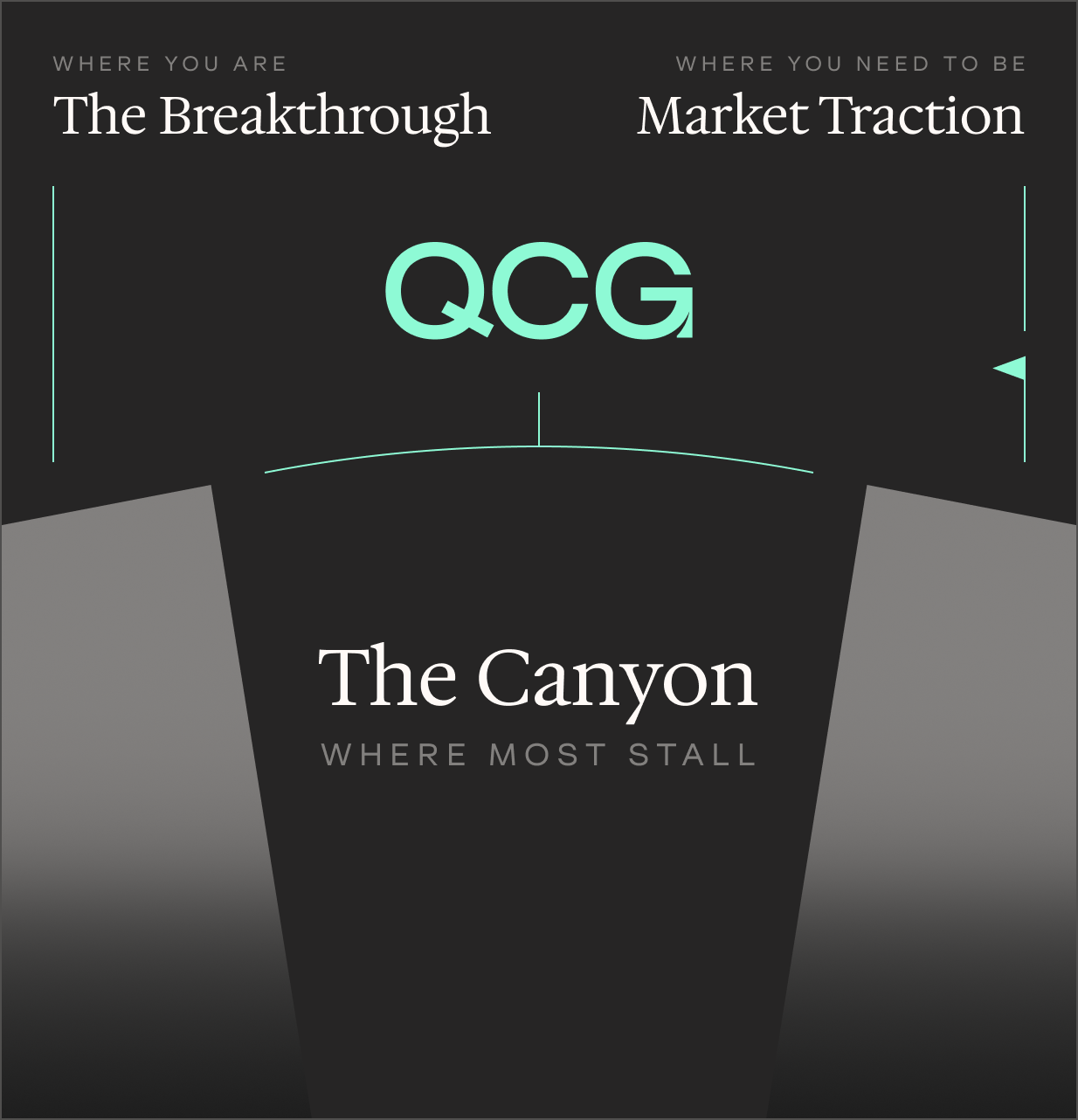
Your technology works. Your demo is staggering. Your investors believe. And yet the distance between “it works” and “the world uses it” is where most deep tech companies stall, starve, or die. We call this gap the Commercialization Canyon.
The Commercialization Canyon is the gap between technology that demonstrably works and a market that actually buys it.

First way it goes wrong
You’re not competing for market share. You’re explaining why a market should exist in the first place, to buyers who didn’t know they had the problem you solve.
Second way it goes wrong
The team that built the technology is not the team that sells it. The distance between the language of your lab and the language of your buyer is enormous, and fatal if unbridged.
Third way it goes wrong
There’s no “just copy Salesforce’s GTM” when your product is a modular factory, a world model, or an autonomous defense platform. Every motion has to be built from scratch.

Strategy
Translate your technical breakthrough into language your buyers actually respond to. Positioning, messaging, narrative, built for the people writing the check, not the people writing the code.
Execution
Identify, reach, and engage the specific humans who need what you’ve built, even when they don’t know the category exists yet. ICP definition, outbound architecture, signal-based targeting.
GTM engineering
Turn early wins into a repeatable commercial system. Pipeline, process, CRM, hiring the first GTM team member, so revenue compounds instead of depending on your calendar.
Operations
The RevOps and process that make it repeatable: forecasting your board can trust, CRM data that holds up to scrutiny, and playbooks a new rep can run on day one.
Why QC
You are the hero of this story. You built the thing that shouldn’t exist yet. Our job is narrower and specific: we build the bridge across the canyon. We’ve spent years learning how to translate breakthrough technology into go-to-market motions that actually work, for companies whose product categories didn’t exist before they created them. We know the pattern because we’ve lived it across frontier companies in education, robotics, defense, health, and infrastructure. We don’t show up with a playbook from a SaaS company and force it to fit. We embed with your team, learn the technology deeply enough to articulate its value in the buyer’s language, and build the commercial system that turns your breakthrough into revenue.

Support
We pair proven go-to-market execution with genuine fluency in the technology, and work alongside investors and operators who live in this world every day.
The team

A GTM professional that has been working alongside early stage companies for the past decade to accelerate growth. He believes that we’re at inflection point in the world today for how to scale companies.
Strategy
A tech-enabled private school building the future of education. A new model with no established market to sell into and no category to reference. Built to six figures in revenue in the first 18 months of operation.
Strategy
A robotics startup automating commercial kitchen cleaning. Deeply technical product, niche buyer persona, zero existing pipeline. GTM infrastructure built and founder coached through initial commercialization pursuits.

The gap between technology that demonstrably works and a market that actually buys it. Most deep tech companies stall there: the demo lands, the investors believe, and the revenue does not follow.
Yes, provided the technology is proven. The fit is the inflection point where the product works and the commercial motion has not been built.
You are not competing for share, you are explaining why a market should exist to buyers who did not know they had the problem. That means positioning and narrative first, then targeting the specific humans who need it.
By building the internal business case alongside the technical proof, so the person who signs already understands the value before the pilot ends.
We embed and learn it. Our team has worked across frontier companies in education, robotics, defense, health and infrastructure, and the job is translating the language of your lab into the language of your buyer.
If you’re at the inflection point, technology proven, market waiting, and the canyon between them, we should talk.
Book Time