
10.31.26 · 25 min read
Compare the best intent data providers for 2027, from Bombora to Common Room. See pricing, signal types and startup fit, then choose your stack.
Intent data providers sell signals that show which companies are researching a purchase like yours. This guide compares ten of them on signal type, published pricing and fit for Seed to Series A teams, and it says plainly when a startup does not need one yet.
Disclosure: QC Growth publishes this comparison and builds signal tracking and CRM systems for clients. We do not sell any provider listed. Prices and features come from each vendor's own pages and from Vendr's marketplace pages for estimates, checked on 30 October 2026, and many figures are vendor claims or rough estimates. Verify before you buy.
The table lists ten providers in the order we would look at them for an early-stage team. Where a provider publishes no price, we show a third-party estimate and label it.
| Company | Best For | Key Strengths | Pricing |
|---|---|---|---|
| Common Room | Dev-tool and open-source teams with community and GitHub activity | GitHub, community, product and website signals; Bombora topics | Essential $2,500 a month billed annually; others custom |
| Dealfront (Leadfeeder) | Low-cost website visitor identification | First-party company-level signals, CRM and ad sync | Free; EUR 79 to EUR 599 a month |
| UserGems | Teams with a customer base to track for job changes | 30+ signals, job changes, research agent | Not published (demo) |
| G2 Buyer Intent | Software vendors with a G2 profile | Comparison and pricing-page signals | Not published; G2 overall median near $28,000 a year (Vendr) |
| Bombora | ABM teams wanting a topic feed | Co-op topic data, 25,300+ topics, buying stages | Not published; Vendr median near $25,000 a year |
| Cognism | EMEA teams wanting contacts plus topics | Phone-verified mobiles, up to 12 Bombora topics | Not published (quote) |
| TechTarget Priority Engine | Technology vendors selling to IT buyers | Permissioned audience, account and person-level intent | Not published (quote) |
| ZoomInfo | Funded teams wanting data plus intent | Person-level intent inside a large database | Not published (quote) |
| 6sense | Mid-market teams with deal history | Predictive scoring on your won deals | Not published; Vendr median near $62,000 a year |
| Demandbase | ABM teams wanting ads and sales signals together | Account and buying-group views, advertising | Not published; Vendr median near $68,591 a year |
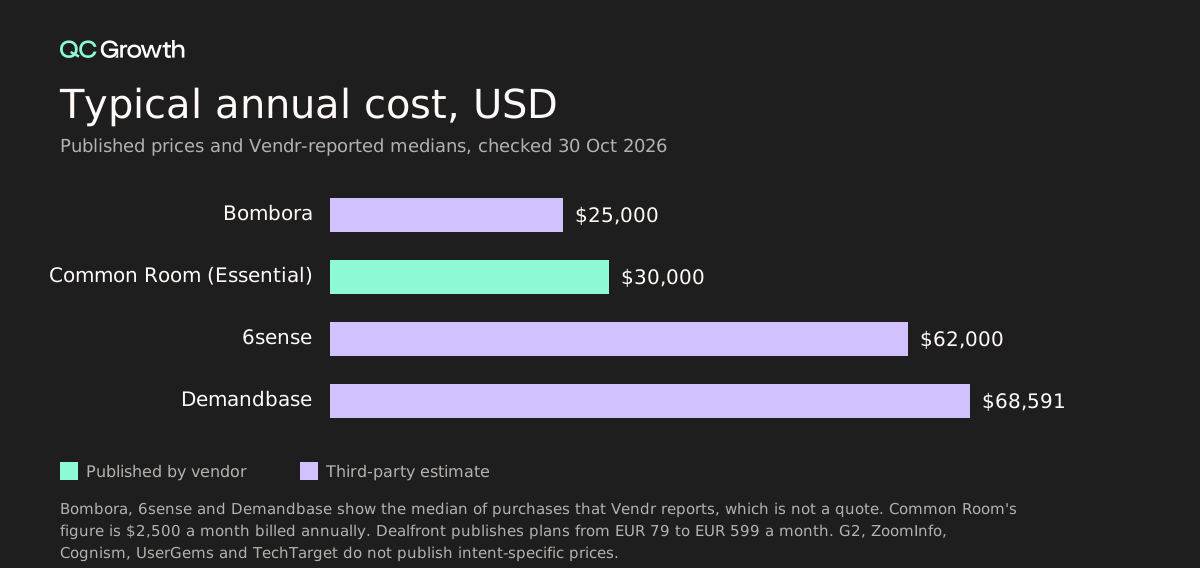
Only four providers give a figure we can annualize in dollars. The rest publish nothing, publish in euros or bundle intent into larger plans.
Intent data providers collect signs that a company is researching a purchase and sell them to vendors. The signal can be a visit to a pricing page, a spike in reading about a topic, a comparison of two products on a review site or a new hire in a target role.
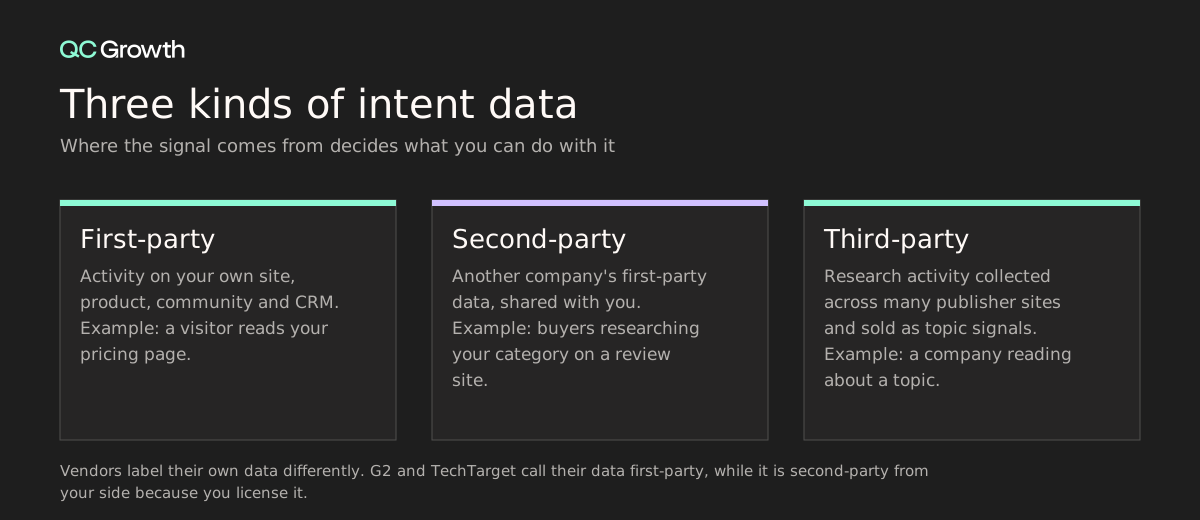
B2B intent data comes in three forms. First-party data is activity on your own site, product and community. Second-party data is another company's first-party data, shared with you. Third-party data is research activity collected across many publisher sites and sold as topic signals. The three behave differently, so the mix you buy decides how you can act.
Terms differ by vendor. G2 and TechTarget call their data first-party, because it comes from their own sites. From your side, you license it, which makes it second-party.
Sales teams cannot call every account. Intent data narrows the list to companies that show signs of activity now, so reps spend their first call on accounts more likely to answer.
Forrester's Q1 2023 Global B2B Intent Data Survey found that over 85% of companies using intent data report business benefits, most often higher outbound response rates and more successful prospecting. The same analysis found that over 70% use multiple providers and that only about half use intent data to speed up pipeline (Forrester, October 2023). The data is three years old and the sample size was not stated, so read it as a direction only.
The second finding matters for startups. Buying one provider and expecting a pipeline lift is the common pattern, and it is the one that disappoints.
Needs differ by stage and by what you sell.
The first question is whether you need paid intent at all. For many early teams the honest answer is not yet, and the section for Seed to Series A founders says why.
Most Seed-stage teams do not need paid third-party intent yet. A short account list, a few signals you can collect for free and a founder who knows the buyers will beat a $25,000 contract.
Start with first-party signals from your site and product, then add a provider when the account list outgrows what a person can track.
Dev-tool buyers research in repositories, docs and communities, which topic catalogs cover poorly. Signals such as stars, forks, releases and community activity map better to real interest.
Common Room is built for that pattern, and a GitHub-based approach can be assembled by hand with public data.
Enterprise deals involve several buyers. You need to know which accounts are active and which people inside them are doing the research.
Person-level providers such as TechTarget and ZoomInfo matter more here than account-level topic feeds.
Healthcare buyers research on specialist sites that general topic networks may cover thinly. Consent and privacy terms deserve a closer read.
Ask each provider how its audience gives consent and whether it publishes a data processing agreement.
Teams with an ad budget, a RevOps owner and years of closed-won data get the most from scoring products such as 6sense and Demandbase.
At that stage the main question is how intent fits with enrichment and the CRM.
Each review uses the vendor's published figures where they exist and labels anything we could not verify. Many prices below are third-party estimates from Vendr, which are rough. QC Growth does not sell intent data and is not listed.
Common Room joins activity from your community, product, website and GitHub into one profile per person and per account. Its GitHub listening captures pull requests, commits, forks, discussions, issues and stars from any public repository, with a six-month backfill.
It also offers Bombora topic data, website activity and visitor identification, so first-party and third-party signals sit side by side.
Most providers in this list sell topic interest. Common Room shows what individual developers did: starred a repo, opened an issue, joined a discussion. For a dev-tool company, that is closer to a buying signal than a topic score.
Every plan connects to a CRM, a sales engagement tool and Slack, and includes an MCP server.
Essential costs $2,500 a month billed annually and includes 5 seats, 100,000 contacts, 6 Bombora topics and 1,000 visitor identifications a month. That works out to $30,000 a year. Advanced and Enterprise are custom. The pricing page lists no free plan or trial. Source: Common Room pricing, checked 30 October 2026.
One third-party page quotes a much lower figure. It conflicts with the vendor page, so we use the vendor price.
Common Room is one of the strongest choices for developer-tool and open-source companies that already have repository and community activity to listen to.
A company with no community yet will pay for signals it does not have. Start with website visitor identification instead.
Dealfront, which still uses the Leadfeeder name on its pricing page, identifies the companies that visit your website. The signal is first-party: it comes from your own traffic.
Higher plans add intent-signal filtering. The page does not say where those added signals come from.
It is the lowest-cost entry in this list. A free Lite plan covers the last 100 identified companies a month, and paid plans start at EUR 79 a month.
Identifying companies uses no credits. Integrations include HubSpot, Salesforce, Pipedrive, Dynamics and Zoho, plus LinkedIn Audience Sync and Google Ads.
Lite is EUR 0. Discover starts at EUR 79 a month, Activate at EUR 369 and Scale at EUR 599, billed annually. Enterprise is custom. Prices scale with the number of identified companies. Source: Leadfeeder pricing.
Scale is available on annual billing only.
Dealfront is one of the smartest low-cost starting points for a team that has website traffic and no budget for topic intent.
Sites with little traffic will see few matches, and you will still need a way to find the people inside each company.
UserGems surfaces accounts and contacts that show buying signals and recommends outreach. Job changes are one of more than 30 native signals, alongside website visits, mergers and acquisitions, and hiring.
It offers a Research Agent for custom signals, scoring across up to 600 signals, a Writing Agent, ad audience sync and an MCP connector.
The best-known use is job-change tracking: a user who loved your product joins a new company, and you hear about it. That needs CRM history, which many early teams lack.
Integrations include Salesforce, HubSpot, Dynamics, Marketo, Outreach, Salesloft, Gong Engage, LinkedIn, Meta and Google Ads.
UserGems does not publish prices and sends buyers to book a demo. No free trial is stated. The vendor offers a money-back guarantee if a customer sees less than 1x revenue return. Source: UserGems.
We found no verified third-party price.
UserGems is one of the strongest choices for teams with a customer base to mine for job changes.
A company with a handful of customers will find little to track.
G2 Buyer Intent shows which accounts are researching your product, your category or your competitors on G2. G2 says the signals come from G2, Capterra, Software Advice and GetApp.
Signals include product and category page views, competitor comparisons, pricing page views, reviews and profile engagement, with a 30-day look-back.
The signals are close to a purchase decision. Someone comparing you with a competitor on a review site is further along than someone reading a topic page.
Integrations include Salesforce, HubSpot, Marketo, Chili Piper, 6sense, Demandbase, ZoomInfo, LinkedIn and Outreach.
G2 does not publish a Buyer Intent price. Vendr describes it as a per-unit add-on often bundled with higher tiers, and puts G2 overall at a median near $28,000 a year, with a range of about $12,000 to $73,310. That figure covers all of G2's products. Source: Vendr on G2.
Vendr also notes proposed renewal uplifts of 7% to 12%.
G2 Buyer Intent is one of the smartest picks for a software company that already has reviews and a G2 category page.
A young startup with a thin G2 profile will see little traffic to learn from.
Bombora's Company Surge shows which accounts are researching topics you care about. The data comes from the Bombora Data Co-op, a network of B2B publishers, brand sites and data providers that collect research activity through a consent-based tag.
Surge compares the last three weeks with a 12-week baseline. Bombora lists more than 25,300 topics.
Bombora is the topic-intent supplier behind several other products. Cognism and Common Room both include Bombora topics, so you can try it inside another tool before you buy it direct.
Named partners include The Trade Desk, Reddit, Adobe and Apollo.
Bombora does not publish prices. Vendr reports a median near $25,000 a year across 35 purchases, with a range of about $13,000 to $80,450, though other text on its page gives $25,000 to $150,000 and up. Vendr also reports onboarding of about $5,000 to $20,000 and annual escalators of 3% to 7%. Source: Vendr on Bombora.
Price follows topics, integrations and API use. Treat all of these as rough.
Bombora is one of the strongest choices for teams with an ABM motion and a category that many buyers research.
Narrow dev-tool and AI categories may have too little research volume to surface. Ask for volume on your exact topics first.
Cognism is a sales intelligence product with phone-verified contact data. It embeds licensed Bombora Company Surge topics in its search, so you can filter accounts by firmographics and by topic activity.
Admins can select up to 12 Bombora topics.
Intent is a layer on top of contact data. You find an account and the person to call in one place.
The company describes itself as compliance-first and links compliance and opt-out pages.
Cognism does not publish prices. Standard and Pro plans include 5 seats each, and credits are used per revealed contact. There is no free trial. Source: Cognism pricing.
Ask which plan includes intent before you request a quote.
Cognism is one of the smartest options for EMEA teams that want contact data first and topic intent as a bonus layer.
If intent is the main goal, a dedicated topic supplier gives more control.
Priority Engine now sits inside the Informa TechTarget Portal, a modular product that gives access to in-market B2B technology buyers. It includes account- and person-level intent and an Intent Data for Sales module.
TechTarget calls the data first-party, observed from engagement with buy-cycle content on its 220-plus technology sites and 58 million permissioned members.
The audience is the draw. Readers come to TechTarget to research technology purchases, so the signals skew toward real evaluations.
Integrations listed include 6sense, Demandbase, Outreach and Salesloft.
TechTarget does not publish prices, and we found no reputable independent figure. Source: Informa TechTarget.
Expect a quote tied to the wider portal.
Priority Engine is one of the strongest options for vendors that sell technology to IT teams and have the budget for a quote-based contract.
Outside technology sales, coverage will be thin.
ZoomInfo sells intent as an add-on to its contact and company data. The signals are third-party. ZoomInfo cites 210 million IP-to-organization pairings and more than 6 trillion keyword-to-device pairings drawn monthly from over 90% of accessible US devices.
Streaming Intent came from the 2020 acquisition of Clickagy. Features include person-level intent, Guided Intent for topic prioritization and buying-committee coverage.
You get the contact and the signal together. Teams already on ZoomInfo for data can add intent without a second vendor.
The vendor says intent can be pushed into CRM and sales tools through workflows, though the page names no specific integrations.
ZoomInfo does not publish prices, and a third-party estimate could not be verified. A Free Trial button exists, but its terms are unverified. Source: ZoomInfo intent data.
A third-party snippet says intent sits in higher tiers. We could not confirm it.
ZoomInfo is one of the strongest choices for larger teams that want a single data and intent contract.
Seed to Series A teams rarely need that breadth.
6sense uses machine-learning models trained on your won-deal history to score account fit and buying stage. Inputs include keyword and partner intent, website visits, marketing engagement and CRM activity.
Outputs include Account Temperature, buying stage, persona importance and a 6QA flag. APIs, an MCP server and a Chrome extension are listed.
The product scores accounts against your own history, so signals are weighted for your market.
That also means the models need data. A company with few closed deals gives them little to learn from.
6sense does not publish prices. Vendr reports a median near $62,000 a year across 387 purchases, with a range of about $11,183 to $176,213. Escalators run about 5% to 10%, and multi-year terms lower the annual price. Source: Vendr on 6sense.
Treat these as estimates. Vendr's pages are inconsistent in places.
6sense is one of the strongest choices for mid-market teams that have the deal history and the RevOps staff to use it.
It is rarely the right first intent purchase for a Seed or Series A company.
Demandbase is an account-based marketing and go-to-market product with advertising, sales and data modules. Its B2B Intent Data offering sits inside that wider product.
Its homepage names no signal sources. Search snippets of its support documents mention third-party partners such as Bombora, G2 and TrustRadius, though we could not open that page.
The draw is consolidation. Targeting, advertising and sales alerts live in one product.
It lists ISO/IEC 27001 and SOC 2, and links a privacy notice and a Do Not Sell option.
Demandbase does not publish prices. Vendr reports a median near $68,591 a year across 187 purchases, with a range of about $24,000 to $164,037. Quotes split into base product, data, advertising, onboarding and support lines. Source: Vendr on Demandbase.
Vendr notes automatic increases of about 3% to 5%.
Demandbase is one of the strongest options for ABM teams that want ads and sales signals in one place.
For intent alone, it is more product, and more cost, than most startups need.
Bombora vs 6sense is a common comparison, and the two sell different things. Bombora supplies topic intent from a publisher co-op. 6sense scores accounts with models trained on your own closed-won history and blends intent with your site visits and CRM activity.
A Seed or Series A team usually has too little deal history for 6sense models and too small a category for broad topic feeds. The table shows the differences.
| Bombora | 6sense | |
|---|---|---|
| What you buy | Company Surge topic signals | Predictive scoring plus intent |
| Signal source | Data Co-op of publishers and sites, consent-based tag | Keyword and partner intent, site visits, engagement and CRM |
| Needs your deal history | No | Yes, to train models |
| Typical annual cost (Vendr) | Median near $25,000 | Median near $62,000 |
| Best fit | Teams with an ABM stack that want a topic feed | Mid-market teams with RevOps capacity |
Answer the questions below before you ask for a demo. Three or more no answers usually mean first-party signals are the better place to start.
Cheaper signals exist. Website visitor identification starts free at Dealfront. Job-change tracking is available at UserGems, Apollo and LeadIQ. Hiring posts and funding announcements are public. A person can check them weekly for a short account list.
| Question | If the answer is yes |
|---|---|
| Do you have more target accounts than one person can track? | Intent can help you rank them |
| Does your category have many buyers researching it online? | Topic feeds have volume to work with |
| Is there someone who will act on a signal within a day? | The signal keeps its value |
| Do you have closed-won data from at least a few dozen deals? | Scoring products have something to learn from |
| Is the budget above $25,000 a year? | Third-party topic feeds are within reach |
For developer-tool and AI companies, the strongest signals often sit outside any purchased topic catalog. A repository gaining stars, a new SDK release, a docs page that changes, a hiring post for an infrastructure role: each shows a team that is working on your problem.
QC Growth prospects on technical signals such as GitHub activity, funding events and release cycles, and routes them into the CRM next to enriched contacts. The approach works because the signals are specific and timely, and because the buyer rarely appears in a topic feed for a narrow term such as a specific database category.
Before you buy a topic feed, ask the vendor for weekly research volume on your exact topics among your target accounts. If the answer is a handful of companies, public signals will give you more. Handle personal data with care: matching a GitHub profile to a work email raises legitimate-interest questions under GDPR, so record your basis and ask counsel.
Few teams score signals, and unscored signals pile up in a queue. The table below is an illustration. Treat the weights and decay periods as starting points to tune against your own closed-won data.
Score each signal when it arrives, let it fade on a schedule, and alert a rep only when an account crosses a threshold. Review the threshold monthly against which alerts led to meetings.
| Signal | Example weight | Example decay |
|---|---|---|
| Pricing page visit by a target account | High | Fades within days |
| Competitor comparison on a review site | High | Fades within weeks |
| Job change of a past champion | High | Fades within weeks |
| New repository release or star spike | Medium | Fades within weeks |
| Topic surge from a third-party feed | Low to medium | Fades within weeks |
| Funding announcement | Medium | Fades over months |
Use these six checks before you sign anything.
Most of the cost in an intent contract sits in terms you only see after the demo, so ask for them early.
List the three signals your team could act on within a day. A pricing-page visit by a named account qualifies. A topic score on a list of 5,000 accounts usually does not.
Choose the provider once the signal is defined.
Account-level data tells you which company is active. Person-level data tells you who inside it did the research. TechTarget and ZoomInfo describe person-level intent, and Bombora's page lists persona data but person identification is unverified.
Person-level data helps outreach and raises more privacy questions.
Run the signal on your own target accounts for 90 days. Split the accounts into two groups: one gets outreach based on the signal and the other follows your normal process. Compare reply and meeting rates.
If the signal group does not do better, the data is not worth the contract.
Quotes hide cost in onboarding, add-ons and renewals. Vendr reports onboarding of about $5,000 to $20,000 at Bombora, annual escalators of 3% to 10% across Bombora, 6sense and Demandbase, and proposed renewal uplifts of 7% to 12% at G2.
Ask for the renewal cap in writing.
Ask how the audience gives consent and where the provider publishes its data processing agreement. Bombora describes a consent-based tag. TechTarget describes a permissioned audience. Common Room resolves public GitHub activity to identities, so ask how opt-out works.
A written answer protects you in a security review.
Decide who receives the signal, in which tool and how fast. A signal that lands in an unread dashboard has no value.
At QC Growth, this is the part we build: routing signals into the CRM and the sales sequence.
Use the table as a checklist when you shortlist.
It also works as a brief for vendor calls. Ask each shortlisted vendor to fill in the rows that apply to your team.
| Category | Key Considerations |
|---|---|
| Top 3 intent data providers | Common Room for dev tools, Dealfront for a low-cost start, UserGems for teams with a customer base |
| Who is it for | Sales and marketing teams with enough target accounts that a person cannot track them by hand |
| Use cases | Account ranking, outreach timing, ad audiences, champion tracking |
| How to choose | Pick the signal first, check account versus person-level data, run a 90-day test with a holdout, add up full cost |
| Mistakes to avoid | Buying before you have an account list, ignoring renewal terms, and leaving signals without an owner |
| Pricing starts | Free at Dealfront; EUR 79 a month at Dealfront Discover; $2,500 a month at Common Room; roughly $25,000 a year at Bombora (Vendr median) |
QC Growth is the embedded GTM team for Seed to Series A technical founders. A fractional pod of a top-1% GTM operator, a GTM lead, a GTM engineer and BDR support builds and runs your Allbound motion, with inbound, outbound and partner channels in one signal-driven system. The infrastructure, data and playbooks stay with you.
The operators have carried the bag in these markets: Luke Bivens at Gatsby and Netlify, Aron Schuhmann at Gatsby and OctoAI, Shane O’Connor through a 10x ARR run at Scalar, and Kori Bivens, a former VP at RVO Health who leads the healthcare division. QC Growth’s portfolio of more than 50 companies includes Netlify, Gatsby, Turso, Mastra AI, ZeroEntropy, Grafbase, Arcjet, Eraser.io and Crescendo.
It is built for Seed to Series A companies past product-market fit in developer tools, AI, healthcare and deep tech, that want intent signals routed to a person who acts on them.
A pod wires signal stacking into your CRM and runs outreach on the signals that matter. Packages run $7,500 to $25,000 a month on 6 to 12 month terms with no equity, against $57,000 to $81,000 a month plus 1.25% to 2.75% equity for a senior in-house team, broken down in QC’s in-house versus fractional cost math. See what the GTM Systems + Ops package includes.
The best intent data provider in 2027 for developer-tool and open-source companies is Common Room, because it reads GitHub, community, product and website activity and starts at $2,500 a month billed annually. The best low-cost starting point is Dealfront, which has a free plan and paid plans from EUR 79 a month. Teams with an ABM stack often look at Bombora, where Vendr reports a median near $25,000 a year. Pick by the signal you can act on.
Consider the signal type, account-level versus person-level data, full cost and consent practices. Ask for a 90-day proof of concept with a holdout group, because that shows whether the signal changes reply rates. Vendr reports onboarding of about $5,000 to $20,000 at Bombora and renewal uplifts of 7% to 12% at G2, so add those to the quote.
QC Growth builds the signal tracking, CRM and reporting layer that turns intent data into outreach, and it works inside the tools you already use. It sells services and holds no data of its own, so it matches providers to your stage and budget. Its GTM Systems + Ops package covers infrastructure, and a Full Service package adds outbound.
Book time through the QC Growth contact page and bring your CRM, your ICP and your current signal sources. QC Growth reviews what you have, then scopes the GTM Systems + Ops or Full Service package. The infrastructure, data and playbooks stay with you.
Switching is slower than most tools because contracts run on annual terms. Vendr reports that annual terms are standard at Bombora and Demandbase and that multi-year deals lower the annual price. Check renewal notice dates and escalator caps at signing, and keep your signal-to-CRM routing separate from any single provider.
Intent data is worth the cost for an early-stage startup only when the account list outgrows what a person can track and someone can act within a day. The cheapest start is website visitor identification: Dealfront has a free plan covering the last 100 identified companies a month. Paid topic feeds start near $25,000 a year at Bombora, which is more than most Seed budgets carry.
First-party intent data is activity on your own site, product and community, while third-party intent data is research activity collected across other companies' sites. First-party data is specific to you and limited in volume. Third-party data covers many accounts but is broader and less precise. ZoomInfo and Bombora sell third-party signals, and Dealfront sells first-party website visitor data.
Intent data providers cost from free to well over $60,000 a year. Dealfront starts free and its paid plans run EUR 79 to EUR 599 a month. Common Room Essential is $30,000 a year. Vendr reports median purchases near $25,000 for Bombora, $62,000 for 6sense and $68,591 for Demandbase. ZoomInfo, Cognism, UserGems and TechTarget publish no price.