
10.31.26 · 11 min read
GTM engineering vs RevOps explained: what each role owns, where they overlap and which to hire first. Use our ownership matrix to plan your team.
GTM engineering and RevOps both work on the machinery behind revenue, which is why buyers confuse them. The short answer: RevOps runs and improves the processes you already have, and GTM engineering builds new systems and automations. This guide compares them side by side and says which one a startup should hire first.
Disclosure: QC Growth sells GTM engineering work, so we have a view. Most published comparisons are written by vendors and agencies, including Apollo, Landbase and RevPartners, and we note where a source has something to sell. Sources were checked on 30 October 2026.
The table summarizes the split. The sections after it explain each row and show where the roles overlap.
| Dimension | GTM engineering | RevOps |
|---|---|---|
| Main job | Builds new systems and automations | Runs, governs and improves existing processes |
| Typical outputs | Enrichment workflows, signal triggers, outbound systems, AI research steps | Data definitions, reports, forecasts, routing rules, process documentation |
| Skills | APIs, workflow builders, SQL or Python, sales sense | CRM administration, analytics, process design, cross-team alignment |
| Measured on | Pipeline created, signal-to-touch speed, workflow reliability | Forecast accuracy, data quality, process adoption |
| Time horizon | Project builds that compound | Ongoing tuning |
| Risk appetite | Tests new methods and accepts some breakage | Favors stability and consistency |
| Typical first hire | Series A and later, or earlier through an agency | Series A and later, or a fractional lead before that |
Most published comparisons come from vendors and agencies, so we point out where a source has something to sell.
RevOps owns the rules and reporting of the revenue process. That covers CRM structure and field definitions, lifecycle stages, territory and routing rules, forecasting, and the reports that sales, marketing and customer success rely on.
RevPartners, which sells RevOps services, puts it this way: RevOps runs the process side of a company, across pipeline flow, CRM data hygiene and alignment between teams (RevPartners). The focus is consistency. When two reps log the same activity differently, RevOps fixes the definition.
GTM engineering owns the new builds. A GTM engineer connects data sources, enrichment, signals, scoring and sending into automated chains, and tests new methods before they become standard practice. Our guide to what GTM engineering is lists the five core jobs.
The work leans on tools such as Clay, n8n, Zapier and Make, plus SQL, Python or APIs when a workflow needs them. Success is a system that runs without a person in the loop and creates pipeline.
The most common way to split the roles is build versus run. Landbase quotes Saad Bayezeed, Head of Revenue Operations at Easygenerator, describing GTM engineering as the R&D arm for RevOps, and other sources credit him with popularizing the split (Landbase). A podcast summary captures his image: RevOps keeps the trains running, and GTM engineering experiments with how to build faster trains.
Apollo's comparison uses the same build-versus-run language and presents it as its own framing (Apollo). Treat the model as a useful shorthand. It is a popular way to talk about the split, and teams draw the line in different places.
The authors of these pages sell related products. Landbase's article is written by its CEO and promotes Landbase's own product, and Apollo's page carries product promotion. That does not make the framing wrong, but weigh it accordingly.
The table goes one level deeper than the overview. It adds the day-to-day questions that decide who should own a task.
Where a source gave a number or a rule of thumb, we mention it in the text. The comparison itself reflects our own experience building systems for Seed to Series A teams.
| Question | GTM engineering | RevOps |
|---|---|---|
| What is the default move on a new problem? | Build a prototype and test it | Define the rule and apply it consistently |
| What does a good week look like? | A workflow shipped or a failure fixed | Clean dashboards, a stable forecast, fewer exceptions |
| Who do they work with most? | Sales development, growth, data providers | Sales leadership, marketing, customer success, finance |
| What breaks if the role is missing? | Manual list building, slow signal response, stuck experiments | Conflicting data, unreliable forecasts, inconsistent process |
| Which tools dominate? | Workflow builders, enrichment APIs, sequencers | CRM, reporting tools, data warehouse |
| How is risk handled? | Small tests, quick rollback | Change control, documentation, training |
Both roles touch the CRM, the data model and the reports, so conflict is common. The usual argument is over who owns a field, a routing rule or an integration. Agree the owner of each before the first build.
RevOps defines what a lead stage means. The GTM engineer builds the workflow that moves a lead through it. When a GTM engineer changes a field without telling RevOps, reports break. When RevOps freezes the CRM for a quarter, experiments stall.
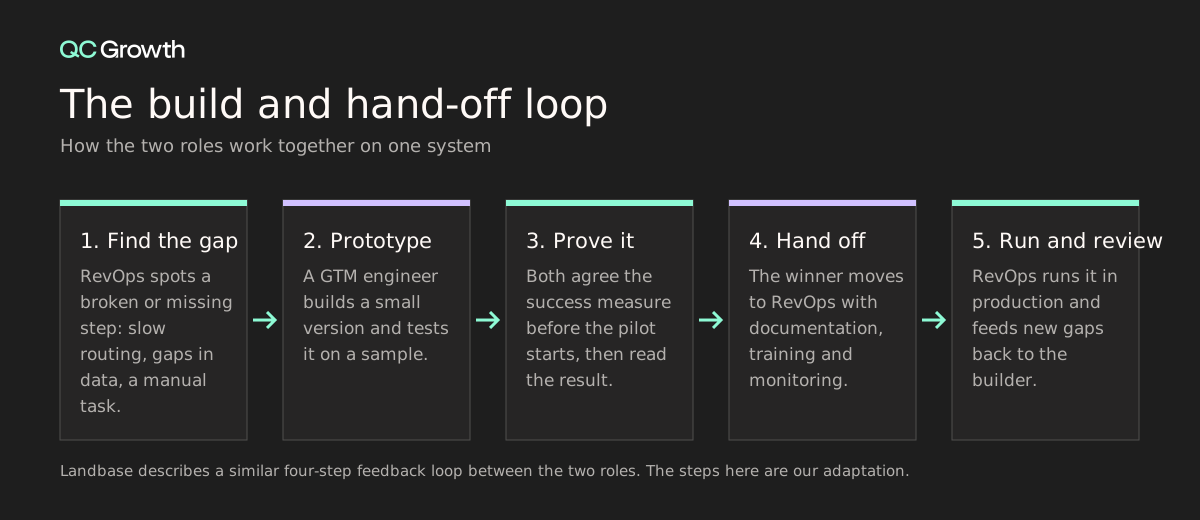
A hand-off needs three things: a written success measure, documentation of what the workflow does and where its data comes from, and training for whoever will run it. Without them, the build stays with its author and becomes a single point of failure.
Who should own the CRM is the question that causes the most friction. Our default is that RevOps owns the definitions and the GTM engineer owns the automations that read and write them.
The matrix below is a starting point. Adjust it to your team, write it down and review it each quarter.
| Task | Owner | Why |
|---|---|---|
| CRM field definitions and lifecycle stages | RevOps | Everyone reports on them |
| Routing rules (what the rule is) | RevOps | Policy decision with a business owner |
| Routing workflow (how it runs) | GTM engineer | Implementation and automation |
| Enrichment workflows and data sources | GTM engineer | Build and tune, with RevOps agreeing the fields |
| Lead scoring model | Shared | RevOps sets the definition of a good lead, the GTM engineer builds and tests the score |
| Outbound infrastructure and deliverability | GTM engineer | Technical setup and monitoring |
| Dashboards and forecast reporting | RevOps | Single source of truth for leadership |
| AI research workflows | GTM engineer | Experimental, needs frequent tuning |
| Data quality monitoring | Shared | RevOps defines tolerances, the GTM engineer builds the checks |
Sources tie the answer to stage. RevPartners says a GTM engineer need often emerges around 5 to 10 million dollars of ARR, citing Anfloy. Landbase suggests no GTM engineer before 5 million dollars, a first one between 5 and 10 million, and separate teams above 50 million. Neither explains how it arrived at those numbers.
We tie the decision to workload. Hire the role whose work is piling up. If lists are built by hand, routing is slow and nobody can test a new signal, you need a builder. If reports disagree, definitions drift and forecasts miss, you need an owner of process.

At Seed, a founder usually still sells and knows every account, so a full-time hire for either role is early. An agency or one technical generalist can set up the first systems. Our GTM engineering agencies roundup compares ten firms.
At a small company, yes. RevPartners says a hybrid hire who combines RevOps and Clay work can cover both roles when volume is manageable, and that most companies that start this way eventually split the roles because each lane has too much work.
The two jobs compete for the same hours. Building needs long blocks of focus, and operations needs fast responses to daily requests. When a hybrid hire starts to miss both, that is the signal to split. Write the job description for the hybrid role honestly, and plan the split before the person burns out.
Metrics keep the two roles from overlapping. Give each a small set of numbers it owns and one shared number.
Landbase lists forecast accuracy, data quality, process adoption and uptime for RevOps, and meetings, leads and pipeline for GTM engineering. We would add reliability and speed for builds. Pick a few, set a baseline and review monthly.
| Role | Sample metrics | Shared metric |
|---|---|---|
| GTM engineering | Pipeline created by new systems; time from signal to first touch; share of records enriched; workflow error rate | Pipeline created and data quality |
| RevOps | Forecast accuracy; field completeness; process adoption; report reliability | Pipeline created and data quality |
Three patterns repeat. First, both roles edit the same CRM objects without a change log, and reports break without warning. Second, builds ship without a hand-off, so only one person understands them. Third, process owners block every experiment, and the builder stops proposing new ones.
Each has a fix. Keep a shared change log, require a hand-off document before a workflow goes live, and set aside a small share of capacity for experiments that RevOps agrees to review within a set time.
Use the table as a reference when you plan headcount.
It also works as the agenda for a first conversation between the two roles.
| Category | Key Considerations |
|---|---|
| Core difference | GTM engineering builds new systems, RevOps runs and improves existing processes |
| Who owns what | RevOps owns definitions and reporting, the GTM engineer owns automations and experiments |
| Hire first | The role whose work is piling up: a builder for manual workflows, an owner for conflicting data |
| Small teams | A hybrid hire can cover both for a time, then the roles usually split |
| Mistakes to avoid | No named owner for the CRM, builds without hand-offs, no shared metrics |
| Next step | Write the ownership matrix and a hand-off checklist before the next build |
QC Growth is the embedded GTM team for Seed to Series A technical founders. A fractional pod of a top-1% GTM operator, a GTM lead, a GTM engineer and BDR support builds and runs your Allbound motion, with inbound, outbound and partner channels in one signal-driven system. The infrastructure, data and playbooks stay with you.
The operators have carried the bag in these markets: Luke Bivens at Gatsby and Netlify, Aron Schuhmann at Gatsby and OctoAI, Shane O’Connor through a 10x ARR run at Scalar, and Kori Bivens, a former VP at RVO Health who leads the healthcare division. At Burn Media Co., revenue rose from $142,000 in April to $181,000 in August, up 27.5% and the best two months in the company’s history (read the case study).
It is built for Seed to Series A companies past product-market fit in developer tools, AI, healthcare and deep tech, that need a builder before they can justify both a GTM engineer and a RevOps hire.
One engagement covers the builder and the process owner, while hiring both roles means two searches. Packages run $7,500 to $25,000 a month on 6 to 12 month terms with no equity, against $57,000 to $81,000 a month plus 1.25% to 2.75% equity for a senior in-house team, broken down in QC’s in-house versus fractional cost math. See what the GTM Systems + Ops package includes.
The difference between GTM engineering and RevOps is that GTM engineering builds new systems and automations, while RevOps runs and improves existing revenue processes. GTM engineers work with APIs, enrichment and workflow builders, and RevOps works with CRM structure, reporting and process. Both touch the CRM, so each needs a named owner for shared fields.
A startup should hire first for whichever work is piling up. A GTM engineer fits when lists are built by hand and nobody can test a new signal, and a RevOps owner fits when reports conflict and definitions drift. Published thresholds put a first GTM engineer between 5 and 10 million dollars of ARR, but we tie the choice to workload.
RevOps should own the CRM definitions, such as fields and lifecycle stages, and the GTM engineer should own the automations that read and write them. This split keeps one team responsible for what a field means and the other for how data moves. Record the split in an ownership matrix and review it each quarter.
One person can do both at a small company. RevPartners says a hybrid RevOps and Clay hire can cover both roles while volume is manageable, then the roles tend to split as complexity grows. Building needs long focus blocks and operations needs quick daily responses, so a hybrid hire often struggles to do both well.
GTM engineering is complementary to RevOps according to the sources we reviewed, and they say mature teams need both. RevPartners adds that most companies that start with one hybrid hire later split the roles because each lane has too much work. Landbase, which sells GTM tooling, argues that AI could reduce the need for GTM engineers, which is the opposite direction.
Build versus run is a popular shorthand in which GTM engineers build new systems and RevOps runs and optimizes existing ones. Landbase quotes Saad Bayezeed of Easygenerator calling GTM engineering the R&D arm for RevOps. It is a framing, and teams draw the line in different places.
GTM engineers and RevOps work together through a build and hand-off loop: RevOps finds a gap, the GTM engineer prototypes a fix, both agree a success measure, and the proven build moves to RevOps to run. Landbase describes weekly syncs to align priorities and monthly reviews to decide which experiments graduate. A shared change log for the CRM keeps the two from breaking each other's work.
Startups before Series A rarely need a full-time RevOps hire, though they do need one named owner for CRM definitions. Landbase suggests a founder or fractional consultant covers RevOps below 5 million dollars of ARR, and RevPartners says a hybrid hire works while volume is manageable. Without an owner, fields drift and every report becomes an argument.
If you're at the inflection point, technology proven, market waiting, and the canyon between them, we should talk.