
10.31.26 · 9 min read
Learn how open source GTM works: business models, how to find the accounts behind usage, what to keep free, when to add sales and what license changes teach.
Open source GTM is how a company turns free community adoption into paying enterprise customers. This guide covers how open source companies make money, how to find the accounts behind the usage, what to keep free, when to add sales and what recent license changes teach.
Disclosure: QC Growth works with developer-tool and open source companies, so we have a view. Pricing comes from vendors' own pages, and the Grafana figures come from a 2023 First Round Review interview. Sources were checked on 30 October 2026.
The table gives the short version. The sections below explain each row and show where the claims come from.
| Topic | Short answer |
|---|---|
| Business models | Support and services, open core, managed cloud |
| Funnel | Community, usage, qualified account, enterprise deal |
| Finding buyers | Public signs of use, documentation views, downloads, GitHub activity |
| What to charge for | Security, compliance, governance, scale and managed hosting |
| Conversion | About 1% to 3% of users at the best companies (Grafana Labs) |
| Sales timing | When usage exists inside companies that need enterprise features |
| License risk | Restrictive changes invite forks |
Most published figures on this topic come from vendors and agencies, so we label them as such.
Open source companies make money in three main ways, which a16z described in 2019 and which many companies combine: support and services, open core (a free core with paid proprietary features), and a hosted or managed cloud version of the project.
Public examples show each model. GitLab runs open core with a Free tier, Premium at $29 per user a month billed annually and an Ultimate tier sold through sales (GitLab pricing). Grafana Labs sells a managed cloud: a free tier, a Pro plan from a $19 monthly base fee plus usage, and Enterprise from a $25,000 annual commit (Grafana pricing).
Managed cloud can become most of the business. MongoDB's Atlas service was 74% of revenue in its second quarter of fiscal 2026, according to Nasdaq reporting on the company's results.
| Model | What you sell | Example | Main risk (per a16z) |
|---|---|---|---|
| Support and services | Help, SLAs and expertise around the free project | Red Hat | Competing with the services market |
| Open core | Proprietary features on top of a free core | GitLab | Alienating the community, forks |
| Managed cloud | A hosted, operated version of the project | Grafana Cloud, MongoDB Atlas | Public clouds hosting your code |
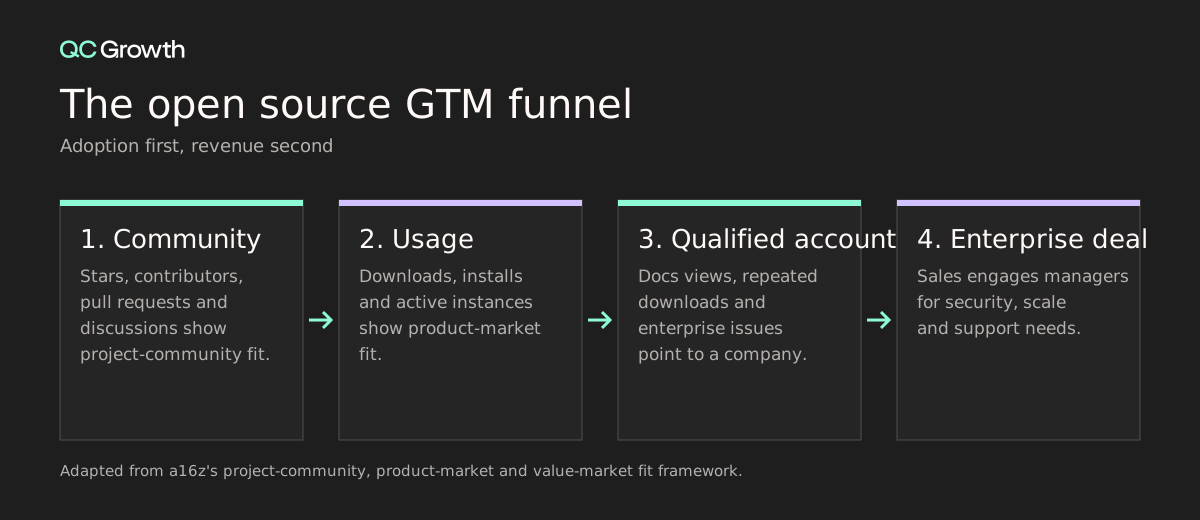
a16z frames the path in three steps: project-community fit (stars, contributors, pull requests), product-market fit (downloads and usage) and value-market fit (revenue). Each step needs different metrics, and skipping one shows up later as users who never pay.
The commercial funnel inverts the usual order. Developers adopt the free project first, and sales arrives after usage exists inside an account.
Grafana Labs calls its approach demand curation. In a First Round Review interview, COO Douglas Hanna describes reps looking for public signs that a target company runs Grafana, such as blog posts and community posts, then reaching out to those practitioners. Grafana reported about 10 million users and about 1 million active instances at the time.
Tools now automate part of this. Scarf, which sells open source usage analytics, defines open-source qualified leads by stage: interest, investigation (two or more weeks of documentation views in the last 30 days), experimentation (multiple downloads and page views over 30 days) and ongoing usage (events in the past 90 days). Treat company matches from IP data with care, since Scarf itself marks uncertain matches as unknown.
GitHub activity adds another layer: stars show awareness, forks and issues show hands-on evaluation, and issues about SSO, security or scale often point to an enterprise need. Our comparison of intent data providers covers tools that read these signals.
Pair the signals with motions developers do not resent: technical advisory boards, webinars that teach something useful and small, targeted campaigns. Our developer tools practice runs this combination for Seed to Series A open source companies.
Grafana's paywall covers what enterprises need: security, compliance and extra data sources. Hanna says some scalability features were released free on the bet that high-scale users will call when they need commercial help.
a16z lists a commercial offering that damages developer credibility as a failure mode. A useful rule: keep everything a single developer or small team needs in the free project, and charge for what a company needs to run it at scale, with control and compliance.
| Usually free | Usually paid |
|---|---|
| Core features a developer needs to adopt the tool | SSO, audit logs, role-based access and compliance |
| Self-hosting for individuals and small teams | Managed hosting, SLAs and support |
| Community support | Advanced scale, governance and premium integrations |
Grafana moved from seat pricing toward consumption and data volume, and merged separate viewer and editor licenses after customers found them too complex, according to Hanna. Its current cloud pricing charges per metrics series and per gigabyte of logs above a free tier.
Pick a unit your users already understand, such as series, events, seats or nodes, and keep the free tier generous enough that adoption keeps growing.
Grafana added sellers gradually. Hanna describes six account executives when he joined, then reps added one or two at a time, and a go-to-market team at about $10 million ARR of six reps, one manager, two account managers, a couple of support staff and two marketers.
He also describes selling upward. Developers lead adoption but cannot sign large contracts, so sales engages directors and VPs once usage exists. Grafana scores regions on web traffic, inbound requests, webinar signups, past opportunities and open source adoption to decide where to hire reps.
For dev-tool founders deciding on the first commercial hire, our guide to GTM for DevTools at Seed covers the sequence.
Expect a small share of users to pay. Hanna says the best open source companies convert about 1% to 3% of users to paying customers. a16z used 5% as an illustrative assumption in a financial model, which is a planning number.
Low conversion is why the free user base matters. A user who never pays may still bring the tool into a company that does.
Several companies changed licenses to protect revenue, and the results show the cost. HashiCorp moved Terraform to the Business Source License in August 2023, the community forked it as OpenTofu, and the Linux Foundation accepted the fork in September 2023 (TechTarget). IBM completed its acquisition of HashiCorp in February 2025 (TechRepublic).
Redis moved to source-available licenses in March 2024. The Linux Foundation launched the Valkey fork within days, backed by AWS, Google Cloud and Oracle (Linux Foundation). Redis added the AGPL license with Redis 8 in May 2025 (The Register). Elastic, which left Apache 2.0 in 2021, added AGPL as an option in August 2024 (Elastic announcement).
The pattern is consistent: a restrictive license change invites a fork, and two of the three companies later added an OSI-approved license back. Decide your free and paid boundary early, so you do not have to change the license later.
| Company | Change | What followed |
|---|---|---|
| HashiCorp | MPL to BSL, August 2023 | OpenTofu fork accepted by the Linux Foundation, September 2023 |
| Redis | BSD to RSAL and SSPL, March 2024 | Valkey fork launched March 2024; Redis added AGPL in May 2025 |
| Elastic | Apache 2.0 to SSPL and Elastic License, 2021 | AGPL added as an option, August 2024 |
Use the table as a quick reference.
It also works as a checklist for your next planning session.
| Category | Key Considerations |
|---|---|
| Models | Support and services, open core, managed cloud |
| Signals | Public mentions, docs views, downloads, forks and enterprise-flavored issues |
| Free line | Everything a developer needs stays free; company-scale needs are paid |
| Pricing | A unit users understand, with a generous free tier |
| Sales | Add sellers gradually and sell upward to directors and VPs |
| Mistakes to avoid | Paywalling developer basics, changing the license late, ignoring the free base |
QC Growth is the embedded GTM team for Seed to Series A technical founders. A fractional pod of a top-1% GTM operator, a GTM lead, a GTM engineer and BDR support builds and runs your Allbound motion, with inbound, outbound and partner channels in one signal-driven system. The infrastructure, data and playbooks stay with you.
The operators have carried the bag in these markets: Luke Bivens at Gatsby and Netlify, Aron Schuhmann at Gatsby and OctoAI, Shane O’Connor through a 10x ARR run at Scalar, and Kori Bivens, a former VP at RVO Health who leads the healthcare division. Grafbase CEO Fredrik Björk says QC Growth “helped us land our first enterprise customers and find product-market fit.”
It is built for Seed to Series A companies past product-market fit in developer tools, AI, healthcare and deep tech, that have developer adoption and need to find the companies behind it.
A pod can start working the accounts already using your project in the first weeks, instead of waiting for inbound. Packages run $7,500 to $25,000 a month on 6 to 12 month terms with no equity, against $57,000 to $81,000 a month plus 1.25% to 2.75% equity for a senior in-house team, broken down in QC’s in-house versus fractional cost math. See what the Full Service GTM package includes.
Open source companies make money through support and services, open core features, or a managed cloud version of the project, and many combine them. GitLab sells Premium at $29 per user a month on top of a free tier, and Grafana Labs sells Grafana Cloud with Enterprise plans from a $25,000 annual commit. MongoDB's Atlas cloud service made up 74% of revenue in one 2025 quarter.
Open core is a model where the core project is free and open source while the company sells proprietary features on top. The paid features usually cover what larger companies need, such as security, compliance, governance and scale. a16z lists community backlash and forks as the main risk of the model.
An open source company should expect about 1% to 3% of users to become paying customers, based on Grafana Labs COO Douglas Hanna's estimate for the best open source companies. a16z used 5% as an example assumption in a financial model. The low rate is why the size of the free user base matters.
An open source startup should hire sales when usage exists inside companies that need enterprise features and someone has to reach the budget holder. Grafana Labs added account executives one or two at a time and had six reps at about $10 million ARR. Sales engages directors and VPs after developers have adopted the tool.
The difference between open core and dual licensing is what gets sold: open core sells extra proprietary features, while dual licensing sells the same code under a commercial license instead of the open source one. Dual licensing often pairs a copyleft license with a paid license for companies that cannot accept copyleft terms. Open core keeps the paid features out of the open project.
A company can make money from open source without proprietary code by selling support, services or a managed cloud version. Red Hat built its business on support and subscriptions, went public in 1999 and was sold to IBM for $34 billion, as a16z notes. Managed cloud services sell the operation of the software.
Open source companies find enterprise buyers by identifying the companies already using the project and then contacting the practitioners and their managers. Grafana Labs reps look for public signs of use such as blog posts and community posts. Tools such as Scarf score open-source qualified leads from documentation views, downloads and ongoing usage.
Charging for features can hurt an open source community if the paid line moves into what individual developers need, and a16z lists that damage as a failure mode. Grafana Labs charges for security, compliance and extra data sources while keeping core use free. License changes at HashiCorp and Redis led to community forks within weeks.
If you're at the inflection point, technology proven, market waiting, and the canyon between them, we should talk.