
10.31.26 · 8 min read
DevTools GTM at seed: choose a motion, define product-qualified leads, price for developers, build pipeline and make first hires. Check your motion.
DevTools GTM at seed turns founder instinct into a motion someone else can run. This guide covers choosing a primary motion, defining activation and product-qualified leads, pricing, building the first pipeline engine, first hires and a checklist for repeatability.
Disclosure: QC Growth works with developer-tool companies from Seed to Series A, so we have a view. Several investor sources cited here date from 2020 to 2023 and are labeled with their years, and funding figures come from Carta. Sources were checked on 30 October 2026.
The table gives the short version. The sections below explain each row and show where the claims come from.
| Topic | Short answer |
|---|---|
| Goal | A repeatable motion |
| Motion | Product-led with sales assistance, for most tools |
| PQL | Activation plus team or enterprise signals |
| Conversion benchmark | Median 5% free-to-paid within six months (Boldstart) |
| Pricing | Free tier plus a cheap first paid tier |
| First hire | Depends on the motion |
| Funding context | Median seed $4.5 million (Carta, Q2 2026) |
Most published figures on this topic come from vendors and agencies, so we label them as such.
Seed is where founder instinct becomes a written, repeatable motion. The question shifts from whether developers want the tool to how a team finds, converts and expands accounts without the founder in every step.
Funding expectations rise too. Carta reports a median seed round of $4.5 million at a $23.9 million post-money valuation in the second quarter of 2026, figures worth checking on Carta's site before you plan around them.
Most developer tools blend product-led and sales-assisted selling. Boldstart's analysis of OpenView and Pendo data found that new ARR at developer-tool companies split about 40% sales-led, 22% sales-assisted and 21% self-serve, and that lead sources were 31% organic and 28% sales-generated.
Pick a primary motion based on buyer and deal size. Low price points and individual buyers suit self-serve. Team-wide rollouts with security reviews need a person in the loop.
| Motion | Fits when | First investment |
|---|---|---|
| Product-led | Low price point, individual adopters, short time to value | Onboarding, docs, in-product upgrade paths |
| Sales-assisted | Usage spreads inside companies that need SSO, security or support | Product-qualified leads and one seller |
| Community-led | Open source or plugin-based products | Community programs and contributor experience |
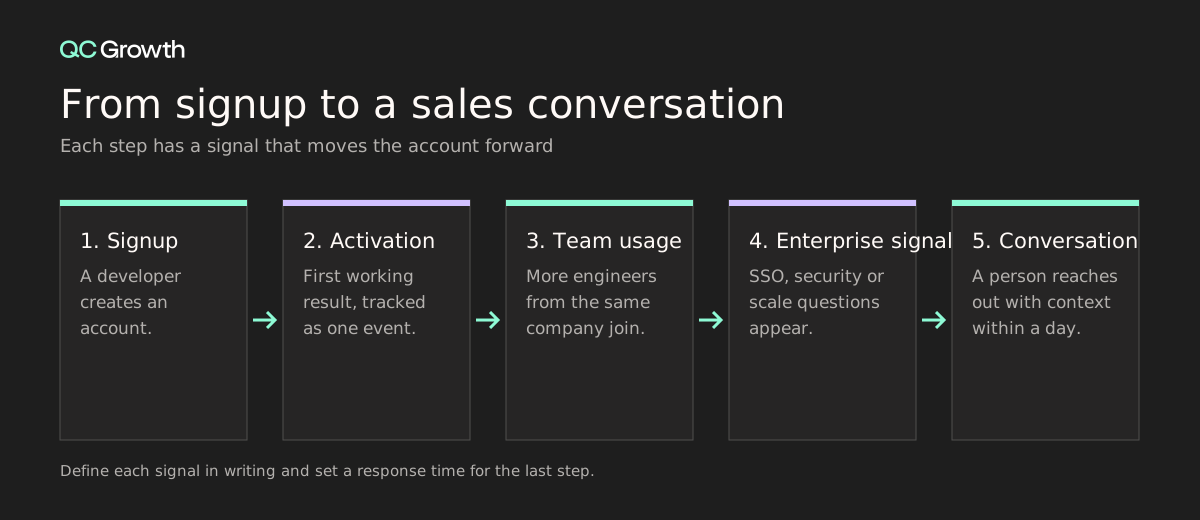
A product-qualified lead is a user or account that has reached real value in the product and shows signs of readiness to pay. Define the activation event first, then the usage and company signals that make an account worth a conversation.
Time matters. Boldstart found 54% of developer-tool conversions happen in the first three months and 85% within the first year, and a median free-to-paid conversion of 5% within six months for developer-focused companies against 10% for others.
Public pricing pages show the common pattern: a generous free tier and a low first paid tier. Vercel's Hobby plan is free and Pro is $20 a month per seat including $20 of usage credit. Supabase is free to start and Pro starts at $25 a month. Sentry's Team plan is $26 a month billed annually or $29 monthly.
Developers name prohibitive pricing as the second biggest reason to drop a tool, according to the same survey. Keep the first paid tier cheap enough that a single engineer can buy it without approval.
| Tool | Free tier | First paid tier |
|---|---|---|
| Vercel | Hobby, $0 | Pro, $20 a month per seat |
| Supabase | $0 | Pro from $25 a month |
| Sentry | Developer, free for 1 user | Team, $26 a month billed annually |
| Neon | $0, no card | Launch, pay as you go |
Combine three sources: inbound from docs and content, outreach to product-qualified accounts and outbound to companies showing technical signals. Fruitful Code, a vendor in this space, suggests tracking about ten category repositories, reviewing the last 30 days of activity and treating forks and issues about SSO, security or scale as stronger signals than stars.
Treat job posts and package downloads as supporting evidence. Score accounts on fit, intent and recency, and reach out with a reference to the specific technical action. Our guide on open source GTM covers finding the companies behind community usage.
Our developer tools practice runs this kind of signal-based outbound for Seed to Series A teams, with operators who sold at Gatsby, Netlify and Scalar.
Sources disagree on the first go-to-market hire, which tells you the answer depends on your motion. Bessemer suggests a product evangelist who carries a quota once deal sizes justify it. Heavybit usually suggests a product marketer first and notes that developer relations is hard to scale for top-of-funnel growth.
On developer relations, Decibel recommends starting early if you believe in the product, while Stackmatix says to hire when founder-led community work is clearly working and the founder is the bottleneck.
| First hire | Fits when |
|---|---|
| Full-cycle seller or evangelist | Teams ask for security reviews, contracts and rollouts |
| Product marketer | Positioning and messaging still vary deal to deal |
| Developer advocate | Community and content already work and the founder is stretched |
A motion is repeatable when someone other than the founder can run it from a document and get similar results. Use this checklist before you raise or hire more.
If three or more items are missing, keep the founder in the loop for another quarter.
| Check | Evidence |
|---|---|
| Defined activation event | Tracked weekly |
| PQL definition | Written, with a response time |
| Pricing | Published, with a cheap first paid tier |
| Pipeline sources | At least two that produce meetings every week |
| Playbook | A document someone else has used to close a deal |
Hiring a VP of Sales before sellers have ramped, layering sales on before usage spreads inside accounts, and heavy discounting to win logos. a16z warns that adding sales too early can kill organic momentum.
When the checklist holds, our guide to GTM for DevTools at Series A covers scaling pipeline without a full sales org.
Use the table as a quick reference.
It also works as a checklist for your next planning session.
| Category | Key Considerations |
|---|---|
| Motion | Pick a primary motion by buyer and deal size |
| Activation | One event, tracked weekly |
| Pipeline | Inbound, PQL outreach and signal-based outbound |
| Pricing | Cheap enough for one engineer to buy |
| Hiring | Seller, product marketer or developer advocate, by bottleneck |
| Mistakes to avoid | Early VP of Sales, sales before usage spreads, heavy discounts |
QC Growth is the embedded GTM team for Seed to Series A technical founders. A fractional pod of a top-1% GTM operator, a GTM lead, a GTM engineer and BDR support builds and runs your Allbound motion, with inbound, outbound and partner channels in one signal-driven system. The infrastructure, data and playbooks stay with you.
The operators have carried the bag in these markets: Luke Bivens at Gatsby and Netlify, Aron Schuhmann at Gatsby and OctoAI, Shane O’Connor through a 10x ARR run at Scalar, and Kori Bivens, a former VP at RVO Health who leads the healthcare division. Eraser.io CEO Shin Kim says the team “built a repeatable outbound process that helped us land our first enterprise customers.”
It is built for Seed to Series A companies past product-market fit in developer tools, AI, healthcare and deep tech, that need the founder's motion written down and run by a team.
A pod builds the PQL routing and signal-based outbound with you and runs it while you hire. Packages run $7,500 to $25,000 a month on 6 to 12 month terms with no equity, against $57,000 to $81,000 a month plus 1.25% to 2.75% equity for a senior in-house team, broken down in QC’s in-house versus fractional cost math. See what the Full Service GTM package includes.
A repeatable sales motion for a DevTools startup is a documented way of finding, converting and expanding accounts that someone other than the founder can run with similar results. It includes a defined activation event, a product-qualified lead definition, published pricing and at least two pipeline sources. Test it by having a new hire close a deal from the document.
A DevTools startup at seed should usually lead with product and add sales assistance where usage spreads inside companies. Boldstart found developer-tool new ARR split about 40% sales-led, 22% sales-assisted and 21% self-serve. Low price points suit self-serve, and team rollouts with security reviews need a person in the loop.
A good free-to-paid conversion rate for developer tools is around 5% within six months, the median Boldstart found for developer-focused companies, against 10% for others. Boldstart also found 54% of conversions happen in the first three months. Reaching out to more than half of new signups roughly doubled conversion in the same data.
DevTools startups should price at seed with a generous free tier and a first paid tier a single engineer can buy without approval. Vercel Pro is $20 a month per seat and Supabase Pro starts at $25 a month. Stack Overflow's 2025 survey lists prohibitive pricing as the second biggest reason developers drop a tool.
A product-qualified lead is a user or account that has reached real value in the product and shows signs of readiness to pay, such as team usage or interest in enterprise features. Define the activation event first, then the usage and company signals that trigger a conversation. Set a response time so the signal does not go stale.
A DevTools startup should hire its first account executive when companies using the product ask for security reviews, contracts and team rollouts that the founder cannot handle. Bessemer suggests a product evangelist who carries a quota once deal sizes justify it. Heavybit often suggests a product marketer first.
Signals that show a company is ready to buy a developer tool include repeated usage across several engineers, forks and issues about SSO, security or scale, and interest in enterprise features. Fruitful Code treats forks and enterprise-related issues as stronger signals than stars. Job posts and package downloads add supporting evidence.
It is not too early to build a light sales process at seed, as long as it supports product-led growth instead of replacing it. a16z warns that layering sales on too early can kill organic momentum. Start with product-qualified leads and one person before any sales team.
If you're at the inflection point, technology proven, market waiting, and the canyon between them, we should talk.