
Compare the best fractional CMO companies and fractional GTM teams for startups in 2027, from QC Growth to Kalungi. See pricing and fit, then book a call.
Disclosure: QC Growth publishes this comparison and appears in it at number one. Prices and features for other firms come from each firm's own site or contact form, and many figures are the firms' own claims. Verify any ranking you read, including this one.
| Company | Best For | Key Strengths | Pricing |
|---|---|---|---|
| QC Growth | Seed to Series A software founders who need a fractional GTM team (sales side, not a CMO) | Embedded operator pod, signal-driven outbound, you keep the system | $7.5k to $25k per month, 6 to 12 month terms |
| Kalungi | B2B SaaS companies from pre-PMF to $10M ARR | CMO-as-a-Service plus execution services, three engagement tiers, 280+ SaaS companies served | Not published, pay-per-performance offered on Full Service |
| NoGood | Funded startups and scale-ups that want growth marketing at volume | SEO, paid, social, PR and creative under one agency, 84% client retention | Retainers averaging above $20,000 per month |
| Chief Outsiders | Small to mid-sized companies and PE portfolios | 100+ fractional CMOs and CSOs, 2,000+ clients, 30 days' notice | Not published |
| MarketerHire | Startups that want a fast match and a trial | 24 to 48 hour matching, two-week trial, month-to-month | $5,000 to $20,000+ per month |
| GTM 8020 | Teams that want a vetted operator without an agency layer | 1,200+ operators, free 90-day GTM roadmap, flexible monthly terms | Not stated |
| Data-Mania | Data, AI and B2B SaaS startups with an existing team | Founder-led fractional CMO, strategy and KPI oversight | Not published, $1M+ marketing budget called ideal |
| CMOx | Small and mid-sized businesses on a tight budget | 5 to 25 hours per week, published rate range | $3,000 to $15,000 per month |
| Demand Revenue | Private equity portfolio companies with large revenue bases | Interim and fractional CMO, CMO coaching, GTM audit | Not published |
| Algocentric | Seed to Series B B2B SaaS startups | Focus on early-stage SaaS (site blocked our review, limited data) | Custom |

A fractional CMO company supplies a senior marketing leader on a part-time basis. That person sets positioning, picks channels, builds the budget, reports to the founders and manages the team or vendors who do the work. Some firms send one executive. Others send an executive plus a pod of specialists, and a few operate as a network that matches you with an independent operator.
A fractional GTM team covers a wider scope. Go-to-market work spans marketing, sales development, pricing, partnerships and the operations that connect them. Teams in this group range from marketing-led shops such as Kalungi to sales-side pods such as QC Growth, so the same label can describe different work.
The common thread is part-time senior capacity. Weekly hours vary by vendor: MarketerHire's own guide says most fractional CMOs work 10 to 20 hours a week, and CMOx quotes engagements of 5 to 25 hours. Ask for the hours in writing before you compare prices.
Early-stage companies hit the same wall. The founder's network funds the first customers, then the network runs dry and nobody owns demand. Hiring a full-time CMO to fix that is slow and costly. CMOx cites full-time CMO salaries of $275,000 to $375,000 per year before bonuses and benefits, and the US Bureau of Labor Statistics puts median pay for the broader group of marketing managers at $165,780 as of May 2025, which is well below executive pay.
A fractional model changes the math, and fractional CMO cost is the reason most startups look at it first. Vendors publish monthly ranges between $3,000 and $20,000 or more, and a senior leader can start in days or weeks according to Chief Outsiders and MarketerHire. Those timelines are the vendors' own claims, so test them in the first call.
The sales side has its own cost. By QC Growth's own math, an in-house senior GTM team costs $57k to $81k per month plus 1.25% to 2.75% in equity. A fractional pod at $7.5k to $25k per month covers a similar scope for a fraction of that spend.
A fractional leader does not fix a missing offer or a weak product. Hire one when the product has pull, the buyer is clear and the missing piece is ownership of the motion.
The right fractional CMO for startups depends on stage, buyer and whether you need a marketing leader or a working sales motion. These are the five profiles we see most often.
You closed early deals through your own network and now need a repeatable outbound motion. A marketing leader will not book your first enterprise meetings. A sales-side pod will, and an embedded full-service GTM team from QC Growth builds the system and runs it with you.
Revenue exists, the website is stale and nobody runs demand. This is the classic B2B SaaS fractional CMO case. Kalungi, Algocentric and Data-Mania focus on this profile, and each pairs leadership with a different level of execution.
Developers ignore generic campaigns. These teams need operators who have sold to engineers and who build targeting from real signals such as hiring, tech stack and repository activity. The dev tools GTM approach pairs operators from developer companies with signal-based account selection.
AI buyers hear from a dozen vendors a week, and healthcare buyers respond to credibility more than volume. Both need a partner who understands long cycles and careful positioning. See how enterprise AI GTM and HealthTech GTM work are handled for these buyers.
Venture and private equity firms need leadership help across several portfolio companies at once. Chief Outsiders and Demand Revenue say they work with PE portfolios. Small venture portfolios can add a fractional GTM pod where sales is the gap.
We reviewed each company's own site for services, pricing, contract terms and stats. Claims below are the companies' own unless stated otherwise. QC Growth is our company and is not a fractional CMO firm, so we rank it first only for the fractional GTM team use case and say plainly where it is the wrong choice. The nine entries after it run roughly in the order they fit an early-stage startup.
QC Growth is an embedded go-to-market team for Seed to Series A B2B software companies. The first thing to know is that its fractional pod is sales-side. The pod is a top-tier GTM operator, a GTM lead, a GTM engineer and BDR support, and it handles strategy, outbound infrastructure, messaging, campaigns and reporting.
QC Growth does not supply a fractional CMO and does not run brand, content or paid media programs. It builds an "Allbound" system, where inbound, outbound and partner channels share signals, and it runs that system with the founder. It fits as a fractional GTM team when the gap is pipeline and first enterprise deals, and it is a stretch if what you need is a marketing executive.
The pod works inside your tools and runs the motion day to day. When the engagement ends, the infrastructure, data and playbooks belong to you. Targeting uses signal stacking, which combines firmographics, LinkedIn activity, job changes, hiring, tech stack and web visits, and a living ICP and messaging context is wired into Clay prompts and scoring.
The operators have sold in the buyer's own vertical, with backgrounds at Gatsby, Netlify, Workpop, Uber, OctoAI, NVIDIA, Tyk, SmartBear and RVO Health. Grafbase CEO Fredrik Bjork said QC helped it land its first enterprise customers, and Eraser.io CEO Shin Kim said QC built a repeatable outbound process. Crescendo COO Zack Urlocker said the fractional sales team model changed everything for the company.
Packages run $7.5k to $25k per month depending on scope, on 6 to 12 month engagements. That compares with the $57k to $81k per month plus equity that QC estimates for an in-house senior GTM team.
QC Growth is the strongest fractional GTM team on this list for early-stage software companies whose gap is outbound and sales leadership. Pick it when you want the motion built and plan to own it afterward. If you need a marketing executive to set positioning and run demand programs, start with the next entries and consider a pod later.
Kalungi is a marketing firm built around B2B SaaS. Its services include CMO-as-a-Service, CMO coaching and execution work such as account-based marketing, RevOps and HubSpot work, branding, paid media, content and SEO, and web development.
It sorts clients by size. Full Service is for $5M to $10M ARR companies, Syntropy is for $1M to $5M ARR teams that run execution in-house, and T2D3 is a playbook tier for pre-PMF and seed companies with $0 to $1M ARR.
Kalungi is one of the clearest choices for SaaS-specific marketing leadership. It says it has served 280+ SaaS companies. Its Full Service tier says it replaces 10+ hires, and it offers pay-per-performance on that tier.
Case results on its site include $4M in pipeline in under six months for DataGuard and 368 trials, 20 demos and 3 enterprise customers in six months for Botdojo. These are the company's own figures, and its page gives two versions of one client's MQL growth, so verify before citing either.
No dollar amounts on the pages we reviewed. Pay-per-performance is available on Full Service, but its terms are not described on the page.
Kalungi suits SaaS founders who want a marketing leader backed by a team. Pre-seed companies will likely start with the playbook tier and move up as revenue grows.
NoGood is a growth marketing agency with offices in New York City, Miami and Dubai. Its service list includes fractional CMO and consulting, plus AEO and SEO, paid growth, organic social, performance creative, earned media and digital PR, and analytics and conversion work.
It names startups, scale-ups and Fortune 100 brands among its clients, across SaaS, B2B, healthcare, fintech, consumer and AI. The page gives no detail on the fractional CMO offer itself.
NoGood shows up in most listings of this category, and its breadth is the draw. It reports an 84% client retention rate and says most clients see improvement within 90 days, with paid channels faster and organic channels taking three to six months. Named clients include AWS, MongoDB and Oura.
Case study percentages on its page (879% for ByteDance, 75% for SteelSeries, 149% for Spring Health) come without a metric or time period, so we do not rely on them.
Monthly retainers with an average above $20,000, scoped individually with no standard packages.
NoGood fits funded companies that want a large growth agency and have the budget for it. Early-stage founders who want a single senior leader will find the model heavier than they need.
Chief Outsiders offers fractional and interim executives, including fractional CMOs, fractional chief sales officers and interim CMOs. It also offers marketing and sales consulting, AI and search services and Team Outsiders, an on-demand execution group.
It says it has 2,000+ clients, 300+ PE firms among them, and 16 years in business. Its page lists 100+ fractional CMOs and CSOs and 70+ industries.
Chief Outsiders is one of the strongest choices for breadth of executive talent. It pairs a fractional leader with execution teams, and it says engagements can be scaled up or down on 30 days' notice. It reports a 75 NPS and says its executives stay with clients longer than typical consultants, with a 2024 average tenure of 3.5 years against 2.4.
Its page says that if the fit is wrong, it will work to find a different team.
Not published. Engagement length is set by client goals, from a single workshop to years.
Chief Outsiders suits companies that want a seasoned executive with a bench behind them. Seed founders should ask how it prices small engagements before booking a call.
MarketerHire is a marketplace of on-demand marketing specialists. Roles cover strategy and leadership, customer acquisition, conversion and retention, and operations and data, and it sells fractional C-suite leadership alongside full-stack growth marketing and paid advertising.
It also offers MH-1, a marketing system that mixes AI and human work. Clients submit a brief, speak with a hiring specialist and meet the marketer before committing.
MarketerHire is one of the lowest-commitment options here. Matches typically happen within 24 to 48 hours, there is a two-week trial and billing is only after you hire. Engagements run month-to-month with 30 days' notice, and the site lists no recruiting fees or termination costs.
It says it has made 30,000+ matches for 7,000+ customers, accepts under 1% of applicants and holds a 4.8 out of 5 rating on Trustpilot. Those figures are the company's own.
Typically $5,000 to $20,000 or more per month, depending on specialization and scope, with exact quotes after a free consultation.
MarketerHire fits startups that want to test a fractional hire quickly and cheaply. Companies that need a full team behind the leader should compare Kalungi or Chief Outsiders.
GTM 8020 is a network of senior go-to-market operators that hand-matches companies with a vetted fractional expert. It lists more than 50 service areas, including SEO and GEO, performance marketing, product marketing, RevOps, demand generation, ABM and web development.
It links to a hire-a-fractional-CMO page and says it holds more than 1,200 vetted operators. The site does not name an ideal customer by size, industry or stage.
GTM 8020 is one of the more flexible entry points. A free 30-minute strategy call leaves you with a custom 90-day GTM roadmap whether or not you hire, and a match typically follows in under 48 hours. The engagement is monthly and runs with the operator directly, without account managers or agency layers.
Not stated on the page we reviewed.
GTM 8020 suits founders who want a vetted operator and a written plan before spending much. Ask for the operator's references at your stage, since the network is broad.
Data-Mania is a fractional CMO practice run by Lillian Pierson, a licensed Professional Engineer and former Microsoft Regional Director. It serves data, AI and B2B SaaS companies. Its fractional CMO covers marketing strategy, execution oversight, KPI reporting, team building, hiring and agency management.
It also sells marketing consulting, a 60-minute Power Hour for founders and a VIP Strategy Intensive. It offers a free GTM Hiring Decision Tree on its site.
Data-Mania is one of the few firms led by a named founder with a technical background, which helps with data and AI buyers. The fractional model focuses on teaching teams to handle execution, so the leader's work stays in strategy and oversight.
Its case studies cite $750K of first-year revenue and 1,100+ organic MQLs with no paid spend. These are the firm's own claims. The page says it is a poor fit for consumer apps and for teams wanting tactics without fixing fundamentals.
Not published. Invoicing is monthly with payment due in advance, and the firm says pricing is tailored to each client.
Data-Mania suits data and AI companies that already have people to execute and need a strategic leader. Founders without a team will need to budget for hands as well as direction.
CMOx is a fractional CMO agency and a training program for marketers who want to start fractional practices. For business owners, it provides part-time CMO leadership covering strategy, team guidance and campaign oversight.
It lists industry focus areas that include SaaS, healthcare, professional services, private equity, franchises and startups. Founder Casey Stanton wrote a book titled The Fractional CMO Method.
CMOx is one of the few firms that states its rates on the page. It quotes $3,000 to $15,000 per month depending on hours, industry and scope, and engagements of 5 to 25 hours per week. It compares that range with full-time CMO salaries of $275,000 to $375,000 per year, which is its own figure.
It serves clients across 22 North American cities and shows 5.0-star Clutch reviews that we could not verify independently.
$3,000 to $15,000 per month depending on hours, industry and scope, per the company.
CMOx fits cost-conscious companies that want a part-time marketing leader with clear pricing. Ask which person would lead your account and what their background is.
Demand Revenue is the practice of Alan Gonsenhauser, a repeat CMO who offers CMO coaching, interim CMO, fractional CMO, GTM advisory and a self-serve GTM audit. Fractional engagements run 6 to 18 months, and interim roles run up to four days a week for 6 to 9 months.
His clients are mainly mid-market and larger HealthTech, SaaS and enterprise software companies, and PE portfolio companies. The page says he focuses mainly on portfolio companies with $200M or more in ARR.
Demand Revenue is one of the stronger options at the large end. It names portfolio clients such as Precisely, FinThrive and Paysafe and PE clients such as Clearlake Capital, KKR and Blackstone. The page says Gonsenhauser has mentored 160 marketing leaders.
Not published. Prospects are directed to book a strategy call or a 15-minute intro call.
Demand Revenue fits larger software companies and PE portfolios. Seed and Series A founders should look elsewhere on this list.
Algocentric is a fractional CMO and B2B SaaS marketing firm. Its own site blocked our automated review, so details come from third-party listings and may be out of date.
A MarketerHire guide lists it as focused on early-stage B2B SaaS companies and as best for Seed to Series B startups that need structured GTM and pipeline ownership. That listing shows pricing as custom, and a TechBullion article describes funnel and account-based campaign work alongside fractional CMO services.
Algocentric stands out for its stated focus on early-stage SaaS, which matches the buyer in this article better than most large firms. Our data on it is thin, so confirm services, pricing and terms with the company and ask for references.
Custom according to a third-party listing. We could not confirm published prices.
Algocentric is worth a call for early-stage SaaS founders who want leadership with an execution team. Verify current terms directly before shortlisting.
Use these five checks to narrow the list. Each one maps to a question you can put in a vendor call.
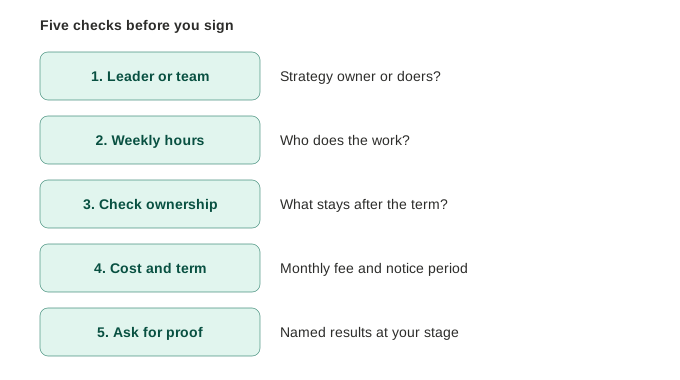
A fractional CMO sets direction and manages the people who do the work. If you have no one to manage, you are paying for strategy with nobody to execute it. Kalungi and Chief Outsiders pair leaders with execution teams, while Data-Mania expects you to bring your own.
A fractional GTM team such as QC Growth covers sales development and runs the work itself. Pick the type that matches the gap you can name today.
Hours differ widely. CMOx quotes 5 to 25 hours a week and a MarketerHire guide says most fractional CMOs work 10 to 20. Ask which named person leads your account, how many clients they carry and how they stay in touch between meetings.
Ask also who writes the copy, runs the campaigns and builds the reports. A leader with no hands behind them rarely moves pipeline.
Some vendors keep the data, sequences and dashboards. Others, like QC Growth, hand them over at the end. Ask what you keep if you stop paying and whether you can export contacts, sequences and reporting.
This decides whether the next hire starts with a ramp or from zero.
Monthly fees run from $3,000 at CMOx to above $20,000 at NoGood. Add setup fees, media spend, minimum terms and notice periods. MarketerHire and Chief Outsiders list 30 days' notice, while QC Growth engagements run 6 to 12 months.
Compare the total against a full-time hire. CMOx cites $275,000 to $375,000 per year for a CMO, and QC Growth cites $57k to $81k per month plus equity for a senior GTM team.
Request named case studies from companies at your size and in your category. Ask for one reference call and ask whether growth got easier or harder after the engagement ended. A firm built for $200M portfolio companies runs a different playbook from one that has taken seed teams to their first enterprise customers.
| Category | Key Considerations |
|---|---|
| Top 3 for early-stage software | Kalungi for marketing leadership, QC Growth for a fractional GTM team, MarketerHire for a fast and flexible match |
| Who Is It For | Founders with early traction who need senior ownership of marketing or outbound and cannot hire full time |
| Use Cases | First marketing leader, first enterprise deals, repositioning before a raise, replacing an agency, interim cover during a CMO search |
| How to Choose | Leader or team, weekly hours, data ownership, total cost and notice period, proof at your stage |
| Mistakes to Avoid | Hiring a leader with no team to manage, skipping reference calls, signing a long term before a trial, treating a marketing CMO and a sales GTM pod as the same thing |
| Pricing Starts | Around $3,000 per month at CMOx, $5,000 at MarketerHire, with QC Growth packages at $7.5k to $25k per month |
QC Growth is the fractional GTM team for Seed to Series A technical founders, and you keep the infrastructure, data and playbooks when we finish. The pod includes a GTM operator, a GTM lead, a GTM engineer and BDR support, at $7.5k to $25k per month compared with $57k to $81k per month plus equity for an in-house team. We run sales-side go-to-market, so if you need a marketing executive, our roundup above points to better fits.
Read how it worked for Burn Media Co., where revenue went from $142k in April to $181k in August, up 27.5%. You can also see the client quotes from Grafbase, Eraser.io and Crescendo on our case studies page. Founders who want to talk through fit can book a strategy call with Luke Bivens' team.
The best fractional CMO companies in 2027 for B2B SaaS startups are Kalungi, Chief Outsiders and MarketerHire, depending on whether you want an execution team, an executive bench or a fast match. Kalungi serves 280+ SaaS companies by its own count. Chief Outsiders lists 100+ fractional CMOs and CSOs. MarketerHire matches clients in 24 to 48 hours on month-to-month terms.
Consider whether you need a leader or a team, how many hours per week you get, who owns the data afterward, total cost and proof at your stage. CMOx quotes 5 to 25 hours per week and a MarketerHire guide says most fractional CMOs work 10 to 20. Ask for one reference call from a company at your size. Compare monthly fees, which run from $3,000 at CMOx to above $20,000 at NoGood.
QC Growth differs from a fractional CMO company because its pod is sales-side and runs outbound, while a fractional CMO leads marketing. The pod is a GTM operator, a GTM lead, a GTM engineer and BDR support, and the infrastructure, data and playbooks stay with you. QC uses signal stacking across firmographics, LinkedIn activity, job changes, hiring, tech stack and web visits. It does not guarantee meeting counts or run brand and content programs.
Getting started with QC Growth begins with a strategy call booked through qcgrowth.com/contact-us. The team reviews your stage, buyer and current pipeline, then recommends either GTM Systems and Ops, which covers CRM, signal tracking and reporting, or Full Service GTM, which adds outbound and an embedded pod. Engagements run 6 to 12 months at $7.5k to $25k per month.
Switching to QC Growth from a fractional CMO is straightforward because the pod works inside your existing CRM and tools instead of replacing them. A marketing leader and a sales-side pod cover different work, so many founders run both at once. You do not need to rebuild your stack first. Because the infrastructure and data are yours, you can also leave without losing the work.
A fractional CMO is worth it for a seed-stage startup when the product has early pull and nobody owns marketing, since full-time CMO salaries run $275,000 to $375,000 per year by CMOx's figure. It is a poor match when there is no one to execute, because a leader alone does not produce campaigns. Monthly fees in this category start near $3,000 at CMOx and $5,000 at MarketerHire. If the gap is outbound pipeline rather than marketing, a sales-side pod at $7.5k to $25k per month is the closer fit.
The difference between a fractional CMO and a full-time CMO is time and cost, since a fractional CMO works part-time for several clients while a full-time CMO works for one company. Fractional leaders typically give 5 to 25 hours per week according to CMOx and a MarketerHire guide. Full-time CMO salaries run $275,000 to $375,000 per year by CMOx's own estimate. Fractional monthly fees in this article range from $3,000 to above $20,000.