
10.31.26 · 7 min read
DevTools GTM at pre-seed: how founders find first users, run design partners, cut time to first value and track the right metrics. Use the 12-week plan.
DevTools GTM at pre-seed is founder-led: the founders talk to developers, ship where users already are and turn early adopters into design partners. This playbook covers the first user, where developers find tools, outreach that gets replies, design partners, time to first value and a 12-week plan.
Disclosure: QC Growth works with developer-tool companies from Seed to Series A, so we have a view. Several investor sources cited here date from 2020 to 2023 and are labeled with their years, and funding figures come from Carta. Sources were checked on 30 October 2026.
The table gives the short version. The sections below explain each row and show where the claims come from.
| Topic | Short answer |
|---|---|
| Who sells | The founders |
| First focus | One persona and their weekly problem |
| Main channel | Docs, communities and founder outreach |
| Design partners | Five to ten teams, ideally paying |
| Key metric | Time to first value and retention |
| What to skip | SDRs, paid ads, vanity launches |
| Exit signal | Partners pay and teams keep using the tool |
Most published figures on this topic come from vendors and agencies, so we label them as such.
At pre-seed the founders are the go-to-market team. There is no seller, no marketer and often no pricing page. Bessemer describes this phase as founders selling themselves, in a way that looks a lot like developer relations, and advises against spending on sales and marketing before product-market fit.
The goal at this stage is proof: a specific developer persona that adopts the tool, keeps using it and brings it into a team.
Write down one persona, the moment they hit the problem and what they use today. "Backend engineers at Series A fintechs who run Postgres migrations by hand" is a usable first user. "Developers" is not.
Narrow beats broad because developer adoption spreads inside teams. One engineer who loves the tool shows it to five colleagues.
Documentation is where developers learn. In Stack Overflow's 2025 Developer Survey, 67.8% of respondents said they learned with technical documentation in the past year, ahead of other online resources at 58.7%, Stack Overflow at 51.4% and videos at 50%. The communities they use most are Stack Overflow (84.2%), GitHub (66.9%), YouTube (60.5%) and Reddit (53.7%).
Developers also say what wins them. The top reasons to become a fan of a tool were an easy-to-use API, a complete API and a reputation for quality, while security or privacy concerns and prohibitive pricing topped the reasons to drop one. At pre-seed, that means docs, a quickstart and a clear free path come before any marketing.
Buyers in general prefer less selling. Gartner found in 2025 that 61% of B2B buyers prefer a buying experience without a sales rep, a figure for all B2B buyers rather than developers. Outreach still works when it helps: Boldstart's analysis of OpenView and Pendo data found that reaching out to more than half of new signups roughly doubled conversion compared with no outreach.
Write like an engineer. Reference something specific the person did, such as an issue they opened or a repo that uses a related tool, offer help with that, and keep the message short. Founders get replies that sales reps do not.
Add motions developers do not resent: a technical advisory board of target users, webinars that teach something useful, and micro-targeted campaigns to a few dozen accounts. Our post on why micro-targeted campaigns work for early dev-tool startups covers the last one.
Pick five to ten teams who feel the problem weekly. Agree what success looks like, a feedback rhythm and permission to use their story if it works.
Ask for a small payment or a written commitment to evaluate a paid plan. Free partners give feedback; paying partners give evidence.
Measure the minutes from signup to the first working result. A quickstart that runs in one command, sample code in the languages your users write, and docs that answer the first three errors cut that time more than any campaign.
Developers who hit a wall rarely file a ticket. They leave, so watch where activation stalls and fix the step.
Track activation, retention and expansion inside teams. Boldstart's data puts median 7-day retention for developer tools at 30% and 28-day retention at 23%, which gives a rough baseline. Rak Garg warns that GitHub stars alone do not show product-market fit.
Keep the list short: activated users, weekly active teams, retention by cohort and the number of design partners ready to pay.
| Metric | What it tells you |
|---|---|
| Time to first value | Whether onboarding works |
| 7-day and 28-day retention | Whether the tool sticks (developer-tool medians about 30% and 23%) |
| Weekly active teams | Whether usage spreads beyond one person |
| Design partners ready to pay | Whether there is a business |
Skip SDRs, paid ads and a big pricing-page project. Bessemer advises against sales and marketing spend before product-market fit, and every hour on those is an hour away from users.
Also skip the vanity launch. A launch that brings 5,000 visitors and no activated teams teaches less than ten calls with real users.
Use the plan as a rhythm and adjust it. Each block ends with a decision.
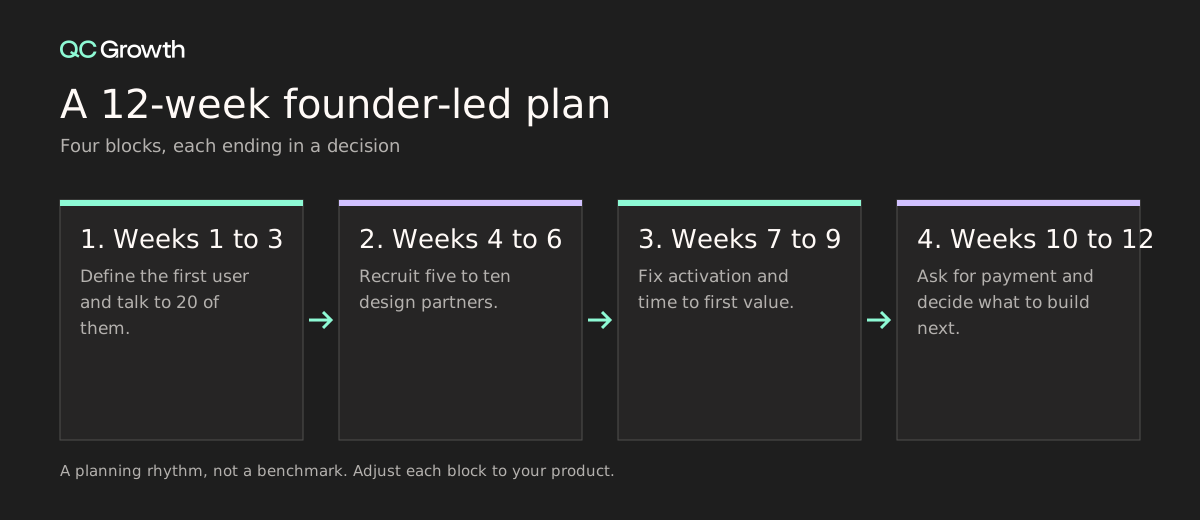
When design partners pay and teams keep using the tool, move to the next stage. Our guide to GTM for DevTools at Seed covers building the first repeatable motion.
Use the table as a quick reference.
It also works as a checklist for your next planning session.
| Category | Key Considerations |
|---|---|
| Persona | One developer, one trigger, one current workaround |
| Channels | Docs, GitHub, Stack Overflow, Reddit, founder outreach |
| Design partners | Five to ten, with success criteria |
| Metrics | Time to first value, 7-day and 28-day retention, active teams |
| Mistakes to avoid | Broad targeting, early sales hires, launches with no activation |
| Next stage | A repeatable motion at seed |
QC Growth is the embedded GTM team for Seed to Series A technical founders. A fractional pod of a top-1% GTM operator, a GTM lead, a GTM engineer and BDR support builds and runs your Allbound motion, with inbound, outbound and partner channels in one signal-driven system. The infrastructure, data and playbooks stay with you.
The operators have carried the bag in these markets: Luke Bivens at Gatsby and Netlify, Aron Schuhmann at Gatsby and OctoAI, Shane O’Connor through a 10x ARR run at Scalar, and Kori Bivens, a former VP at RVO Health who leads the healthcare division. Grafbase CEO Fredrik Björk says QC Growth “helped us land our first enterprise customers and find product-market fit.”
It is built for Seed to Series A companies past product-market fit in developer tools, AI, healthcare and deep tech, whose founders are still the main sellers.
A pod works your target accounts beside you from the first weeks, while you keep the user conversations. Packages run $7,500 to $25,000 a month on 6 to 12 month terms with no equity, against $57,000 to $81,000 a month plus 1.25% to 2.75% equity for a senior in-house team, broken down in QC’s in-house versus fractional cost math. See what the Full Service GTM package includes.
DevTools startups get their first users through founder-led outreach, developer communities and documentation that works on the first try. Stack Overflow's 2025 survey found 67.8% of developers learned with technical documentation, and GitHub and Reddit are among their most-used communities. Founders who reference a specific technical action in outreach get more replies.
A pre-seed DevTools startup should not hire sales yet. Bessemer describes this phase as founders selling themselves and advises against sales and marketing spend before product-market fit. Hire after design partners pay and usage repeats.
The metrics that matter for a pre-seed DevTools startup are time to first value, 7-day and 28-day retention, weekly active teams and design partners ready to pay. Boldstart's data puts median developer-tool retention at about 30% at 7 days and 23% at 28 days. GitHub stars alone do not show product-market fit.
A DevTools startup should have about five to ten design partners at pre-seed, each with a weekly problem and a clear success measure. Ask for a small payment or a written commitment to evaluate a paid plan. Paying partners give evidence that investors and later customers trust.
Developers find new tools mainly through documentation, online resources, Stack Overflow, videos and developer communities. In Stack Overflow's 2025 survey, 67.8% learned with technical documentation, 58.7% with other online resources and 51.4% with Stack Overflow. GitHub, YouTube and Reddit are among the communities they use most.
Developers respond to cold outreach when it is specific and helpful, though many buyers prefer less selling. Gartner found 61% of B2B buyers prefer a rep-free buying experience. Boldstart found that reaching out to more than half of new signups roughly doubled conversion.
A DevTools founder should hire the first DevRel when founder-led community work is clearly working and the founder has become the bottleneck, according to Stackmatix. Others, including Cassidy Williams writing for Worklife, argue it is never too early for products developers use directly. Heavybit often suggests a product marketer first.
Founder-led sales is not a waste of founder time at pre-seed, because the founder learns what users need faster than any hire could. Bessemer notes that founder-led selling at this stage looks a lot like developer relations. The time pays back as the playbook a first hire will run.
If you're at the inflection point, technology proven, market waiting, and the canyon between them, we should talk.