
10.31.26 · 15 min read
Learn when to move from founder-led sales to a first sales hire, plus ramp time, comp ranges and what to do if the hire fails. Use our checklist.
Founder-led sales means the founders sell the product themselves, and most startups reach a point where that stops scaling. This guide covers when to hand sales to a first hire, who to hire, how long ramp takes, what to pay and what to do if the hire fails.
Disclosure: QC Growth sells GTM services, including embedded outbound that runs next to founders, so we have a view. Most benchmarks cited here come from vendors, recruiters and bloggers, and several are secondhand. We label them and show where sources disagree. Sources were checked on 30 October 2026.
The table gives the short version. The sections below show the evidence and where sources disagree.
| Topic | Short answer |
|---|---|
| When to hire | When a rough, repeatable playbook exists: a clear ICP, a pattern in pricing and close process, and enough lead flow to keep a seller busy |
| Who to hire | A full-cycle account executive who can learn a motion the founder is still shaping, not a sales leader |
| How many | Two sellers if you can afford it, so you can tell a weak hire from a weak market |
| Ramp | Plan for 3 to 8 months depending on deal size, with a reduced quota at the start |
| Pay | Early-stage SaaS OTE is often cited from $120,000 to $180,000, split 50/50 or 60/40, with quota at 3 to 4 times OTE |
| Founder role after the hire | Stay on strategic deals, pricing and the feedback loop, and hand off lists, first calls and follow-up |
| If it fails | Diagnose the hire, the market and the playbook before you decide, and set exit criteria in advance |
Most published benchmarks come from vendors, recruiters and bloggers, so treat the numbers as ranges to test against your own ACV and sales cycle.
Founder-led sales is the stage where the founders run the whole sales process: finding prospects, running calls, handling objections and closing. It works early because founders know the product, can change it on the spot and can hear why a buyer says no.
It stops working when deals are lost to lack of time. Ben Cassel, who writes about early-stage sales, says to keep selling yourself as long as possible, ideally until you lose deals because you cannot get to them (Ben Can Sell). That is the point where a first hire starts to pay back.
Sources agree on the logic and disagree on the numbers. Pillar VC says most companies hire a first account executive once they have version one of a sales process, and that the goal is to test and improve it, not to make the hire figure it out. QuotaPath lists three conditions: a basic playbook, some pattern in ICP, pricing and close process, and enough lead flow to keep a seller busy (Pillar VC, QuotaPath).
On counts, SaaStr's column on the first account executive points to roughly 10 to 20 customers closed by the founder, according to a summary of its guidance (SaaStr). Other sources give no fixed number. Use the count as a sanity check and the playbook as the real test.
A rule we use: hire when you can explain to a stranger, in one page, who buys, why they buy, what it costs and how the deal closes. If that page does not exist, write it before you post the job.
| Readiness check | What to look for |
|---|---|
| A rough playbook | ICP, pitch, pricing logic and close steps written down, even in a short document |
| A pattern in wins | Deals that close share a buyer type, trigger and price range |
| Enough lead flow | Warm inbound or outbound capacity to keep a full-time seller busy |
| Deal size that supports the cost | SaaStr suggests an ACV of at least $5,000 to $10,000 to justify an account executive |
| Founder time under pressure | Deals are slipping because the founder cannot follow up fast enough |
The first hire sets the pattern for everything after it. Three choices matter: which role, how many and what profile.
Most sources point to an individual seller who can run a deal start to finish. QuotaPath recommends a full-cycle account executive over a split of SDR and handoff, because the person has to learn a motion the founder has only partly worked out.
Point Nine says founders who want a VP of Sales or CRO as soon as they see product fit should wait until their account executives have ramped, and notes that strong sales leaders want proof they can scale a team (Point Nine). Cassel adds that a leader needs performance data from full-time sellers to make good decisions. An exception exists for low deal sizes: QuotaPath notes that at an $8,000 ACV a $500,000 quota needs more than 60 deals, which points toward an SDR.
Cassel recommends at least two first sellers, because with one you cannot tell whether a weak result comes from the person or the market. Two let you compare approaches side by side.
Pillar VC offers a variant: hire one person with industry expertise and no sales background and one with sales experience and no industry background, then compare results after three to six months.
Pillar VC advises against over-weighting sales experience and for a high figure-it-out factor, plus the ability to listen and tie the product to buyer problems. It also warns against hiring for a Rolodex and suggests using advisors for network access.
Vet sales skill first and culture fit second, as Cassel suggests. Ask candidates to run a mock discovery call on your product, and have them walk through a deal they lost.
Ramp figures vary by deal size and by source. QuotaPath, a commission-software vendor, suggests three months at reduced quota and full quota from month four, and cites no independent source for the figure. GigRadar, citing Predictable Revenue, says a full-time account executive takes around eight months to reach full productivity. SaaStr gives a rule of thumb of three to six months for an ACV of $20,000 to $80,000.
Summaries of the Bridge Group's SaaS account executive report put the average ramp near 5.7 months in the 2024 edition, though other summaries give 4.7 and 5.0 months, so check the report itself before you quote it.
| Source | Reported ramp | Note |
|---|---|---|
| QuotaPath (vendor) | 3 months at reduced quota, full quota from month 4 | No independent source cited |
| GigRadar, citing Predictable Revenue | About 8 months to full productivity | Secondhand figure, agency context |
| SaaStr | 3 to 6 months for ACV of $20,000 to $80,000 | Rule of thumb from a Q&A column |
| Bridge Group SaaS AE report, via summaries | About 5.7 months (2024), summaries differ | Primary report not checked |
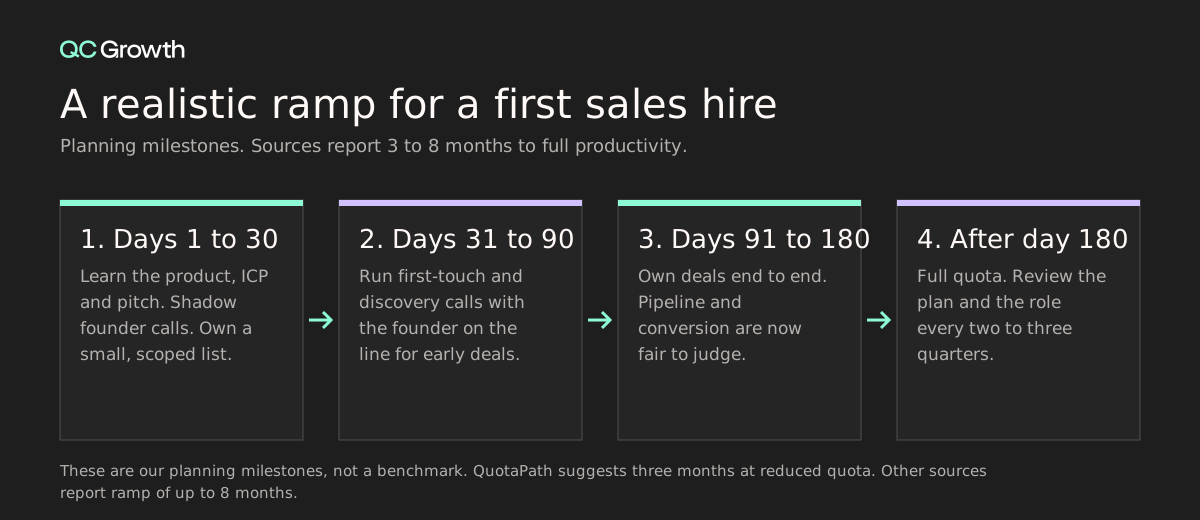
Budget for the longer end. A short ramp assumption leads to early judgment, and early judgment leads to churn. Judge activity in the first 30 to 60 days and results from day 90 onward.
Pay structure is where first hires go wrong. QuotaPath, using data from its own AI tool, reports early-stage SaaS on-target earnings of $120,000 to $180,000, a split of 50/50 or 60/40 between base and variable, and a quota of 3.0 to 4.0 times OTE. Pillar VC uses a similar rule: multiply OTE by 3 to 4 to estimate the revenue a seller should produce, with a 50/50 split as the usual case. GigRadar reports lower figures for small agencies, with account executives near $90,000 to $110,000 OTE, which shows how much context matters.
The commission rate follows from the plan. QuotaPath's example: $75,000 of variable pay divided by a $500,000 quota gives a 15% rate. It recommends quarterly quotas for cycles of 30 to 90 days, accelerators of 1.25 to 1.5 times above 100% of quota, and payment on new closed-won ARR.
| Element | Reported range | Source |
|---|---|---|
| OTE, early-stage SaaS | $120,000 to $180,000 | QuotaPath (vendor data) |
| Base to variable split | 50/50 or 60/40; Pillar VC also mentions 70/30 | QuotaPath, Pillar VC |
| Quota as a multiple of OTE | 3.0 to 4.0 times | QuotaPath, Pillar VC |
| Accelerator above 100% of quota | 1.25 to 1.5 times | QuotaPath |
| Quota period | Quarterly for 30 to 90 day cycles | QuotaPath |
| Ramp protection | Reduced quota for the first 3 months, or a short guarantee | QuotaPath |
Keep the plan simple. QuotaPath recommends one or two modifiers at most, and warns that long guarantees separate pay from results. It also flags founder-assisted deals as the main source of crediting disputes, so write the crediting rule before the first deal closes.
Check any benchmark against your own numbers. At a $150,000 OTE with a 50/50 split, base pay is $75,000 a year. If quota is 3.5 times OTE, the seller needs to close about $525,000 of new ARR a year. Divide that by your ACV to see how many deals that implies, and ask whether your pipeline can support it.
A handover is a project with a plan, not a job post. These four steps cover most of the work.
Document the ICP, the pitch, discovery questions, objections and answers, pricing rules, deal stages and the signs of a bad fit. A few pages is enough. The first hire will improve it.
Pillar VC suggests building a library of top sales calls in a tool such as Gong or Salesloft so new hires can listen to real conversations.
Pillar VC advises founders to stay on as many pitches as possible early on. Start with the new hire listening, move to the hire leading with the founder on the line, then let the hire run calls alone while you review recordings.
Agree on feedback after every call for the first few weeks.
Write down which accounts belong to the founder, which belong to the seller, and how founder-assisted deals are credited. QuotaPath names unclear ownership as the main cause of first-year pay disputes.
Put the rule in the plan document and in the CRM.
Hold a weekly pipeline review and a monthly look at conversion and activity. Review the pay plan every two to three quarters, as QuotaPath suggests, and avoid monthly changes that leave too little data to learn from.
Keep a written log of what you changed and why.
Founders often leave sales too soon. SaaStr's guidance, as summarized in search results, names exiting sales after the first hire as the biggest mistake, and Pillar VC advises staying on as many pitches as possible. The founder remains the best source of buyer insight.
Hand off the tasks that follow the playbook, and keep the ones that need judgment about price, product and strategy.
| Founder keeps | Hand off to the hire |
|---|---|
| Strategic and large accounts | List building and first-touch outreach |
| Pricing and packaging decisions | Discovery calls and demos on standard deals |
| Product feedback from buyers | Follow-up and CRM updates |
| Executive relationships | Proposal drafting from the playbook |
| Reviewing lost deals | Routine renewals and small expansions |
Failure is common enough to plan for. Cassel cites a 40% mis-hire rate for sales hires and a $500,000 revenue loss per mis-hire, attributing both to a blog post by Chris Orlob. Those are secondhand estimates from a vendor blog, so read them as a warning and not as data.
Pillar VC does not describe a failure plan, and GigRadar's guide gives no worked example. The sections below fill that gap with our own approach.
Watch for low activity after the first 30 to 60 days, calls that stay weak after coaching, a pipeline that stays empty and a seller who avoids joint calls. Compare the numbers with the plan you wrote at the start.
One signal alone proves little. Two or three together deserve a conversation.
The direct cost is base pay during ramp, recruiting costs and tools. At a $150,000 OTE with a 50/50 split, base pay alone is about $37,500 over six months, before benefits or fees. The larger cost is founder time spent coaching and the deals that stalled.
Add up those three items, base pay, recruiting and founder hours, to judge how long you can afford to wait.
A weak result can come from the person, the market or the setup. Check the second and third causes first. If the founder struggles on the same accounts, the problem is probably the ICP or the offer. If the seller has few qualified conversations to work, the problem is lead flow or a missing playbook.

Write the criteria into the offer: activity targets at 30 and 60 days, qualified pipeline at 90 days, and closed deals by a stated month. Pillar VC suggests judging a two-profile test after three to six months.
If the hire misses the criteria and the diagnosis points to the person, act quickly and kindly. A slow exit costs both sides.
Keep deal notes in the CRM so the founder or the next hire can pick up each account. Review every open deal in the first week after the exit and reassign the ones with momentum.
Use what you learned to update the playbook and the profile before the next search.
A full-time seller is not the only route. A fractional sales leader or an embedded GTM team can run the system while you decide whether the playbook is ready. Our roundup of fractional GTM teams compares the options.
Each route fits a different problem. Choose a fractional leader to set up process, an embedded team to run outbound next to the founder, and a full-time seller once the playbook works without you.
The founder-led sales ceiling is a system problem as much as a hiring problem. A lone SDR without infrastructure tends to fail, and by QC Growth’s estimate a senior sales leader costs $250,000 to $350,000 in on-target earnings plus equity and takes quarters to show results. QC’s founder-led sales coaching works on the founder’s live deals while the team builds the engine around them.
Use the table as a checklist before you post the job.
It also works as a one-page brief for an advisor or an investor.
| Category | Key Considerations |
|---|---|
| When to hire | A written playbook, a pattern in wins, enough lead flow and an ACV that supports the cost |
| Who to hire | A full-cycle account executive, ideally two sellers, not a sales leader first |
| Ramp | Plan for 3 to 8 months and judge results from day 90 |
| Pay | OTE often cited at $120,000 to $180,000, split 50/50 or 60/40, quota at 3 to 4 times OTE |
| Founder role | Stay on strategic deals, pricing and buyer feedback |
| If it fails | Diagnose the hire, the market and the playbook, and write exit criteria first |
QC Growth is the embedded GTM team for Seed to Series A technical founders. A fractional pod of a top-1% GTM operator, a GTM lead, a GTM engineer and BDR support builds and runs your Allbound motion, with inbound, outbound and partner channels in one signal-driven system. The infrastructure, data and playbooks stay with you.
The operators have carried the bag in these markets: Luke Bivens at Gatsby and Netlify, Aron Schuhmann at Gatsby and OctoAI, Shane O’Connor through a 10x ARR run at Scalar, and Kori Bivens, a former VP at RVO Health who leads the healthcare division. Grafbase CEO Fredrik Björk says QC Growth “helped us land our first enterprise customers and find product-market fit.”
It is built for Seed to Series A companies past product-market fit in developer tools, AI, healthcare and deep tech, whose founders are still the main sellers.
A pod sells next to the founder from the first weeks, so you test the playbook before you commit to a full-time hire. Packages run $7,500 to $25,000 a month on 6 to 12 month terms with no equity, against $57,000 to $81,000 a month plus 1.25% to 2.75% equity for a senior in-house team, broken down in QC’s in-house versus fractional cost math. See what the Full Service GTM package includes.
A founder should stop doing all the sales when a rough playbook exists and deals are slipping for lack of time. Pillar VC says to hire a first account executive once version one of a sales process is in place, and a SaaStr summary points to about 10 to 20 customers closed by the founder. Even then, keep selling on strategic deals and stay close to buyer feedback.
Your first sales hire should usually be a full-cycle account executive, as QuotaPath recommends, because the person has to learn a motion you are still shaping. An SDR fits better at low deal sizes: at an $8,000 ACV, a $500,000 quota needs more than 60 deals. Avoid a VP or CRO first, since Point Nine advises waiting until account executives have ramped.
A first salesperson at an early-stage SaaS company is often offered $120,000 to $180,000 on-target earnings, according to QuotaPath. The common split is 50/50 or 60/40 between base and variable, with quota at 3 to 4 times OTE. Smaller agencies report lower figures, so test any range against your market and ACV.
If your first sales hire fails, diagnose the hire, the market and the playbook before you decide. Check whether the founder also struggles on the same accounts and whether the seller has enough qualified pipeline. Write exit criteria for the 30, 60 and 90 day marks in advance, and keep deal notes in the CRM so you can reassign open deals.
A new sales rep takes about 3 to 8 months to reach full productivity, depending on deal size and the source. QuotaPath suggests three months at reduced quota, SaaStr suggests three to six months for ACV of $20,000 to $80,000, and GigRadar cites about eight months. Summaries of the Bridge Group report give around 5.7 months for SaaS account executives.
You should hire two salespeople if you can afford it. Ben Cassel recommends at least two sellers because with one you cannot tell whether weak results come from the person or the market. Pillar VC suggests hiring one with industry expertise and one with sales experience and comparing them after three to six months.
A founder should keep selling strategic deals, setting prices and collecting buyer feedback after hiring a salesperson. Pillar VC advises founders to stay on as many pitches as possible early on, and a summary of SaaStr's guidance calls exiting sales after the first hire the biggest mistake. Hand off list building, first calls, follow-up and CRM updates.
A founder can keep selling until deals slip for lack of time, which is what Ben Cassel recommends. The cost is founder hours taken from product, hiring and fundraising, and a ceiling on how many deals one person can run. An embedded team that sells next to the founder is a middle route while the playbook is still being tested.
If you're at the inflection point, technology proven, market waiting, and the canyon between them, we should talk.