
Compare the 10 best AI SDR tools for 2027 with published pricing, from Apollo and Clay to Smartlead, plus when to hire a team. Book a strategy call.
Disclosure: QC Growth publishes this comparison. QC Growth is a GTM agency, not an AI SDR tool, so it is not ranked here and appears once as a managed alternative. Prices and features come from each vendor's own site, and many figures are the vendors' own claims. Verify any ranking you read, including this one.
The ten tools below are software you buy and operate. Apollo is entry 1 on price, scope and fit for Seed to Series A B2B teams, and the other nine follow in order of fit for that stage. A managed alternative, which is an agency and not software, is covered in its own section after the reviews and is not ranked.
| Tool | Best For | Key Strengths | Pricing |
|---|---|---|---|
| Apollo | Budget-conscious teams that want data and sequencing together | Large contact database, sequences, AI research, free tier | Free; Basic $49, Professional $79, Organization $119 per user per month billed annually |
| Clay | Teams that want to build custom prospecting workflows | Data enrichment, signals and AI research in one table-based product | Free; Launch from $167 per month; Growth from $446 per month; Enterprise custom |
| Salesforge | Teams that want a low-cost sender or an AI SDR agent | Agent Frank AI SDR, unlimited senders, MCP access | Pro $40 and Growth $80 per month; Agent Frank $499 per month |
| Amplemarket | Sales teams that want AI agents with human approval | Intent signals, multichannel sequences, Duo Copilot, MCP access | Startup $600 per month on an annual term; Growth and Elite custom |
| Instantly | High-volume email senders | Email sending, lead database, AI Sales Agent and Reply Agent | Bundles from $94 per month ($85 billed yearly); managed VIP custom |
| Smartlead | Teams that want cold email with deliverability infrastructure | Unlimited email accounts, SmartAgents, lead sourcing, master inbox, MCP | Base $39, Pro $94, Unlimited Smart $174, Unlimited Prime $379 per month; annual billing saves 17% |
| lemlist | Teams that want multichannel outreach with an AI agent | lemAgent, LinkedIn and email, built-in dialer | Email $69 and Multichannel $109 per month ($55 and $87 billed yearly) |
| 11x | Teams that want autonomous outbound and inbound agents | Alice for outbound, Julian for inbound voice and chat | Not published, demo required |
| Artisan | Teams that want a single AI BDR agent | Ava combines data, enrichment, sequencing and a dialer | Credit-based tiers, figures not retrievable on our review |
| Outreach | Larger sales teams that already run a sales engagement stack | AI research agents, large enterprise customer base | Not published |
The prices above come from each vendor's own site on the date we checked. Several vendors show conflicting figures on a single page, and we flag those in each review.

The final bar in the chart is a reference point for the managed alternative described later in this article. It is an agency price range and not a ranked entry, and it sits on the same scale so you can see how far a team costs from a tool subscription.
AI SDR tools are software products that automate parts of the sales development job: finding prospects, researching them, writing outreach, following up and booking meetings. Some products cover one slice, such as data or email sending. Others, including 11x, Artisan and Salesforge's Agent Frank, present a single agent that tries to run the whole loop.
The category also goes by AI sales agents, AI SDR software and AI BDR tools. Market researchers put a number on the interest: a ResearchAndMarkets report sized the AI SDR market at $4.12 billion in 2025, growing to $15.01 billion by 2030 at a 29.5% compound annual growth rate, according to its BusinessWire release. That is a forecast from a research firm and should be read as direction, not proof that any one tool works.
Most products fall into three groups. Data and orchestration tools such as Clay and Apollo gather and enrich the information. Sending and sequencing tools such as Instantly, lemlist and Salesforge deliver the messages. Agent products such as 11x and Artisan bundle those steps and promise to run them with less supervision.
Early-stage outbound has a lot of repetitive work. Someone builds a list, checks each account for a reason to reach out, writes a message, sends it, handles replies and logs the result. A single founder can do that for a few dozen accounts, and the work stops scaling at the point where the founder's network runs out.
AI SDR tools take on the repetitive parts. Clay describes enrichment and AI research that run across a table of accounts, and Apollo describes agents that handle research, list building, outreach, follow-ups and meeting booking. Both are the vendors' own descriptions, so test them on your own accounts before you rely on the claims.
The tool does not remove the need for judgment. It needs an ideal customer profile, messaging context, clean data and healthy sending domains, and none of those come in the box. By QC Growth's own math, a senior in-house GTM team costs $57k to $81k per month plus 1.25% to 2.75% in equity, which is why many Seed teams look for software and a fractional operator instead.
A tool run badly can also harm you. Sending to the wrong accounts burns a small market, and weak deliverability lands messages in spam. The sections below weigh each tool against those risks.
The right mix of software and people depends on stage, buyer and how much of the motion you want to own. These five profiles come up most often.
You closed the first deals yourself, you have a product with clear signal, and your calendar cannot absorb daily prospecting. Buying three tools and wiring them together is a project of its own, and most founders do not have the weeks it takes. Apollo gives you data and sequencing in one product, and Clay fits if someone on the team likes to build.
If the setup work does not fit your calendar, a managed team is a second route, covered after the reviews. Whichever route you take, start with one data tool and one sending tool, and add an agent only after the targeting works.
Developers ignore generic outreach, and they notice AI-written filler quickly. These teams need targeting from real signals such as hiring, tech stack and repository activity, plus messaging that shows the sender understands the product. The dev tools GTM approach pairs operators who sold to developers with signal-based account selection.
Tools that expose their data to your own scripts, such as Clay with its HTTP API and webhooks on the Growth plan, give technical teams more room to build.
Every enterprise buyer hears from a dozen AI vendors a week, so an AI-written email has to beat a lot of similar-looking mail. These teams benefit from tight account lists, strong context about the buyer and a human who reviews what goes out. See how enterprise AI GTM is handled for this profile.
Autonomous agents suit this group less well than copilot-style tools, since a single bad message to a named enterprise account is expensive.
Provider and payer buyers respond to credibility and referrals, and compliance concerns make them cautious about unfamiliar senders. Automated volume can burn the relationships you need. HealthTech GTM work calls for operators with a healthcare sales background and a conservative sending policy.
A tool is useful here for research and list hygiene, while the message and the decision about whom to contact stay with a person.
Companies past Series A with a documented script, a clear ICP and an in-house sales operations person can adopt Outreach, Amplemarket or Apollo and run them internally. The pitch is tested, so the tool's job is volume and speed. Pricing for these products grows with seats and credits, so model the cost at your team size before you commit to an annual term.
We checked each vendor's own site for features, channels, pricing and terms. Claims are the vendor's own unless stated otherwise. Apollo is entry 1 because its free plan, low entry price and combined data and sequencing suit a Seed to Series A team that runs outbound itself, and the entries after it are ordered by fit for that stage.
Reply.io blocked our fetch of its site and pricing page with a 403 error, so Smartlead takes the tenth slot. Teams that want a hands-off option should read the managed alternative section after the tenth review.
Apollo describes itself as an AI go-to-market system that connects data, AI agents and outreach. It offers a database of more than 240 million contacts and 30 million accounts, sequences, dialer features, waterfall enrichment and AI research.
It says over 600,000 companies use it. Apollo Anywhere works with CRMs, ChatGPT, Claude and Gmail, and the site lists more than 200 integrations.
Apollo is one of the most accessible options by price. Its paid plans start at $49 per user per month on annual billing, and a free plan lets smaller teams test search and enrichment. The page lists GDPR, CAN-SPAM and do-not-call support and cites SOC 2 Type II and ISO 27001.
Its AI agents are described as trained on your ICP and products through its AI Context Center, and can handle research, list building, outreach, follow-ups and meeting booking. Testimonials cite figures such as a 47% increase in meetings booked, which are customer-reported.
Apollo's own help article lists Free at $0, Basic at $49, Professional at $79 and Organization at $119 per user per month billed annually, with Organization requiring three users. Monthly billing is available at a higher effective price that we could not verify. Annual plans are a 12-month commitment, and downgrades take effect at the next term without refunds for unused time.
Apollo suits teams that want a low-cost start and are willing to do the targeting and review work themselves. It gives you data and sending, and you still supply the ICP and the judgment.
Clay is a data enrichment and workflow product built around tables, where each row is an account or contact and each column pulls data, runs AI research or triggers an action. It connects to many data providers and to your own API keys, and its pricing page lists a research agent called Claygent.
Clay is the orchestration layer many AI SDR setups are built on. Launch and above include email sending, and many teams still pair it with a dedicated sequencer.
Clay is one of the strongest choices for flexibility. The Growth plan adds CRM sync, an HTTP API, webhooks, web intent signals and ad audiences, and the Launch plan includes phone enrichment, job-change signals and email sending. Users can bring their own API keys, which skips data credits but still uses one action per run.
The page cites SOC 2 Type II, GDPR, CCPA, ISO 27001 and ISO 42001. Failed enrichments that return no result are not charged, which keeps waste down on thin data.
The Free plan costs $0 with 500 actions and 100 data credits per month and a cap of 200 rows per table. Launch lists at $167 per month and Growth at $446 per month, with annual billing saving 10%. The page FAQ lists different starting prices of $185 and $495, so confirm the current figure at signup. Enterprise is custom.
Clay fits teams with a builder who will own the setup and want control over targeting logic. Without that person, it becomes a tool that costs credits and produces little. Teams without that person can look at the managed alternative covered after the reviews.
Salesforge sells a family of products, including a sequencing tool and an AI SDR called Agent Frank. Its page describes Agent Frank as an AI SDR with 24/7 prospecting, Auto-Pilot and Co-Pilot modes, a 500M+ contact search engine and 20+ languages.
The sequencing plans include unlimited email senders, a unified inbox with AI, smart mailbox rotation and rotating IPs.
Salesforge is one of the lowest-priced ways to get an AI SDR agent, with the agent sold separately from the sequencer. Agent Frank includes 2,000+ contacts per month (about $0.25 per contact), a customizable agent, a dedicated account manager and a shared Slack channel. Access requires a demo first.
The sequencing plans carry no long-term contract and can be changed at any time with pro-rated charges, and annual billing includes two months free.
Pro is $40 per month and Growth is $80 per month on monthly billing. Agent Frank is $499 per month, billed quarterly or annually, with an optional Email Infrastructure add-on at $416 per month billed quarterly. Expert sessions cost $500 for two one-on-one consulting calls.
Salesforge fits teams that want to try an AI SDR agent at a published price point. Start in Co-Pilot mode and read every message before you move to Auto-Pilot.
Amplemarket is a sales prospecting and outreach product with multichannel sequences, AI intent signals and an AI copilot called Duo. Its page lists Duo Copilot, Duo Copywriter, Duo Signals, Duo Voice and Duo Inbox, plus AI agents that find buyers, research prospects and personalize outreach.
It also offers an Amplemarket MCP, which runs outbound from AI tools such as Claude or ChatGPT.
Amplemarket is one of the more complete options for teams that want AI help without full autonomy. Every plan includes multichannel sequences, AI intent signals and Duo Copilot, and the Growth plan adds Duo Voice for AI voice messages. Duo Inbox, which drafts replies to prospect emails, comes with Elite and is also labeled as an add-on.
The Startup plan includes 2 users, 27,000 contacts, 13,500 email credits per user per year and 600 phone credits per user per year. It includes community onboarding sessions and a scaled customer success team.
Startup is $600 per month on an annual term. Growth and Elite are custom. Additional users can be added on every plan, and all plans include a free trial.
Amplemarket fits sales teams that have at least one person to run it and want an AI assistant in the loop. At $600 per month on an annual term, a pre-revenue team should have outbound working before signing.
Instantly began as an email sending and warmup product and now sells bundles that add a lead database, an AI Sales Agent, an AI Reply Agent and a web researcher agent. Its page lists a 450M+ lead database, waterfall email enrichment from 5+ providers and access to five major LLMs, with an option to use your own API key.
It also offers a managed VIP tier with AI agent setup, domain and account setup, campaign launch and a dedicated GTM engineer.
Instantly is one of the most economical choices for email volume. The Starter bundle includes the AI Sales Agent, and Scale adds the AI Reply Agent, a shared inbox for replies, advanced deliverability features and premium live support. The Agency bundle adds a system that allocates dedicated servers and IPs for deliverability.
Signup requires no credit card according to the page, and volume can be upgraded as needed.
The bundles list Starter at $94 per month ($85 billed yearly), Scale at $194 ($175 yearly) and Agency at $555 ($500 yearly). Outreach-only plans start at $47 per month, and credits-based plans for lead data start at $47 per month. The managed VIP tier is custom. Confirm figures with Instantly before budgeting, given the inconsistencies.
Instantly suits teams that want an inexpensive sending engine with AI agents attached. It rewards volume, so a founder with a short, precise target list should send fewer messages than the limits allow.
Smartlead is a cold email product built around sending infrastructure. Its site lists SmartInfra for deliverability, SmartProspect for lead sourcing with intent-based filters, SmartSenders for pre-screened Google and Outlook mailboxes, and SmartAgents, which research leads, write emails and update CRMs.
It also lists a Master Inbox for replies, a SmartDialer for calls, an integrated CRM board and a Smartlead MCP that connects an AI assistant to campaigns, leads and replies. Integrations named on the page include HubSpot, Salesforce, Pipedrive, Clay, Zapier, Make and N8N.
Smartlead is one of the better-priced options for teams that treat sending infrastructure as the core problem. Every plan includes unlimited email accounts according to its FAQ, and the site describes a warm-up engine, sender rotation and dedicated-tenant infrastructure. Lead data, mailboxes and deliverability testing are sold as separate add-ons.
The site says it is trusted by more than 100,000 businesses, which is the vendor's own claim. Testimonials cite figures such as a 21% reply rate and 1.5M cold emails per month, and those are customer-reported with no stated baseline.
The plan cards list Base at $39, Pro at $94, Unlimited Smart at $174 and Unlimited Prime at $379 per month. Annual billing brings those to $32, $78, $144 and $315 per month, and the FAQ says annual billing saves 17%. Base covers 2,000 contacts and 6,000 email sends per month, and Pro covers 30,000 contacts and 90,000 sends.
Add-ons include white-label client workspaces at $29 per month each, SmartDelivery testing from $49 per month and mailboxes from $3.99 per month each. Its managed SmartServices tiers list no price. Because the comparison grid conflicts with the cards, confirm the figures at signup.
Smartlead suits teams that want a low-cost sending engine with strong deliverability controls and are comfortable doing the targeting themselves. Send to a short, well-chosen list first, and read the replies before you scale volume.
lemlist is an outreach product with email, LinkedIn, SMS and a built-in dialer, plus an AI agent called lemAgent. Its pricing page lists intent signal agents, data enrichment agents, URL-scraping and LinkedIn agents, AI reply intent detection and AI-generated replies.
It also sells lead data enrichment and buying intent signals as add-ons.
lemlist is one of the more affordable multichannel options. The Email plan allows 50,000 emails per month with unlimited users and senders, and Multichannel adds LinkedIn automation, SMS and a dialer. Unused credits roll over while the subscription stays active.
The pricing page includes deliverability protections and lemwarm in all plans. The trial is described as 14 days in the FAQ, while a banner advertises 30 days, so confirm at signup.
Email is $69 per month ($55 billed yearly) and Multichannel is $109 per month ($87 billed yearly). Lead data enrichment is $20 per month for 2,000 credits, and buying intent signals are $29 per month for 100 signals. Enterprise is custom.
lemlist suits small teams that want published prices and multichannel outreach. Founders who want the targeting logic built for them will still need an operator or a service.
11x sells two AI agents. Alice handles outbound, with email and social agents that research accounts and draft outreach. Julian handles inbound, with voice and chat agents that contact, qualify and book meetings with inbound leads. The site also lists an Expansion agent for existing customers.
Channels listed include voice, chat, email, social, SMS and WhatsApp, and a human dialer. Integrations include HubSpot, Salesforce, Pipedrive, LinkedIn, Gmail and Outlook.
11x is one of the broadest choices for autonomous agents. Julian responds to form-fills and follows up across SMS, WhatsApp and email, and Alice coordinates email, social and dials in one sequence. The site lists multi-lingual outreach and consented outbound calling.
Its claimed stats include $4M in pipeline generated and a speed-to-lead under 20 minutes, with a testimonial citing a 9.7% outbound email reply rate. The page gives no baselines or methodology for these figures, so they are the vendor's claims only.
Not published. The site offers demo calls only, and no contract terms are listed.
11x suits teams with budget for a demo-led purchase and a clear inbound or outbound use case. Ask for references at your stage and a clear list of what the agent does without human review.
Artisan sells Ava, which it describes as an autonomous AI BDR that runs outbound end to end. Its page lists lead finding and enrichment, personalized outreach, reply handling and meeting booking, and says Ava combines B2B data, enrichment, deliverability, sequencing, a dialer and intent signals.
The site has pages for startups, small and mid-size businesses and enterprise.
Artisan is one of the more consolidated choices, because the vendor says one product covers data, enrichment, deliverability, sequencing and a dialer. That reduces the number of tools to wire together. Its pricing page describes credit-based pricing and plan tiers from startups through enterprise.
Our review of Artisan's pages returned thin data. The home page named no channels in detail, no customers and no statistics, and the pricing page returned a summary with no figures.
Credit-based pricing with tiers from startups through enterprise, per the page summary. We could not retrieve the figures, so confirm them with Artisan directly.
Artisan suits teams that want a single agent and accept a demo-led process. Because our data on it is thin, verify channels, pricing and terms before you shortlist it.
Outreach is a sales engagement and revenue orchestration product, and its site now sits at outreach.ai. Its page says agents research every inbound lead and outbound target and draft a message for each buyer, triggered by signals.
The site does not use the term SDR for a dedicated agent. It lists customers including Avis, Databricks, Zoom, Siemens, Snowflake and Okta.
Outreach is one of the most established names among the entries here. The site cites a Forrester Wave 2024 Leader designation in the Revenue Orchestration category for B2B, and lists Gartner, Forrester and IDC recognition. Those are the vendor's own statements of recognition.
Claimed outcomes include a 90% reduction in prospecting time and a 45% increase in average deal size, and the page gives no methodology for either.
Not published on the page we reviewed. The site links to pricing information that requires contact.
Outreach suits larger sales teams that already work inside a structured engagement process. A founder with a first outbound motion to build will find lighter tools easier to start.
Software does the repetitive work, and a person still has to choose the accounts, write the context, watch deliverability and read the replies. Some Seed to Series A teams have that person. Others have a founder with no spare weeks, and for them a managed team is an alternative to buying tools at all.
QC Growth, our company, sits in that second category. It is an agency, meaning an embedded go-to-market team, and it sells no software, so it is not ranked among the ten tools above. The fractional pod includes a top-tier GTM operator, a GTM lead, a GTM engineer and BDR support, and it builds and runs strategy, outbound infrastructure, messaging, campaigns and reporting for Seed to Series A B2B software companies.
The pod works in Clay plus AI orchestration, with a CRM and dashboards on top. Targeting uses signal stacking, which combines firmographics, LinkedIn activity, job changes, hiring, tech stack and web visits, and context engineering keeps a living ICP and messaging context wired into Clay prompts and scoring. The infrastructure, data and playbooks stay with you when the engagement ends, so you keep the system. Packages run $7.5k to $25k per month on 6 to 12 month terms, and the full-service GTM package adds execution such as outbound, campaigns and the embedded pod.
The limits are real. QC Growth does not guarantee meeting counts, so it is a poor match for buyers who want volume pricing. It is built for Seed to Series A software companies, and the 6 to 12 month term is a longer commitment than any monthly tool subscription above. If you want software running this week, pick from the reviews.
Grafbase CEO Fredrik Bjork said QC "helped us land our first enterprise customers and find product-market fit." Eraser.io CEO Shin Kim said QC "built a repeatable outbound process that helped us land our first enterprise customers." Crescendo COO Zack Urlocker said, "The fractional sales team model changed everything for us." The closing section below has the details for talking through fit.
These five checks map to what separates a tool that fills a calendar from one that burns a domain. Run every vendor on the list, and any managed team you consider, through the same five.
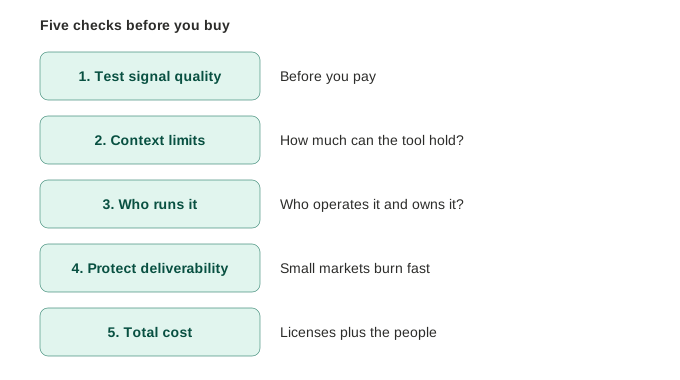
An AI SDR is only as good as the accounts it targets. Ask where the data comes from, how fresh it is and whether the tool can use job changes, hiring, tech stack and web visits. Clay's Growth plan lists web intent signals, and Apollo and Amplemarket list intent and job-change signals.
Run a small test on your own account list. Combining several signals, such as firmographics, LinkedIn activity, job changes, hiring, tech stack and web visits, finds accounts with a reason to talk, and you can ask any vendor how close its data gets to that.
Generic AI messages read like generic AI messages. The tool needs your ICP, your product and your buyer's language. Apollo describes an AI Context Center, and Clay lets you wire prompts and scoring to your own inputs.
Ask each vendor how the context is stored, who updates it and whether you can export it. A living ICP and messaging document that feeds every prompt beats a one-time setup that goes stale.
Every product above needs someone to set it up and watch the results. Autonomous agents reduce the daily work and raise the review burden, since a wrong message goes out at machine speed. Co-pilot modes such as Salesforge's Co-Pilot and Amplemarket's Duo Copilot keep a person in the loop.
Ownership matters when you leave. With a vendor agent, the data and sequences often live inside the vendor's product, so ask what you can export. If nobody on your team can run the tool, read the section on [hiring a team to run it](#when-a-tool-is-not-enough-hire-a-team-to-run-it) before you buy.
A Seed company may have a few hundred real target accounts. Spraying them with automated email can burn the list and the sending domain. Look for warmup, mailbox rotation, bounce detection and sending limits, which Instantly, Salesforge, Smartlead, lemlist and Apollo each list in some form.
Precision beats volume in a small market. Send to accounts with a reason to talk, which protects domain reputation and the addressable market.
The subscription is the smaller part of the bill. Add data credits, extra seats, mailboxes and the hours someone spends building and reviewing campaigns. Clay's top-ups carry a 30% premium and Apollo's credits expire each cycle, so usage spikes cost more than the headline price suggests.
Compare the total against $57k to $81k per month plus equity, which QC Growth estimates for a senior in-house GTM team. A managed team falls between the two, and the tool costs inside a package are a question to settle on the first call.
The table below compresses the choices for a Seed to Series A software team. Use it to shortlist, then test two options on your own accounts for a few weeks before committing to an annual term.
| Category | Key Considerations |
|---|---|
| Top 3 for early-stage software | Apollo (low-cost start), Clay (build it yourself), Salesforge (low-cost agent test) |
| Who Is It For | Founders and first sales hires who need outbound running and cannot staff a full SDR team |
| Use Cases | Prospect research, list building, signal-based outreach, reply handling, inbound lead response |
| How to Choose | Test signal quality, check context handling, decide who runs and owns it, protect deliverability, compare total cost |
| Mistakes to Avoid | Letting an agent send without review, signing an annual term before a test, ignoring domain health, forgetting that data credits are billed separately |
| Pricing Starts | Free at Clay and Apollo, $39 per month at Smartlead Base, $40 per month at Salesforge Pro, and $600 per month at Amplemarket Startup |
The numbers in the last row come from the vendors' own sites. Treat them as starting points, because credits, seats and add-ons change the real bill.
AI SDR vs human SDR is a question most buyers ask. Tools handle research and repetitive follow-up well, and humans handle judgment, relationships and unusual replies. A hybrid model works best for early-stage teams, with software doing the preparation and a person owning the conversation.
If you have picked a tool and nobody has the time to run it, QC Growth's pod can set it up and operate it with you. You keep the infrastructure, data and playbooks, and packages run $7.5k to $25k per month compared with $57k to $81k per month plus equity for an in-house team.
Read how it worked for Burn Media Co., where revenue grew from $142k in April to $181k in August, a 27.5% increase. You can also see more client stories on our case studies page. Founders who want to talk through fit can book a strategy call with Luke Bivens' team.
The best AI SDR tools in 2027 start with Apollo for most Seed to Series A B2B teams, because it has a free plan and paid plans from $49 per user per month billed annually. Clay suits teams with a builder and also has a free plan. Amplemarket Startup costs $600 per month on an annual term, and Salesforge's Agent Frank costs $499 per month. 11x, Artisan and Outreach do not publish prices.
When choosing an AI SDR tool, consider signal quality, how much context it holds, who runs and owns it, deliverability safeguards and total cost including people. Test on your own account list before you sign an annual term. Clay top-ups carry a 30% premium and Apollo credits expire each cycle, so usage changes the bill. Compare the total against $57k to $81k per month plus equity, which is QC Growth's estimate for an in-house senior GTM team.
You should buy an AI SDR tool when a founder or first sales hire has the weeks to set it up and run it, and hire a team when nobody does. Apollo and Clay start at $0, and the paid tools above run from $39 to $600 per month. A managed team such as QC Growth costs $7.5k to $25k per month on 6 to 12 month terms and does not guarantee meeting counts. An in-house senior GTM team costs $57k to $81k per month plus equity by QC Growth's estimate.
Getting started with an AI SDR tool begins with a free plan, since Apollo and Clay both cost $0 to test. Load a short list of your best-fit accounts, send a small batch, and read every message before you turn on automation. Smartlead and Amplemarket list a free trial on every plan, and Salesforge's Co-Pilot mode keeps a person approving messages. Confirm trial length at signup, because Smartlead does not state it and lemlist's page shows both 14 and 30 days.
Switching AI SDR tools is easiest when you export your lists, sequences and messaging context before you cancel. Salesforge's sequencing plans have no long-term contract, and Smartlead says it has no lock-in. Apollo's annual plans are a 12-month commitment, with downgrades taking effect at the next term, and Amplemarket's Startup plan requires an annual term. Check what each vendor lets you export, since sequences and data often live inside the product.
An AI SDR will not replace human judgment at a seed-stage startup, because the tool handles research and follow-up while a person decides whom to contact and what to say. A tool starting at $40 per month at Salesforge or $0 at Clay and Apollo is cheap, yet the in-house alternative costs $57k to $81k per month plus equity by QC Growth's math. Autonomous agents such as 11x and Artisan do not publish prices, so request a demo and references first. A short test on your own accounts shows whether the output meets your standard.
An AI SDR is software that automates prospecting, research, outreach, follow-up and meeting booking that a sales development representative would otherwise do by hand. Some products cover one step, such as Clay for enrichment or Instantly for sending. Others, such as 11x's Alice and Julian, Artisan's Ava and Salesforge's Agent Frank, present an agent that runs several steps. They are also called AI sales agents or AI BDR tools.
If you're at the inflection point, technology proven, market waiting, and the canyon between them, we should talk.