
11.06.26 · 23 min read
Compare the best outsourced SDR companies for 2027, from Belkins to CIENCE. See published pricing, terms and startup fit before you hire.
Outsourced SDR companies supply reps, data and management that book first meetings for your team. This guide compares ten of them on model, published pricing and fit for B2B startups, and it shows how the cost compares with hiring an SDR yourself.
Disclosure: QC Growth publishes this comparison and sells embedded GTM services that compete with parts of what these firms offer. It does not list itself among the ten. Prices and features come from each firm's own pages, checked on 6 November 2026, and many figures are vendor claims. Verify before you buy.
The table lists ten firms in the order we would look at them for an early-stage team. Where a firm publishes no price, we say so and do not estimate.
| Company | Best For | Key Strengths | Pricing |
|---|---|---|---|
| Belkins | Multichannel outbound with a long term | Email, LinkedIn, phone, ads; appointment tiers | Not on pricing page; $7,995 on its blog |
| CIENCE | Scaling SDR count month to month | Line-item prices, month to month | From $4,249 for 1 offshore SDR (our sum) |
| SalesRoads | Phone-led managed team | Strategist and coach included, 15-day launch | $11,950 per 4 weeks for 1 SDR |
| Martal Group | Fractional reps and multilingual teams | Fractions of a rep, many languages | Not published; 3 to 4 month pilot |
| Leadium | Done-for-you program on monthly terms | Month to month, candid guarantees | Not published; form bands from $2,500 |
| memoryBlue | Enterprise teams that may hire the reps | Audition-to-hire, works inside your tools | Not published |
| SalesHive | Flat plan with US or offshore reps | No setup fee stated, volume tiers | Quote only |
| Abstrakt | Low-cost start for trades and services | US-based reps, published starting prices | From $5,000 a month outbound |
| Callbox | Multi-region programs with AI voice | Regional teams, event follow-up | Not published |
| Sales Focus | Launch-date commitment | 45-day launch guarantee | Not published |
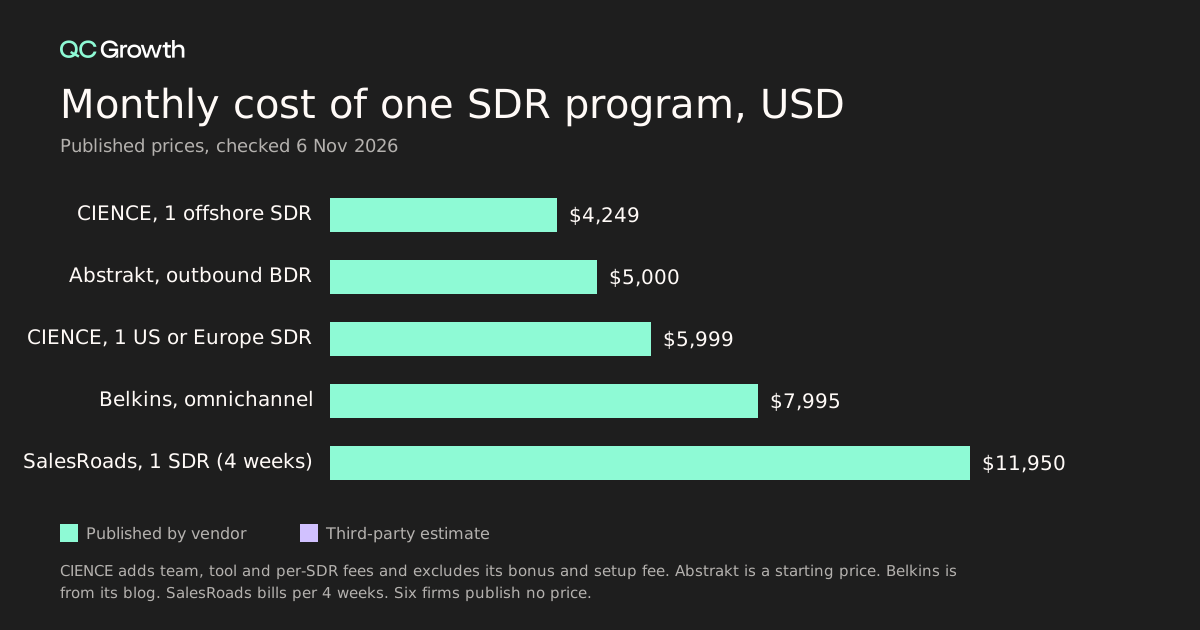
Only four firms give a number you can compare. Prices vary by almost a factor of three for a single program, so the quote you receive depends on channels, volume and term as much as on the firm.
An outsourced SDR company hires, trains and manages sales development reps and assigns them to your account. The reps research prospects, send email, call, message on LinkedIn and book first meetings with your sales team.
Firms differ in what sits inside the fee. Some bundle data and software, some charge per rep and some tie part of the fee to meetings. Meeting definitions also vary: a booked meeting, a held meeting and a qualified meeting are three different numbers.
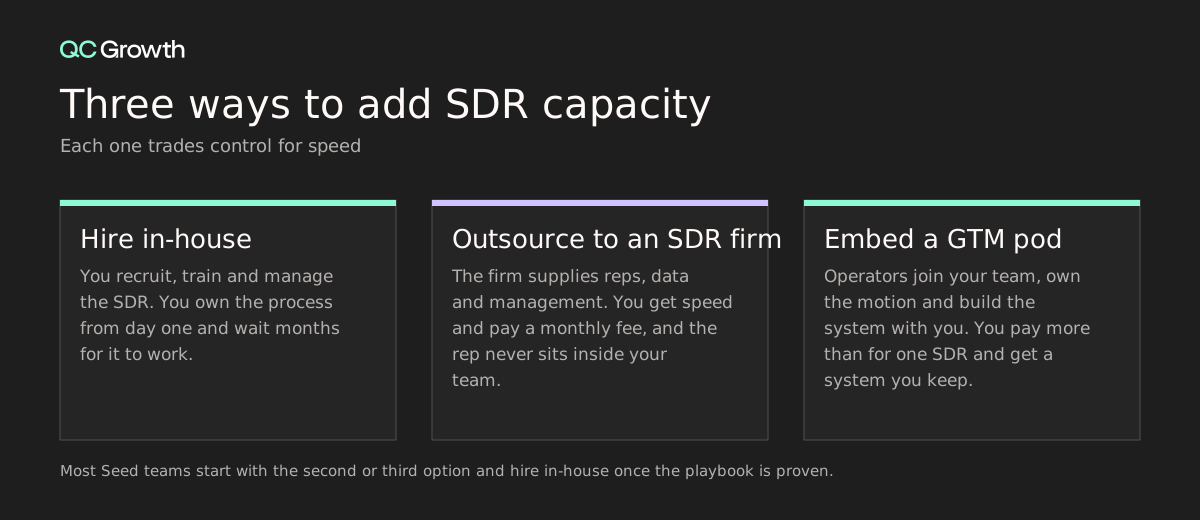
The model sits between hiring an SDR yourself and embedding a full GTM team. The diagram shows the three options.
Speed is the main reason. The Bridge Group's 2025 SDR Models and Metrics Report puts average SDR ramp time at 3.0 months, median attrition at 40% a year and average tenure at 1.9 years (Bridge Group, February 2025). A rep spends a sixth of a typical tenure getting up to speed, and four in ten leave within a year.
An outsourced firm absorbs that churn and already has sequences, data sources and sending infrastructure. You can start testing a market in weeks and not in quarters.
The cost is control. The rep works for the firm, learns your product from a brief and may handle several clients. For a technical product, that gap shows up in meeting quality.
The right fit depends on how well you know your buyer.
Stage and product type change the answer, as the five cases below show.
Outsourcing works when you can describe the buyer in a sentence and have closed a few deals to that buyer. The firm tests volume against a known target.
If you cannot yet say who buys, start with founder-led outreach, because an SDR firm will only amplify the guess.
A company with a funded sales hire planned for next year can use an outsourced team to fill the calendar and learn which messages work.
Ask the firm to hand over sequences, data and domain access at the end so the next hire starts with a tested script.
Developer buyers ignore generic outreach, and phone-led programs fit them poorly. Ask any firm for software references and a plan for technical messaging.
An embedded GTM team often fits better because operators write messages from product knowledge.
Regulated buyers need compliance-aware outreach. Ask how the firm handles consent, opt-out and the data it stores.
Ask for references in your segment, because a generic B2B record says little about hospital or payer buyers.
Companies past Series B often use outsourced teams to cover new regions or segments without a long hiring plan.
Firms such as Callbox and memoryBlue are built for that case.
Each review uses the firm's own pages where they exist and labels anything we could not verify. Several firms publish no price, and we say so instead of guessing. QC Growth is an embedded GTM team and is not one of the ten, so we describe where it fits in a separate section.
Belkins sells monthly retainer packages that combine cold email, LinkedIn, intent-based calling, account-based marketing and ads. Its pricing page lists SDR outsourcing as an optional add-on, and appointments are tiered by plan at 30 or more, 100 or more or 200 or more a year.
The firm is based in Dover, Delaware, and reports more than 1,000 clients on its own pages. Treat that count as a vendor claim.
Belkins covers more channels than most firms here, and it publishes a long library of outbound content that shows how it thinks about deliverability and targeting.
Its pricing page names appointment tiers, which gives a buyer a volume target to hold the firm to.
Belkins publishes no price on its pricing page. Its own blog lists omnichannel from $7,995 a month and email-only from $6,500, while a table in the same article says $5,500. Ask for a written quote and the exact term.
Belkins fits teams that want one firm to run several channels and can commit to a long term.
Seed teams with a small market should ask how the firm protects a short account list from over-contact before signing.
CIENCE sells outsourced SDR teams on a month-to-month basis, and you can add or remove SDRs as needs change. It states that campaigns go live in under 14 days, which is a vendor claim.
The site now carries graph8 branding, including a SOC 2 badge that belongs to graph8. We could not confirm the ownership history from an independent source, so check who you are contracting with.
CIENCE is the only firm in this guide that lists a price for each part of the program: a campaign team, a software tool and each SDR.
Logos shown on the site include Okta, Microsoft, Google, Uber and Salesforce, and case studies include SendBird, Stage 1 Financial, Mandolin and Emulate.
The pricing page lists a campaign team at $2,000 a month, the graph8 tool at $499 a month, offshore SDRs from $1,750 each and US or Europe SDRs from $3,500 each, plus a performance bonus and a setup fee. One offshore SDR works out to $4,249 a month and one US or Europe SDR to $5,999 before the bonus and setup fee, by our arithmetic.
CIENCE is the easiest firm in this guide to price before you talk to anyone, and the month-to-month term limits your downside.
Ask how the performance bonus is calculated and what counts as a qualified meeting before you start.
SalesRoads provides a staffed outsourced SDR team that includes SDRs, a strategist, a coach, a campaign specialist and a research team. Each SDR comes with 500 prospect records a month, and launch takes 15 business days.
The firm is based in Boca Raton, Florida, and leads with phone calling.
SalesRoads states that there is no long-term commitment and that you can cancel at any time. It also recommends a 12-week go-to-market test before you scale.
Its pricing page lists a clear ladder from one to six SDRs.
The pricing page lists one SDR at $11,950 per 4-week engagement, two at $16,750, three at $23,500, four at $30,150, five at $36,700 and six at $43,150. Third-party pages still quote $9,950 for one SDR, so use the live figure.
SalesRoads is a reasonable choice for a company that has proven phone works in its market and wants a managed team fast.
A Seed team with a developer buyer should test other channels first.
Martal Group offers fractional, full-time and enterprise sales teams across email, LinkedIn and phone. Its pricing page describes a flat monthly fee, plus sales commission on the higher tiers.
It reports reps in the US, Canada, the EU and Latin America. The split is a vendor claim.
Martal separates tiers by the amount of rep time, which lets a smaller company start with a fraction of a rep.
Named clients on its site include Jedox, Clickworker, Deephow, Forerunner and Awin.
Martal publishes no dollar figures on its pricing page. Tier 1A has a 3-month pilot and Tiers 2 and 3 have a 4-month pilot, then monthly terms. Request a written quote.
Martal suits a company that wants to start with a fraction of a rep and can commit to a pilot of three to four months.
The pilot length makes it a poor fit for a team with less than a year of runway to test.
Leadium provides appointment setting, data sourcing and inbound qualification by email, phone and LinkedIn. Contracts run month to month, and onboarding starts on the 1st or 15th of each month.
The site calls the firm US-based and mentions Orlando, while its footer lists Las Vegas. Confirm the team's location if that matters to you.
Leadium is open that it does not guarantee appointments and instead commits to service and sales-activity deliverables. That is a more candid position than many firms take.
Logos on the site include Segment, SignalWire, Phunware, Bottomline, MedPanel, Veem and People.ai.
Leadium publishes no price. Its pricing page shows a form with budget bands from $2,500 to $3,500 up to more than $10,000, and the unit is not stated.
Leadium fits a team that wants monthly terms and a done-for-you program and is comfortable judging the firm on activity as well as meetings.
Ask for the activity targets in writing.
memoryBlue supplies SDR, account development and account executive teams that work inside your tools. Reps go through a six-week academy, and you can audition them and hire the ones you like.
It reports more than 650 reps and offices across North America, EMEA, APAC and Latin America. Both figures come from the firm.
The audition-to-hire model lets you convert an outsourced rep into a team member, which no other firm in this guide advertises as a core feature.
Logos on the site include Adobe, CrowdStrike, Fortinet, Splunk and Zoom, though the page does not say whether they are current clients.
memoryBlue publishes no price. Its site has a cost calculator, and the Belkins blog estimates about $11,000 a month. That is a competitor's figure, so confirm with the firm.
memoryBlue works best for a company with a working sales process that wants reps it can later hire.
Seed teams without a CRM or a documented pitch will not get full value from the model.
SalesHive sells Starter, Growth and Crush plans with a dedicated SDR team, a strategist and its own tools. You can choose US-based or offshore SDRs.
Pricing is quoted by location, channels and daily volume, and annual plans cost less per month. The firm states there is no setup fee.
SalesHive tiers its plans by volume and lets a buyer choose where the reps sit, which makes it simple to compare against other vendors.
It states no setup fee and no per-meeting pricing.
SalesHive quotes each plan by location, channel and daily volume, as the pricing page explains. Annual plans cost less per month than monthly ones. No dollar amount is published.
SalesHive is a fair choice for a team that wants a simple flat-fee plan and is happy to compare US and offshore quotes.
Ask how it defines a meeting and whether you pay for no-shows.
Abstrakt provides US-based SDRs who work under your company name, along with a results portal. Its appointment-setting page lists starting prices for outbound, inbound and brand services.
The firm is based in St. Louis, Missouri, and covers all 50 states and Canada. It states that it books only B2B meetings.
Abstrakt publishes starting prices for three programs, which gives you a number to compare without a sales call.
Its agreement includes an appointment guarantee, though the number is not published.
The appointment-setting page lists outbound BDR service starting at $5,000 a month, inbound SDR at $1,000 a month and a Brand Boost at $500 a month. Enterprise is custom. Earlier QC Growth roundups quoted $5,000 to $7,000, so use the live wording.
Abstrakt is a sensible low-cost starting point for a company that sells to business owners and wants to test outbound.
A developer-tool company should ask for software references first.
Callbox offers appointment setting, account-based marketing, SDR outsourcing and event follow-up over email, LinkedIn and phone. It mixes human reps with AI voice agents, and it has regional pages for North America, Asia Pacific, Europe, Latin America and Southeast Asia.
The firm's domain is callboxinc.com. A different company at callbox.com sells call tracking.
Callbox is the only firm in this guide that builds AI voice agents into the offer and publishes regional pages for several markets.
Logos on the site include Google, Microsoft, AWS, SAP, LinkedIn and Intel.
Callbox publishes no price. Its site says cost depends on market, coverage, channels, language and support. A ZoomInfo article quotes $15,000 to $30,000 a month per campaign pod, and we could not confirm that on Callbox's own site.
Callbox fits a larger company that needs several regions and languages in one program.
Most Seed-stage teams will find it more than they need.
Sales Focus provides outsourced lead generation and appointment setting, and its site advertises a 45-day launch guarantee. Named case studies include Hitachi USA and a regional health system.
The site states no headquarters, pricing or minimum term, so this entry rests on a thinner record than the others.
The 45-day launch guarantee is a concrete commitment that most firms in this guide do not make.
One testimonial, from AgileBlue, says the client later moved the function in-house, which shows the firm can bridge to a team of your own.
Sales Focus publishes no pricing or minimum term on its site. Request a written quote and ask what the launch guarantee covers if the date slips.
Sales Focus is worth a call if the launch guarantee matters to you and your buyer is in healthcare or enterprise technology.
Verify each claim with references because the public record is short.
Start with pay. The Bridge Group reports median SDR on-target earnings of $80,000, split between $55,000 base and $25,000 variable. Payscale lists an average base of $52,866 across 699 profiles, updated September 2026 (Payscale).
Benefits add to that. In the US Bureau of Labor Statistics June 2026 release, benefits made up 30.0% of total compensation for private industry, or $14.07 of $46.89 an hour (BLS Employer Costs for Employee Compensation). If $80,000 is the wage portion at 70% of total, the full cost is about $114,000, or $9,500 a month. That is our illustration using an all-industry average, and it is no measured SDR figure.
The comparison below leaves out recruiting fees, a manager's time and the cost of an empty seat. Those make in-house hiring look dearer, and they are hard to price without your own numbers.
| Cost line | In-house SDR | Outsourced SDR firm |
|---|---|---|
| Pay | $80,000 median OTE ($55,000 base, $25,000 variable), per Bridge Group | Included in the monthly fee |
| Benefits and payroll costs | About 30% of total compensation across US private industry, per BLS, which takes $80,000 in wages to roughly $114,000 | Included |
| Monthly cost of the above | About $9,500 | $4,249 to $11,950 for one SDR program where published |
| Ramp | 3.0 months on average, paid in full | Often 2 to 4 weeks to launch, per vendor claims |
| Data, tools and sending setup | Extra: CRM seat, data, sequencing, domains | Usually included |
| Management | Your time or a sales lead | Firm strategist or coach |
| Attrition risk | 40% median annual attrition | The firm replaces the rep |
A firm quote of $5,000 to $12,000 a month for one program is therefore close to the cost of one in-house SDR before tools, and it comes with management and data.
The difference is what you own. An outsourced program ends when the contract ends, unless you negotiate for the sequences, data and domains.
Use these six checks before you sign.
Most of the risk in an SDR contract sits in terms you only see in the paperwork, so ask for them early.
Ask whether the firm counts booked, held or qualified meetings. A booked meeting that does not show costs you a rep's calendar time.
Write the definition into the contract, along with who decides whether a meeting qualifies.
Pilots of three to four months, such as Martal's, can use a third of a short runway before you see results. Month-to-month terms, such as CIENCE and Leadium list, carry less risk.
Ask for a clause that lets you stop if the first 90 days miss an agreed target.
Ask who owns the domains, mailboxes, sequences, lead lists and call recordings at the end. Without a clause, you may start from nothing.
Ask for a handover of everything in writing.
A seed-stage market may hold a few hundred accounts. A firm that sends high volume can burn them in weeks.
Ask how the firm caps contacts per account and per month.
Ask for two references from software or developer-tool companies and for sample messages. A rep who cannot explain the product loses technical buyers on the first call.
If references are thin, run a short paid test before a long contract.
Decide who takes the meeting, how fast and with what notes. Slow follow-up wastes the work the SDR did.
Set a rule such as a reply within one business day and measure it.
Use the table as a checklist when you shortlist.
It also works as a brief for vendor calls. Ask each firm to fill in the rows that apply to you.
| Category | Key Considerations |
|---|---|
| Top 3 outsourced SDR companies to check first | CIENCE for published pricing, Abstrakt for a low-cost start, Belkins for multichannel coverage |
| Who is it for | B2B startups with a defined buyer and a few closed deals that need meetings before a hire |
| Use cases | Testing a market, filling a calendar, covering a new region, bridging to a first SDR hire |
| How to choose | Define a meeting, match the term to runway, secure asset ownership, protect a small market, check technical fit |
| Mistakes to avoid | Signing a long pilot with no exit, accepting booked meetings as the metric, and handing a small market to a high-volume program |
| Pricing starts | $4,249 a month for one offshore SDR at CIENCE (our sum), $5,000 at Abstrakt, $11,950 per 4 weeks at SalesRoads |
An SDR firm books meetings. It builds none of the signals, CRM routing, positioning or partner channels that make those meetings convert. When the ICP is still moving, that gap is where Seed teams lose money.
QC Growth takes the other approach. Operators join your team as an embedded pod and run inbound, outbound and partner channels together, so the playbook stays with you at the end. It costs more than a single SDR program and covers more ground. QC Growth is an embedded team and no SDR firm, so we left it out of the ten above.
QC Growth is the embedded GTM team for Seed to Series A technical founders. A fractional pod of a top-1% GTM operator, a GTM lead, a GTM engineer and BDR support builds and runs your Allbound motion, with inbound, outbound and partner channels in one signal-driven system. The infrastructure, data and playbooks stay with you.
The operators have carried the bag in these markets: Luke Bivens at Gatsby and Netlify, Aron Schuhmann at Gatsby and OctoAI, Shane O’Connor through a 10x ARR run at Scalar, and Kori Bivens, a former VP at RVO Health who leads the healthcare division. QC Growth’s portfolio of more than 50 companies includes Netlify, Gatsby, Turso, Mastra AI, ZeroEntropy, Grafbase, Arcjet, Eraser.io and Crescendo.
It is built for Seed to Series A companies past product-market fit in developer tools, AI, healthcare and deep tech, that want a system that keeps working after the first meetings are booked.
A pod builds the outbound motion, the signals and the CRM routing, then runs it with you. Packages run $12,000 to $15,000 a month for GTM Systems + Ops and $15,000 to $20,000 for Full Service GTM, with a three-month minimum and no equity, against $57,000 to $81,000 a month plus 1.25% to 2.75% equity for a senior in-house team, broken down in QC’s in-house versus fractional cost math. See what the Full Service GTM package includes.
The best outsourced SDR company in 2027 depends on your buyer and budget. CIENCE is the easiest to price because it publishes line items and runs month to month. Abstrakt starts at $5,000 a month for outbound, and Belkins offers the widest channel coverage. Ask each shortlisted firm for software references and a written meeting definition.
Consider the meeting definition, contract term, asset ownership, market protection and technical fit. Pilots of three to four months can use a large share of a short runway. Ask who owns the domains, sequences and lead lists at the end, and write the answer into the contract.
QC Growth is an embedded GTM team and no SDR firm. It builds and runs outbound, inbound and partner channels with you, and it can sit alongside an SDR firm or replace one. The playbook, data and infrastructure stay with you.
Book a Free Growth Audit through the QC Growth contact page and bring your ICP, your CRM and your current outbound results. QC Growth reviews what you have and scopes a package. You keep the infrastructure, data and playbooks.
Switching is easy only if you plan for it. Month-to-month terms, such as those at CIENCE and Leadium, let you move quickly. Pilots at Martal run three to four months. Ask for sequences, lead lists and domain access in writing so a new firm does not start from nothing.
Outsourced SDR companies cost about $4,200 to $12,000 a month for one program where prices are published. CIENCE works out to $4,249 for one offshore SDR and $5,999 for one US or Europe SDR before its bonus and setup fee. Abstrakt starts at $5,000 and SalesRoads charges $11,950 per four weeks. Many firms publish no price.
An outsourced SDR program costs about the same as one in-house SDR and includes management, data and tools. Median SDR on-target earnings are $80,000 per the Bridge Group, which is about $9,500 a month once average benefit costs are added, by our illustration. The outsourced fee buys speed, and the in-house hire buys ownership.
Most firms state that launch takes two to six weeks, and results take longer. CIENCE says under 14 days, SalesRoads says 15 business days and Sales Focus offers a 45-day launch guarantee. SalesRoads recommends a 12-week test. Judge any firm on held meetings after 90 days.