
A GTM agency builds and runs the go-to-market motion for a startup rather than just advising on one. That motion covers: positioning, outbound and inbound infrastructure, messaging, campaign execution and reporting, among other key aspects of GTM strategy. Some agencies stop at strategy and just hand over a deck. Others (including QC Growth), embed operators who run the system daily until it belongs to the client. This category sits between two extremes on the buying spectrum. At one end is a fully outsourced appointment setting, which books meetings on volume and hands them off with little strategic input.
A GTM agency builds and runs the go-to-market motion for a startup rather than just advising on one. That motion covers: positioning, outbound and inbound infrastructure, messaging, campaign execution and reporting, among other key aspects of GTM strategy.
Some agencies stop at strategy and just hand over a deck. Others (including QC Growth), embed operators who run the system daily until it belongs to the client.
This category sits between two extremes on the buying spectrum. At one end is a fully outsourced appointment setting, which books meetings on volume and hands them off with little strategic input.
On the other hand, is hiring a full-time, in-house GTM team - which is the most durable option long-term, but also the slowest and most expensive to stand up at the seed stage.
A go-to-market agency worth considering sits between those two poles: an embedded team that moves with the speed and expertise of an in-house hire, at a fraction of the 6-figure monthly cost.
Most B2B founders reach product market fit through deals they closed personally, not through a repeatable system.
That personal-selling ceiling shows up in 3 specific ways:
A GTM consultant or a fractional team closes the hiring gap for a fraction of the in-house cost, since the retainer covers the operator, the infrastructure, and the ongoing execution in one line item.
The best GTM agencies also fix the data quality problem with signal driven targeting rather than volume. That is a meaningful part of why we at QC Growth, have built our entire outbound approach around signal stacking versus headcount.
Each persona below runs into this ceiling differently, depending on the vertical and how the team is structured today:
A technical founder who closed the first few enterprise deals personally usually hits a wall once the pipeline needs to run without them on every call.
This group tends to be skeptical of agencies after bad experiences with generic outbound, so GTM partners who specialize in developer tools, rather than a generalist shop treating them like any other B2B buyer, matter more here than almost anywhere else.
That same skepticism applies to GTM support for AI startups, where founders need a partner fluent in selling to enterprise buyers still forming an opinion on the category.
Clinical and technical founders selling into hospitals, payers, or health systems face trust driven sales cycles that can run 9 to 18 months.
A generic outbound motion can damage credibility fast in an industry this relationship dependent, so this group needs healthtech commercialization partners with real healthcare selling experience behind them, not a team learning the vertical on the client's dime.
The same logic applies to founders running go-to-market for deep tech and hardtech companies, where niche, signal-driven buyers punish generic outreach just as fast.
A non-technical co-founder juggling marketing and sales alone is usually drowning in disconnected tools rather than lacking effort.
What this group needs from a GTM agency is infrastructure and senior air cover: someone who can wire the existing stack together and take some of the pipeline ownership off their plate.
Platform partners at Seed and Series A funds often need a repeatable answer for "who fixes GTM" across several portfolio companies at once.
A top GTM agency that founders will actually accept, rather than resist as an outside imposition, is what makes this persona's job easier at scale.
Sales managers running a small team of reps often lack a documented process that survives a new hire or a bad quarter.
A GTM agency that leaves behind reusable infrastructure, not just a set of recommendations, is what turns this into a lasting fix rather than a temporary boost.
QC Growth is an embedded GTM agency built for Seed to Series A B2B software founders who have product market fit signals but no repeatable revenue engine behind it.
Rather than handing over a strategy deck, QC Growth plugs a fractional team into your GTM motion. This usually includes: a top 1% GTM operator, a GTM lead, a GTM engineer, and BDR support, who build and run the full motion: starting from strategy and infrastructure to messaging creation and reporting.
Our “allbound” approach combines inbound, outbound and partner channels into a unified, signal-driven system, where marketing surfaces intent, while sales acts on it.
Few go-to-market agencies for startups can say their operators previously sold at the exact companies founders are trying to emulate, including Netlify's ecosystem, Gatsby, and Scalar. QC Growth is one of them.
QC Growth's operators have previously held sales roles at companies like Netlify, Gatsby and Scalar, which is rare in a category dominated by generalist volume shops.
Instead of scaling headcount, we use 'signal stacking', an approach that layers in firmographics, hiring activities and technology stack data; so outreach targets accounts which already show buying intent versus going in completely cold.
We also run a dedicated healthtech division, which most generalist GTM consultant shops can't match.
QC Growth's GTM pricing ranges from $7,500 to $25,000 per month, depending on the engagement scope, with typical contracts lasting 6 to 12 months.
The model is positioned as a fractional alternative to building an in-house GTM team, which can cost $57,000 to $81,000 monthly plus equity.
QC Growth is built for founders turning founder-led deals into a repeatable engine, with operators who have solved that exact problem in the same verticals before.
Between the pricing math against an in-house hire and the infrastructure that stays behind, we're a strong option at the seed stage.
The GTM Engineering Company positions itself as a lighter touch GTM agency built around structured, time-boxed retainers rather than an open-ended engagement.
Every engagement includes a CRM audit at the outset, which gives founders a clear picture of what is broken before any new campaigns launch.
The agency leans into a more technical, systems-first framing of GTM functions; treating outbound infrastructure and CRM hygiene as engineering problems rather than purely creative ones.
This suits founders wanting visible structure and a short initial commitment before scaling into a larger go-to-market agency retainer.
The GTM Engineering Company's structured 3 and 6 month retainers give founders a defined start and end point, which is less common among agencies that default to open-ended contracts.
Including a CRM audit as a standard part of every engagement is a practical touch that surfaces data problems most teams do not know they have until campaigns underperform.
The GTM Engineering Company offers 3 and 6 month retainers starting at $4,000 per month and scaling to $6,000 per month.
Every engagement also includes weekly working sessions and asynchronous implementation, along with a CRM audit as a standard part of the package.
The GTM Engineering Company suits early stage founders who want structured, lower cost GTM support before committing to a larger retainer.
Companies needing daily embedded execution or deep vertical specialization will likely need a more comprehensive GTM agency.
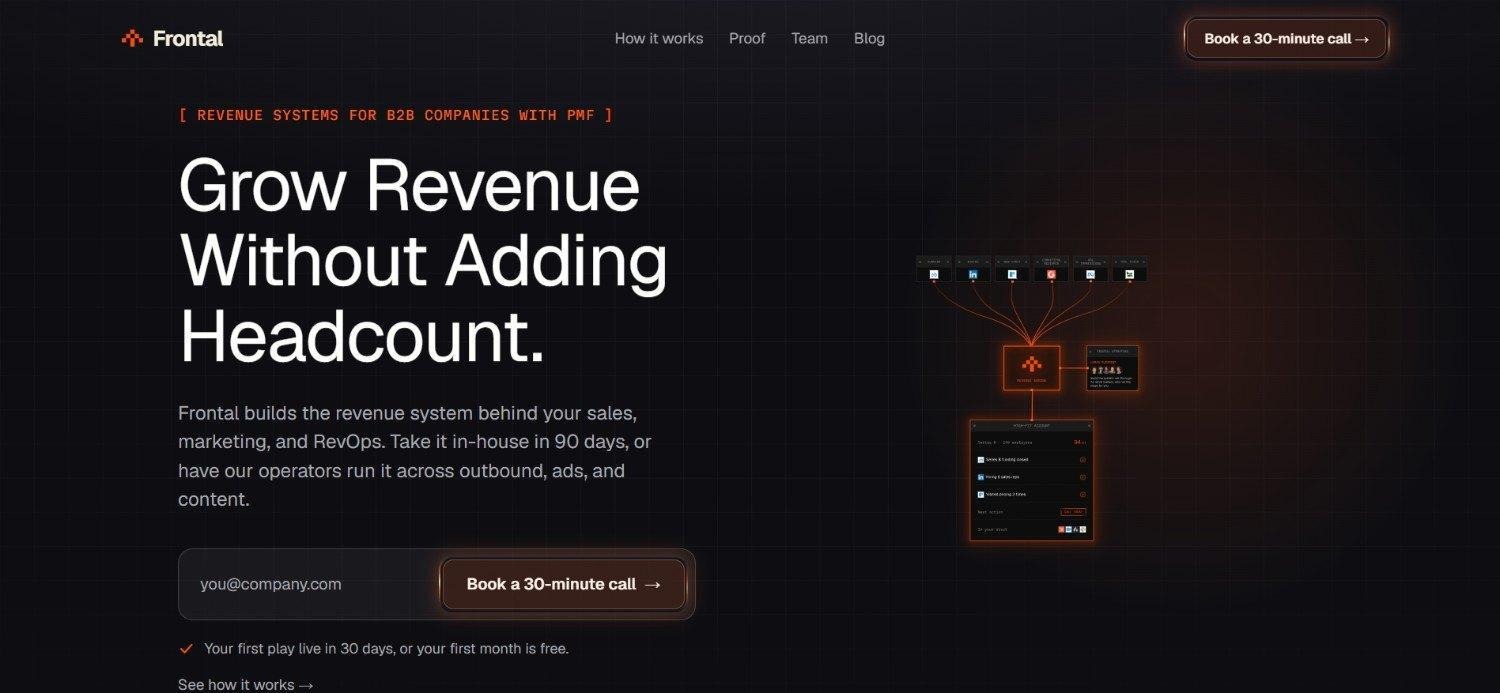
Frontal is built around a risk-averse entry point into GTM work: a 90 day pilot rather than an immediate long-term retainer. That structure appeals to founders who have been burned by agencies before and want proof of fit before committing further.
Frontal combines a fixed-fee GTM foundation with month-to-month demand generation services layered on top, and software costs are billed separately from the service fee.
Pricing itself is scoped during a 30 minute consultation based on GTM complexity and growth goals, rather than published as a flat rate.
This makes Frontal a reasonable option for founders who want to test a go-to-market agency relationship before signing a longer commitment.
Frontal's 90 day pilot structure lowers the risk of a bad agency fit, which is a real concern for founders who have already tried and abandoned outbound once.
Separating the fixed-fee foundation from month-to-month demand services also gives founders more control over what they are paying for at any given time.
Frontal uses custom pricing with month-to-month demand services, a fixed-fee GTM foundation, and software costs billed separately.
Pricing is scoped during a 30 minute consultation based on GTM complexity, growth goals, and required execution support.
Frontal works well for founders who want to de-risk their first GTM agency relationship through a pilot rather than a long-term contract.
Teams already confident in what they need may find the consultation-based pricing slower than a GTM agency with clearer published rates.
The Kiln operates as a fully custom go-to-market agency, building strategy and execution scope around each client rather than offering a standardized package.
That flexibility means engagements can look meaningfully different from one client to the next, which suits founders with unusual GTM problems that do not fit a templated retainer.
The Kiln tends to attract founders wanting a bespoke build over a productized offering, which suits complex, multi-channel GTM problems a standardized retainer would struggle to address.
For founders comparing best GTM agencies for SaaS specifically, The Kiln is worth a look if a custom build matters more than price transparency.
The Kiln's fully custom approach to scope means engagements are built around the specific GTM problem rather than fitted into a predefined package, which can matter for founders with unusual buyer journeys.
That flexibility has a cost: no published pricing benchmark, so comparison shopping takes more upfront effort than with agencies that publish rate ranges.
The Kiln offers custom pricing for GTM solutions, and founders need to request a custom quote directly from their sales team before scope or cost details become available.
The Kiln is a solid choice for founders whose GTM problem genuinely does not fit a standardized package and who are comfortable working through a discovery process for pricing.
Founders wanting to compare costs quickly across several GTM agencies may find the lack of published pricing frustrating.
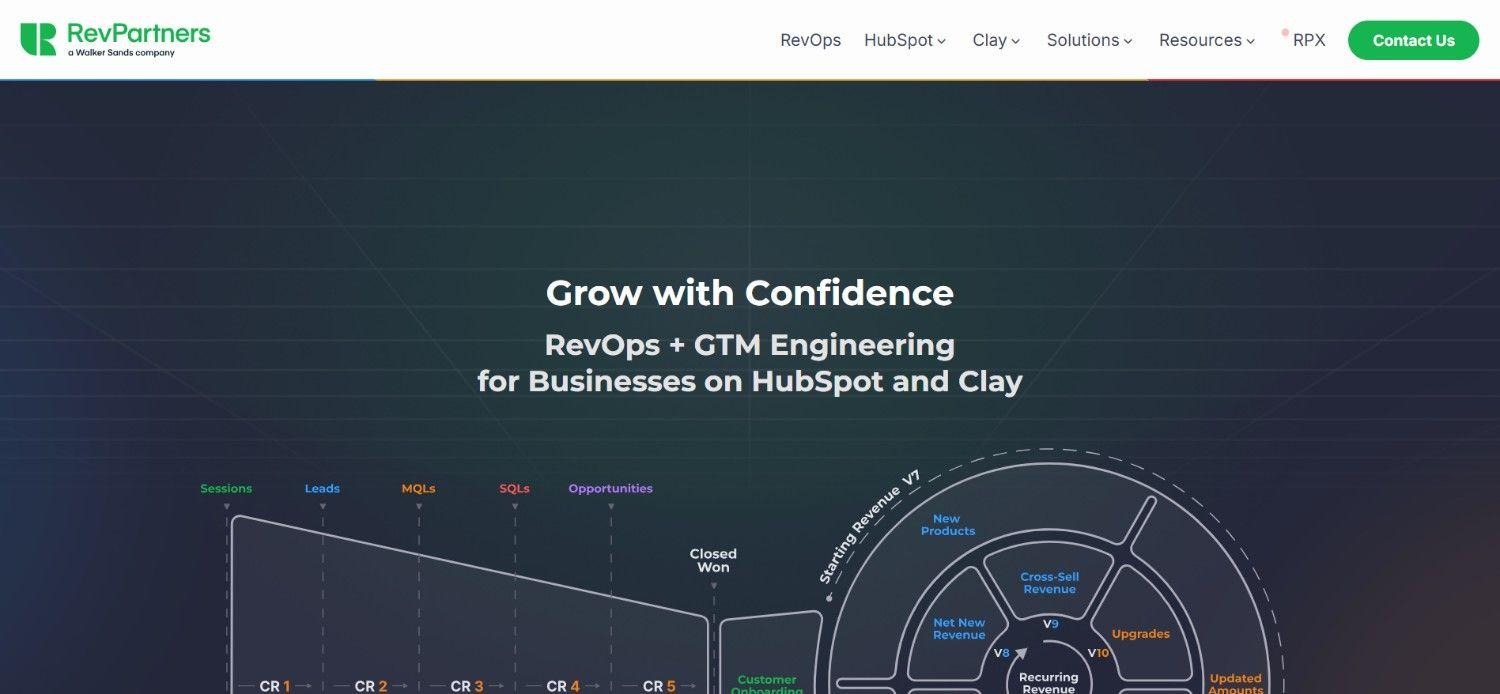
RevPartners operates as a GTM agency built around RevOps and CRM infrastructure, particularly for teams already running HubSpot and Clay as core parts of their stack.
Engagements are scoped individually to each client's use case: whether that means a HubSpot implementation, a Clay-based enrichment workflow, or a broader RevOps cleanup - rather than a fixed package applied to everyone.
This focus makes RevPartners a strong fit for teams whose core GTM problem is operational rather than strategic: messy data, disconnected systems, or reporting that no longer reflects reality.
RevPartners' depth in HubSpot and Clay specifically gives it an edge for teams whose GTM problems are rooted in tooling and data rather than messaging or campaign strategy.
Its discovery-led scoping tailors engagements to the tech stack already in place, rather than assuming a one-size-fits-all implementation.
RevPartners does not publicly share pricing information.
Engagements are scoped based on each client's specific use case; including: HubSpot, Clay and RevOps requirements; with pricing usually discussed during the discovery process.
RevPartners is a strong pick for teams whose GTM problem sits mostly in RevOps and CRM infrastructure rather than outbound strategy.
Founders needing a full campaign build alongside the operational layer may need to pair RevPartners with a broader GTM agency.
Go Nimbly operates as a RevOps consultancy built around the systems and process layer connecting marketing, sales, and customer success data.
Unlike a full-service GTM agency handling outbound execution, Go Nimbly focuses on what sits underneath: routing logic, reporting pipelines; and the handoffs between teams that quietly break as a company scales.
Their project-based approach suits companies with a well-defined RevOps problem, such as a broken lead routing system or disconnected reporting, rather than an agency building outbound campaigns from scratch.
Go Nimbly's project-based model gives founders a clear scope and endpoint for RevOps work, rather than an ongoing retainer that continues regardless of whether the original problem is solved.
That focus makes it a practical choice for a specific, well-diagnosed process issue rather than a broad go-to-market build.
Go Nimbly is a RevOps consultancy with no published fixed pricing. It charges project-based fees scoped to the specific engagement.
Go Nimbly fits companies with a specific RevOps problem that needs solving rather than a full go-to-market build from scratch.
Founders looking for a complete go-to-market agency covering outbound, messaging, and campaigns will likely need a broader partner.
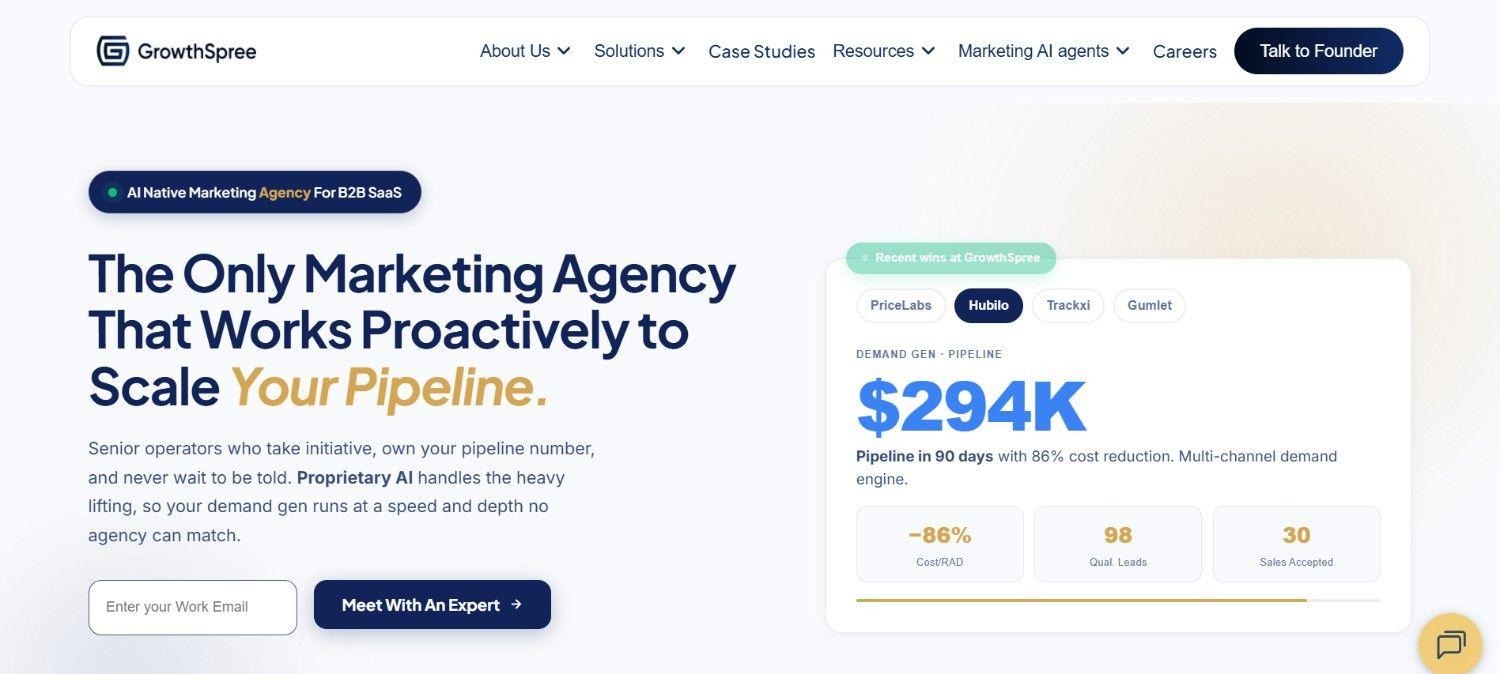
Growthspree is a GTM agency built for B2B SaaS companies that covers channels like paid acquisition, ABM, demand generation and RevOps under one roof.
Rather than specializing narrowly in a single channel, Growthspree positions itself as a broad execution partner - handling the coordination between different channels into a unified layer that tracks how each one performs.
This breadth suits founders who want several GTM functions running in parallel without stitching together separate vendors for each individual channel or campaign type they need covered.
Growthspree's flat monthly retainer, with no percentage-of-ad-spend fee or long-term contract requirement, makes budgeting simpler than agencies that scale fees with spend or scope.
That predictability is a real advantage for early-stage teams trying to plan runway carefully.
Growthspree charges a flat $3,000 monthly retainer for its B2B SaaS GTM execution services, covering paid acquisition, ABM, demand generation, and RevOps.
Pricing is billed monthly; with no long-term contracts, commissions or minimum commitment fee required.
Growthspree is a sensible option for budget-conscious B2B SaaS teams wanting broad, predictable coverage across multiple GTM functions.
Companies needing deep vertical specialization or a larger embedded team will likely need a more comprehensive GTM agency.
Ironpaper blends demand generation and broader GTM strategy work, positioning itself as a partner for B2B companies that need both marketing execution and go-to-market planning under one roof.
The agency works across the funnel: from top-of-funnel content and demand generation through to the messaging and positioning work that feeds sales conversations.
Ironpaper suits companies whose GTM challenges are as much about content as outbound infrastructure, making it a different kind of go-to-market agency than a pure sales execution shop.
Ironpaper's combination of demand generation and GTM strategy work gives it a broader marketing lens than agencies focused purely on outbound sales execution.
That range suits B2B companies whose growth challenges span both content and pipeline generation rather than sales infrastructure alone.
Ironpaper offers custom pricing based on business requirements, and founders need to contact sales directly to receive a scoped quote.
Ironpaper suits B2B companies looking for a partner that spans demand generation and GTM strategy rather than outbound execution alone.
Founders wanting a dedicated embedded sales pod may find a narrower, sales-focused GTM agency a closer fit.
Refine Labs operates at the premium end of the market, with service tiers spanning creative-only support up to full-service demand and pipeline programs.
The agency built its reputation around demand generation methodology aimed at later-stage B2B companies with the budget to match a more comprehensive program.
Refine Labs also offers a standalone 'Revenue Performance Assessment' - a shorter engagement designed to diagnose pipeline and demand issues before committing to a larger retainer.
Among the best GTM agencies for B2B companies, Refine Labs sits closer to the enterprise end than the founder-led, early-stage end of the spectrum.
Refine Labs' tiered structure, from creative-only support through to full-service programs, lets companies choose the level of investment that matches their stage and budget.
The standalone 'Revenue Performance Assessment' also gives teams a lower-commitment way to get a diagnosis before signing a larger contract.
Refine Labs' GTM services are premium-priced: Paid Media Management starts at $14,000 a month, and Full Service starts at $26,000 a month, both with six-month minimums.
Creative-only engagements start lower, at $5,000 a month for three months, while the standalone Revenue Performance Assessment starts at $35,000.
Refine Labs is a strong option for later-stage B2B companies with the budget for a premium demand generation program.
Seed-stage founders comparing top GTM agencies on cost will likely find the price point out of range compared to fractional alternatives.
SalesCaptain is a strong GTM agency for B2B startups that need hands-on support building a predictable outbound sales motion.
The agency's multi-channel approach is particularly relevant for startups that have a defined product but lack the internal resources to build and operate outbound from scratch.
SalesCaptain can support campaign strategy while also handling day-to-day execution.
The agency also emphasizes targeted prospecting over simply increasing outreach volume.
This makes it suitable for B2B SaaS companies and other startups selling to specific decision-makers.
SalesCaptain's full-stack positioning across RevOps and GTM execution means fewer handoffs between vendors compared to splitting operational and outbound work across two separate agencies.
Scoping by ICP and channel distribution keeps each engagement matched to actual complexity, not a generic package.
SalesCaptain is a full-stack RevOps and GTM agency that does not have published fixed pricing.
The agency charges based on your requirements, ICP, channel distribution and other relevant factors.
SalesCaptain suits companies wanting RevOps and outbound execution handled by a single partner rather than split across vendors.
Founders wanting a more predictable, published price point may prefer a GTM agency with a flatter rate structure.
The 10 options above cover a wide range of models and price points, so narrowing them down usually comes down to a handful of factors:
Some agencies embed a team that runs the motion day to day, while others hand over a strategy document and leave execution to the client.
Confirm which model an agency actually uses before signing, since the gap between advice and execution is where most engagements succeed or fail.
A go-to-market agency that has sold into developer audiences will approach outbound very differently than one selling into hospital systems.
Ask for named examples of companies in your vertical, not just a general client list, before assuming the fit is right.
Some agencies keep their tooling and processes proprietary, which leaves a client starting over once the contract ends.
Others, including QC Growth, leave the infrastructure, data, and playbooks with the client, which matters more the longer a founder plans to run the business.
A full in-house GTM team can run $57,000 to $81,000 a month once salary and equity are included, which makes even a $20,000 monthly retainer look inexpensive by comparison.
Run this math explicitly rather than judging a GTM agency's price in isolation.
Agencies built around volume outbound tend to burn domain reputation and total addressable market faster than signal-driven approaches that prioritize accounts already showing buying intent.
Ask how an agency actually builds its target lists before assuming more volume means more pipeline.
QC Growth is an embedded GTM agency for founders across industries like DevTools, AI, and healthtech; who have proven they can sell but have not yet built the system that sells without them.
The operators behind our agency have previously taken products to market at companies like Netlify, Gatsby, and Scalar - so the vertical fluency is not theoretical.
We built this for founders who are tired of choosing between an expensive in-house hire and a volume agency that burns their list.
To see what a full GTM engagement actually covers and check results from past engagements, book a free growth audit and see how the math compares against your current plan.
QC Growth stands out as the best GTM agency for Seed to Series A technical founders in devtools, AI, or healthtech who need an embedded operator team rather than advice alone. Its operators have personally sold at companies like Netlify, Gatsby, and Scalar, and the infrastructure stays with the client once the engagement ends.
Consider whether the agency embeds real operators or only advises, and whether it has sold into your specific vertical before. What happens to the infrastructure once the engagement ends also matters, since some agencies leave playbooks and data behind while others keep tooling proprietary. Pricing ranges from flat $3,000 monthly retainers to premium engagements above $25,000 a month.
QC Growth embeds a full operator pod, a GTM operator, a GTM lead, an engineer, and BDR support, rather than a single part-time consultant. Unlike volume-focused agencies, it uses signal-driven targeting called Signal Stacking to prioritize accounts already showing buying intent. Operators have personally sold at Netlify, Gatsby, and Scalar, giving vertical fluency generalist consultants typically lack.
Getting started with QC Growth begins with a free growth audit, where the team reviews your current GTM setup and pipeline data. From there, pricing is scoped based on engagement needs, generally landing between $7,500 and $25,000 a month depending on scope. Most engagements run 6 to 12 months, giving enough time for the Allbound system to move from setup to a running motion.
Switching to QC Growth is designed to work alongside your existing CRM and tooling rather than requiring a full rebuild from scratch. The team audits current infrastructure during onboarding and integrates signal stacking and campaign execution into what already exists where possible. Because the goal is a system the client keeps, the transition is built to strengthen existing infrastructure rather than replace it entirely.
Hiring in-house can feel simpler on paper, but a senior GTM leader alone still needs infrastructure and support staff to execute a motion. A single hire without that support often becomes another bottleneck, and the fully loaded cost of the team around them, $57,000 to $81,000 a month plus equity, is far higher than most fractional retainers. QC Growth is designed as a faster, lower-risk path to the same engine.
An outsourced SDR firm typically books meetings on volume and hands them off, with limited investment in strategy or the systems behind the outreach. A GTM agency like QC Growth builds the full motion, targeting, messaging, execution, and reporting, and often leaves that infrastructure with the client once the engagement ends. Precision-targeted, signal-driven outreach tends to hold up better over time than volume-based cold outbound.