
01.13.26 · 5 min read
Revenue engineering is an emerging role and operating mindset that sits at the intersection of revenue operations and go-to-market engineering. As revenue motions become more technical and interconnected, companies need builders who understand how signals, systems, messaging, and workflows work together end to end.
For a long time, this type of work lived across two roles.
On one side was revenue operations. RevOps focused on systems, data, reporting, and process. Keeping the CRM clean, defining stages, maintaining attribution, and making sure sales and marketing could operate with some level of structure.
On the other side was go-to-market engineering. GTM engineers were closer to execution. Building outbound campaigns, creating lead lists, running enrichment, wiring together tools, and making sure outreach could scale.
Both roles solved real problems.
But as go-to-market motions have become more technical and more interconnected, the line between them has blurred.
What we are seeing now is a convergence of these two skill sets into a new role.
I didn’t coin the term, but the first time I saw this idea clearly articulated was in a post from Benjamin Reed, founder of RevyOps. It put language to something we were already seeing happen in practice.
That role is what we think of as revenue engineering
Revenue engineering is not a single workflow, channel, or system.
It is a way of thinking about how revenue moves through a business and how to design systems that support that motion end to end.
That includes:
The systems come after the understanding, not before.
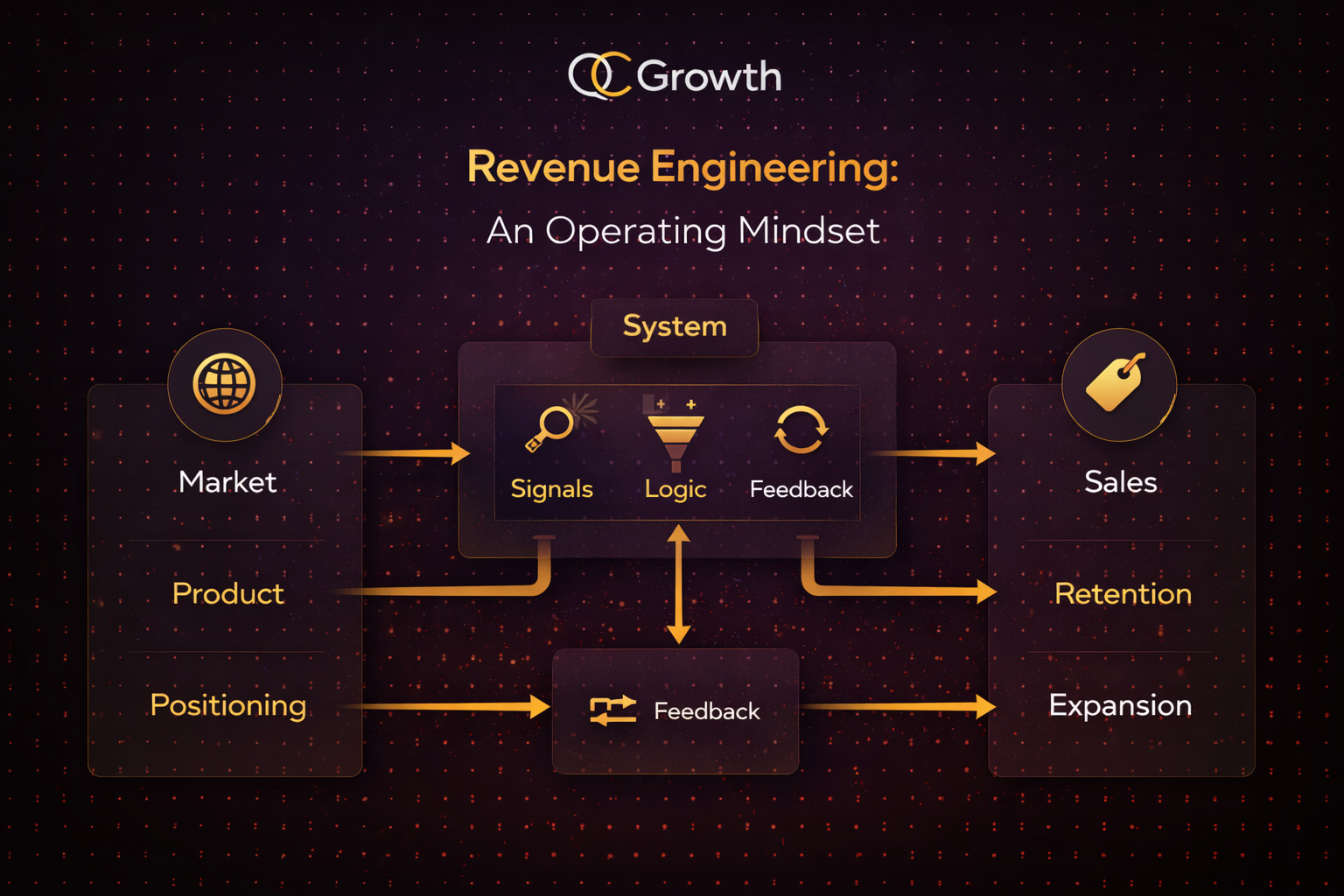
At QC Growth, this mindset shows up in different ways depending on the client and the stage they are in.
One common pattern is how we approach data and context.
We often start with limited inputs and incomplete information. Instead of treating that as a blocker, we design systems that can progressively add signal, apply logic, and surface what actually matters. The goal is not perfect data. The goal is making better decisions than before.
That usually means:
None of this is about enrichment for enrichment’s sake. It is about focus.
A big part of revenue engineering is understanding which signals are worth paying attention to.
Finding the right signals requires a deep understanding of the product, the positioning, the market, and what has historically worked. Without that context, it is easy to pull in activity that looks interesting but does not create action.
A revenue engineer needs to do two things well.
First, identify the signals that are most likely to indicate intent or readiness. The signals that, when acted on, actually lead to conversations.
Second, build systems around those signals so they can be used consistently.
That usually means connecting several components together:
All of these pieces matter.
A strong signal without the right message falls flat. Good messaging sent to the wrong list wastes time. The wrong channel at the wrong moment kills momentum.
Revenue engineering is about pulling all of that together into a system that can run repeatedly and improve over time.

Revenue work does not end once a lead is qualified.
In practice, the systems we build usually touch multiple teams.
That is why most of the systems we design push intelligence back into shared infrastructure like HubSpot/Attio instead of living in isolated dashboards or one off exports.
If insight cannot be acted on, it is not useful.
Not all revenue systems are data pipelines.
We also build systems around things like content and publishing because those inputs shape demand and trust over time.
One example is using internal context from Notion and Slack to help founders generate first drafts for blogs or social posts. The goal is not to replace writing. The goal is to remove friction and make it easier to show up consistently with content that reflects the reality of the business.
That is still revenue work.
It affects how a company is perceived, how clearly it communicates, and how often it stays top of mind. Those inputs compound in the same way outbound systems do.
Another important piece of the role is the ability to build.
Not everything needs to be custom coded, and not everything should be. But a revenue engineer needs to be comfortable using coding tools and automation platforms to design systems that do not exist out of the box.
That includes:
“Vibe coding” does not work for everything yet. But when used intentionally, these tools dramatically expand what a small team can build and maintain.
The goal is not to replace engineering teams. The goal is to remove bottlenecks.
Revenue engineers sit close enough to the problem to know what needs to exist, and close enough to the tools to actually build it. That might be a lightweight internal dashboard, a custom scoring service, a routing layer, or a workflow that gives sales and customer success better visibility without waiting on a roadmap.
This is especially important for revenue driven work.
When signals, scoring, messaging, and reporting all live in different systems, small gaps add up quickly. Being able to build or extend systems closes those gaps and keeps momentum moving.
This is where the idea of the revenue engineer fully comes together.
A revenue engineer does not own a single channel or tool. They own the system.
That means being accountable for:
It requires comfort moving between strategy and execution, between commercial conversations and technical decisions.
That combination is what makes the role hard and valuable.
I did not coin the term revenue engineer. But it accurately describes how this role has evolved and what it now demands.
At QC Growth, we do not think about this as a title. We think about it as how the work gets done.
Learn the full motion. Respect the messiness. Build systems that help revenue move with more intention over time.
Nothing is ever finished. The systems just get sharper.
If you're at the inflection point, technology proven, market waiting, and the canyon between them, we should talk.